

Textile Notes related to fiber, yarn, fabric knowledge, spinning, weaving, processing, projects, knitting, Indian Traditional Textiles and denim manufacturing
Sunday, 15 August 2010

How to Use Pick Glass
How to Use a Pick Glass to Measure Reed and Pick in Woven Fabrics
A pick glass, also called a counting glass, is a small magnifying instrument used to count the number of warp and weft threads in a woven fabric. It is commonly used in textile laboratories, mills, buying offices, quality inspection departments, and classrooms to determine fabric construction.
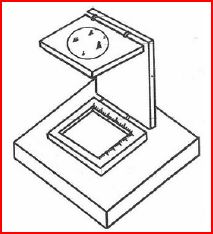
In trade language, the terms reed and pick are often used while discussing woven fabric construction. In this context, reed generally refers to the number of warp ends per inch, and pick refers to the number of weft picks per inch. Technically, these are better described as:
| Term | Meaning | Common Unit |
|---|---|---|
| Ends | Warp threads running lengthwise in the fabric | Ends per inch or ends per cm |
| Picks | Weft threads running widthwise in the fabric | Picks per inch or picks per cm |
| Reed | In trade usage, often used to indicate warp thread density | Usually ends per inch |
Terminology note:
In strict weaving terminology, reed also refers to the loom reed used for spacing warp ends. However, in mill and trade conversation, “reed” is often used to indicate the number of warp ends per inch in the fabric. This article uses the term in that practical trade sense.
In strict weaving terminology, reed also refers to the loom reed used for spacing warp ends. However, in mill and trade conversation, “reed” is often used to indicate the number of warp ends per inch in the fabric. This article uses the term in that practical trade sense.
.png)
.png)
Purpose of Using a Pick Glass
A pick glass is used to determine the thread density of a woven fabric. It helps answer questions such as:
- How many warp ends are present in one inch or one centimetre?
- How many weft picks are present in one inch or one centimetre?
- Does the actual fabric construction match the required specification?
- Has the fabric changed after processing, washing, finishing, or relaxation?
The following procedure is based on the principles of IS 1963:1981, Methods for Determination of Threads per Unit Length in Woven Fabrics. Needs source verification against the latest applicable version before formal laboratory use.
.png)
Sampling Precautions
Before counting the threads, proper sampling is important. If the sample is not chosen carefully, the result may not represent the actual fabric construction.
- Avoid taking readings within 50 mm from the selvedge.
- Avoid taking readings within two metres from either end of a fabric piece or roll.
- Keep the fabric flat, smooth, and free from wrinkles.
- Do not stretch the fabric while measuring.
- Take readings from different places in the fabric to get a representative average.
.png)
Practical note:
The selvedge portion may have a different construction from the body of the fabric. Therefore, readings taken too close to the selvedge may give misleading results.
The selvedge portion may have a different construction from the body of the fabric. Therefore, readings taken too close to the selvedge may give misleading results.
Special Case: Designed or Figured Fabrics
In designed fabrics, dobby fabrics, jacquard fabrics, extra-warp fabrics, extra-weft fabrics, and other figured constructions, counting may be more difficult because all threads may not appear uniformly.
For such fabrics, it is useful to:
- Determine the number of units in one weave repeat from a point paper diagram, if available.
- Count the number of complete repeats within the selected measuring distance.
- Count the remaining units beyond the complete repeats.
- From this information, calculate the number of warp or weft threads per centimetre or inch.
Technical note:
In plain fabrics, thread counting is usually straightforward. In figured fabrics, the count may need to be interpreted with reference to the weave repeat. This is especially relevant for decorative saree fabrics, brocades, jacquards, and extra-weft designs.
In plain fabrics, thread counting is usually straightforward. In figured fabrics, the count may need to be interpreted with reference to the weave repeat. This is especially relevant for decorative saree fabrics, brocades, jacquards, and extra-weft designs.
Procedure for Measuring Reed and Pick
- Place the fabric sample on a flat table.
- Smoothen the sample gently without stretching it.
- Set the pointer of the counting glass at zero.
-
Place the counting glass on the fabric:
- Parallel to the warp direction when weft density is to be counted.
- Parallel to the weft direction when warp density is to be counted.
- Count the number of warp or weft threads in the specified measuring length.
- Repeat the same procedure in at least four more places on the fabric.
- Calculate the thread density using the formula given below.
- Calculate the average of all readings and report it as the thread density of the fabric.
Formula
The number of warp or weft threads per unit length is calculated as:
n = N ÷ L
Where:
- n = number of warp or weft threads per centimetre or inch
- N = observed number of threads in the measured distance
- L = distance in centimetres or inches across which the threads are counted
Example
Suppose 32 warp threads are counted in a distance of 1 inch.
n = 32 ÷ 1 = 32 ends per inch
Therefore, the warp density of the fabric is 32 ends per inch.
Similarly, if 28 weft threads are counted in 1 inch, the weft density is 28 picks per inch.
Recording the Readings
A simple table may be used to record the readings before calculating the average.
| Reading No. | Warp Threads / Ends | Weft Threads / Picks | Unit |
|---|---|---|---|
| 1 | -- | -- | Per inch / per cm |
| 2 | -- | -- | Per inch / per cm |
| 3 | -- | -- | Per inch / per cm |
| 4 | -- | -- | Per inch / per cm |
| 5 | -- | -- | Per inch / per cm |
| Average | -- | -- | Per inch / per cm |
Important Precautions
- Do not count the same set of warp or weft threads more than once.
- Do not take readings from creased, stretched, or distorted areas.
- Avoid the selvedge area.
- Take readings from different positions in the fabric.
- For threads per centimetre, the value may be rounded off to one decimal place.
- For heavily textured, hairy, slub, fancy, pile, leno, or highly figured fabrics, counting may require extra care. Needs source verification for special fabric categories.
Practical example:
In saree fabrics, the body, border, and pallu may have different constructions. Therefore, if the purpose is quality checking, each area may need to be checked separately rather than assuming one reading represents the entire saree.
In saree fabrics, the body, border, and pallu may have different constructions. Therefore, if the purpose is quality checking, each area may need to be checked separately rather than assuming one reading represents the entire saree.
Common Confusion: Reed, Ends, and Picks
| Expression | Usually Means | Clarification |
|---|---|---|
| Reed | Warp ends per inch in trade usage | Technically, reed is also a loom part used to space warp ends. |
| Ends | Warp threads | Counted lengthwise in the fabric. |
| Picks | Weft threads | Counted widthwise in the fabric. |
| Fabric count | Ends and picks per unit length | Used to describe woven fabric construction. |
.png)
Conclusion
A pick glass is a simple but very useful tool for understanding woven fabric construction. By carefully counting warp ends and weft picks, one can check whether a fabric matches the required construction, compare different fabrics, or study changes caused by finishing, washing, or processing.
Although the method is simple, accuracy depends on correct sampling, proper alignment of the counting glass, avoiding distorted areas, and taking readings from multiple places. For formal testing, the relevant standard such as IS 1963 or an equivalent international standard should be consulted.
Reference
- Bureau of Indian Standards. IS 1963: Methods for Determination of Threads per Unit Length in Woven Fabrics.
- ASTM D3775: Standard Test Method for End (Warp) and Pick (Filling) Count of Woven Fabrics.
- ISO 7211-2: Textiles — Woven fabrics — Construction — Methods of analysis — Determination of number of threads per unit length.
- Manual on Quality Assurance for Khadi, section on determination of thread density in woven fabrics.
- Textile testing textbooks covering fabric count, end count, pick count, and fabric construction analysis.
500 count Khadi
A master weaver from Murshidabad, Kalicharan Sharma, had re-discovered the technique of spinning the fine yarn a few years ago, and Saha learnt it from him. Making the 500-count muslin sari— a 5.5 metre saree requires 60,000 metres of yarn to make—is a laborious process that takes more than two months for a team of three weavers. “Making muslin is a very sensitive and lengthy process that takes loads of patience. The yarn breaks frequently. Spinning is done only early mornings and after dusk. The heat during the day breaks the thread. Earlier, very young girls aged about ten years or so would spin the yarn with their nimble fingers. I’ve modified the charkha to replicate those nimble fingers. I’ve modified the apron, rubber rollers, gears and other parts of the machine. I’ve also re-invented the original technique of weaving muslin,” he says.

Subscribe to:
Posts (Atom)