Textile Notes related to fiber, yarn, fabric knowledge, spinning, weaving, processing, projects, knitting, Indian Traditional Textiles and denim manufacturing
In a paper entitled "Study of property and structural variants of mulberry and Tussar silk filaments" by professor Mohan Gulrajani, one can get several hints which may lead to the answer to the question.
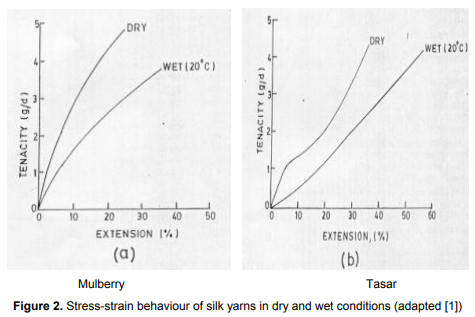
"A glance at the typical tensile behaviour reveals that the stress-strain curve of these two varieties is distinctly different, in that tasar shows a clear yield point and very high elongation compared to the mulberry filament."
Conclusion 1: Tussar silk can undergo significant stretching before permanently deforming.
The tusar silk stress-strain curve exhibits a clear yield point. A yield point is a point on the stress-strain curve where the material transitions from elastic deformation (where it returns to its original shape after the force is removed) to plastic deformation (where it retains some deformation even after the force is removed). This suggests that Tussar silk can undergo significant stretching before permanently deforming.
Conclusion 2: Tussar can stretch a lot before reaching its breaking point compared to mulberry silk.
The stress-strain curve of tussar silk also shows very high elongation compared to mulberry silk. Elongation refers to how much a material stretches before breaking. The fact that tussar silk exhibits high elongation means it can stretch a lot before reaching its breaking point compared to mulberry silk.
In contrast, mulberry silk does not show as pronounced a yield point and has lower elongation compared to tussar silk. This implies that mulberry silk is less flexible and may have a more limited ability to stretch before breaking compared to tasar silk.
Why there is a difference in their properties
One answer can be density. The density of mulberry is higher ( 1.35 g/cc) as compared to tussar ( 1.30 g/cc). This suggests a relatively poor degree of orientation and less order in Tussar, which gives to lower modulus and elongation behavior of tussar.
These values have their commercial and functional implications.
A paper titled "Study of property and structural variants of mulberry and Tussar silk filaments" by professor Mohan Gulrajani has suggested this idea.
Earlier research suggested that the wet strength of silk specially Mulberry reduces considerably when subjected to water during laundering. This happens because in an aqueous environment, the hydrogen bonds between the molecules break. These bonds are crucial for maintaining the structure and strength of the fibers.
However the paper suggests that " silks can be machine washed at 40-60ºC provided one uses appropriate washing procedures, such as the use of neutral detergents".
The results for both Tussar and Mulberry found that " the tenacity and elongation at break are not
significantly different in dry or wet state ". However there is slight decrease in modulus. The figure given below talks about the result.
A reduction in modulus would make the fiber less stiff.
Modulus, specifically in the context of materials science, refers to the measure of a material's stiffness or rigidity. It indicates the ability of a material to resist deformation under an applied force. Modulus is typically expressed in terms of stress divided by strain, where stress is the force applied per unit area, and strain is the resulting deformation.
When the modulus of a material decreases, it means that the material becomes less resistant to deformation for a given stress. In other words, it becomes more flexible or less stiff. Conversely, an increase in modulus would indicate that the material becomes stiffer or more resistant to deformation.
Then why it is not advised not to launder Pure silk sarees ?
The answer lies in the properties of commercially available silk fabrics or sarees. The above study was done after fully degumming the yarn. However, in commercially available silk fabric, the yarn is not fully degummed, there is always a residual gum or sericin. In the study about 20% sericin was found in mulberry and 5% in tussar. On wetting, the sericin weakens, and allows inter filament slippage, which in turn leads to a drastic reduction in mechanical properties. Hence the strength of the wet silk gets reduced.
What is sericin, what is silk fiber composed of ?
Silk fiber is primarily composed of two main proteins: fibroin and sericin. These proteins are produced by specialized glands in the silk-producing organisms, such as silkworms (Bombyx mori). The composition of silk fiber can vary depending on factors such as the species of the silk-producing organism and the conditions under which the silk is produced.
Fibroin: Fibroin is the structural protein that forms the core of silk fibers. It constitutes the majority of the silk fiber's mass and is responsible for its strength and resilience. Fibroin is a fibrous protein composed mainly of amino acids such as glycine, alanine, and serine. The exact composition and arrangement of amino acids within fibroin contribute to its unique mechanical properties, including its tensile strength and elasticity.
Sericin: Sericin is a glue-like protein that surrounds and binds the fibroin filaments together within the silk cocoon. It serves to protect the fibroin and provide cohesion to the silk fiber structure. Sericin is composed of various proteins and amino acids, with its composition varying depending on factors such as the silk-producing species. Sericin is typically removed from silk fibers during processing to improve their texture and appearance, leaving behind only the fibroin core.
In addition to proteins, silk fiber may also contain small amounts of other substances such as lipids, sugars, and minerals. These minor components can influence the properties of silk fibers but are present in much smaller quantities compared to fibroin and sericin.
The unit of measurement of tussar cocoons is Kahan. Number of Cocoons per Kahan vary in different states. In MP one Kahan has 1000 cocoons while in Maharashtra it has 4000 Cocoons.
About 1200 cocoons are required to produce one kg of yarn.
ERI
The Eri cocoons are measured on the basis of weight ( kg)
MUGA
The Muga cocoons are transacted in thousand numbers. About 5000 cocoons are required to produce 1 kg of Muga Raw Silk.
Looking for Tussar, I came across several other interesting features. Some of these are as follows:
1. China exports two types of Tussar Silks: 33/37 D Water reeled and 70 D Dry Reeled Silk. I am just wondering if the "China" that is 50/70 quality that we use in India is dry reeled always.
2. There are 7 grades of quality of Tussar Exported by China, 4A, 3A, 2A, A, B, C and Off grade.
3. The standard moisture regain of Tussar Silk is 10% and density is 1.58 to 1.63 gms/cm3.
4. Elongation at break of water reeled tussar is 23% and dry reeled tussar is 16%.
5. China tussar is different from Indian ( Tropical ) tussar due to the fact the China Tussar the species of the worm is different and fed on "Oak Leaves" ( Also done in Himalyan Regions of the country). Whereas in India it is fed on "Arjun" and "Aasan" leaves.
6. 8 is the usual number of cocoon filaments to form a single thread. The normal size of the thread produced is 30-35 deniers.
7.Tussar silk is the primary kind in the silk which lustrous,bright,soft handfeel,it has highest wear resistance in the natural faric. The Acid & Alkali Resistance of tussah silk is better than mulberry silk.
However I could not find out how they do dry reeling of tussar. Would require your inputs.
And yes, I found the Tussar process practiced in Bihar, Bhagalpur. You can click here to find out more.
Now that you've finished reading this post, what are you going to do? You should join the Forum.
Silkworm belong to the order Lepidoptera. They belong to family of Bombycidae and Saturniidae. Under Bomycidae, we have Bombyx Mori or commonly known as Mulberry Silkworm. Under Saturniidae family the eri silk worm is called Philosamia Ricine, Muga is called Anthrerea Assamensis and Tasar is called A. Mylitta.
Silk filament is made up of 75-80 percent fibroin and 20-25% sericin or gum. Fibroin is insoluble but sericin may be removed by boiling.
The Muga and Tasar varieties of the worm also secrete a cement which causes a drab color to develop, making bleaching a very laborious process.
Silk of the B. Mori variety is triangular in cross section. It has a capacity to reflect light and the layers of protein impart it with a pearly sheen. Tasar silk has a flatter structure which is a reason for its dull appearance.
Muga is rounder and more lustrous.
The B.Mori and Muga imagos cut their way through one end of the cocoon, thus making the filament discontinuous. The Tasar moth secrets an enzyme called cocoonase, which softens the cocoon shell facilitating emergence. The eri moth spins an open ended cocoon through which the imago can fly to full term.
In silk only male worm can fly.
During the process of boiling of silk 75% of the sericin is removed. Care is taken to retain the 25% of the gum to prevent tangling. If the boiling is insufficient, filaments tend to snap during weaving, while excess boiling increases the amount of waste silk.
The thread drawn from the cocoon is of uneven consistency, being finer at the beginning and the end. In order to provide uniformity in consistency, additionaly filaments are drawn in course of reeling, the process is called throwing.
Because of the structure of cocoon, the process of reeling also generates a residue of waste fiber. In B. Mori, about 45% of the product is floss. This material is spun. This is called Matka. In the case of muga worm 25 to 50 percent may be spun. With regard to tasar only about 10 per cent of the filament can be reeled
Now that you've finished reading this post, what are you going do? You should go join the Forum.
Some Online Resources in Silk: A Practical Guide to Silk Types and Market Terms
Silk is one of those fibres where the same word can mean different things to different people. A weaver may speak in terms of Korea silk, China silk, Desi silk, Katiya, Matka or Ghicha, while a textbook may classify silk into Mulberry, Tasar, Eri and Muga. A merchandiser, therefore, needs both languages: the scientific classification and the market vocabulary.
This note began as a search for useful online resources on silk, especially for terms that are frequently heard in Indian textile markets but are not always clearly explained in standard textile books. The most important lesson is simple: when somebody says “silk”, we must immediately ask: which silk, which yarn route, which cocoon source, and which fabric construction?
India is especially important in this discussion because it produces all four commercially known natural silks: Mulberry, Tasar, Eri and Muga. Tasar, Eri and Muga are generally grouped as Vanya silks, or non-mulberry silks. For a buyer or student, this classification is only the beginning. The real understanding comes when we connect the fibre source with yarn preparation, weaving practice, finishing and market terminology.
Visual 1: Silk understanding map showing fibre source, yarn route, fabric character and market terminology.
Why Silk Terms Are Confusing
Silk terminology is confusing because it comes from several worlds at the same time. Some terms come from biology, such as Mulberry, Tasar, Eri and Muga. Some come from yarn preparation, such as reeled silk, spun silk, noil silk and filature silk. Some come from market usage, such as Korea silk, China silk and Desi silk. Some come from Indian craft practice, such as Matka, Ghicha, Katiya, Balkal, Gajji and Mashru.
The problem starts when we treat all these terms as if they belong to the same classification system. They do not. For example, Mulberry is a silk type based on the silkworm and feed source. Matka is better understood as a spun silk yarn or fabric character. Dupion is related to double cocoons and slubbed yarn. Gajji is a fabric construction and market term, not a biological silk category.
A useful way to reduce confusion is to ask four questions. First, what is the fibre source? Second, is the yarn reeled, spun, drawn or waste-based? Third, what is the fabric construction? Fourth, how is the term used in the market? Once these questions are asked, silk becomes much easier to understand.
The Four Major Natural Silks
The four important natural silks in the Indian context are Mulberry, Tasar, Eri and Muga. Mulberry silk is generally associated with smoothness, fineness and lustre. Tasar silk is associated with natural texture, subdued lustre and earthy character. Eri silk is associated with softness, warmth and spun yarn character. Muga silk is associated with Assam, natural golden colour and cultural value.
Silk Type
General Source
Typical Character
Common Practical Use
Mulberry Silk
Bombyx mori silkworm feeding mainly on mulberry leaves
Smooth, lustrous, fine and regular
Sarees, scarves, dress materials, luxury fabrics
Tasar or Tussar Silk
Wild or semi-wild silkworms, often from the Antheraea group
Textured, earthy, slightly coarse and naturally rich
Mulberry silk is the best-known and most widely used type of silk. It is produced by the silkworm Bombyx mori, which feeds mainly on mulberry leaves. In general trade language, when people simply say “silk”, they often mean mulberry silk unless specified otherwise.
Mulberry silk is valued for its smooth handle, lustre, softness and drape. It is used in sarees, dress materials, scarves, furnishing fabrics, carpets and many traditional Indian textiles. From a merchandiser’s point of view, mulberry silk is usually associated with finer and more regular yarns compared to many wild silks.
However, final fabric quality depends not only on the fibre. It also depends on yarn denier, twist, degumming, weaving, finishing, dyeing and the skill of production. In simple terms, a fabric can be made from mulberry silk and still vary greatly in handle, lustre, strength, transparency and price.
Tasar or Tussar Silk
Tasar silk, also written as Tussar or Tussah, is a non-mulberry silk. In India, tasar is strongly associated with traditional and craft-based fabrics. It is often described as having a slightly coarse, textured, natural and earthy character.
Tasar does not try to imitate the smooth perfection of fine mulberry silk. Its beauty lies in its natural irregularity, subdued lustre and organic texture. Many tasar fabrics have beige, honey, coppery or dull-gold tones depending on source, processing and dyeing.
For merchandisers, Tasar is important because it frequently appears in sarees, dupattas, stoles and dress materials. The buyer should check whether the fabric uses reeled tasar, spun tasar, Ghicha, Katiya or other waste-based yarns, because each of these gives a different fabric character.
Eri Silk
Eri silk is another non-mulberry silk. The name is linked with the castor plant, as castor leaves are one of the important food sources of the Eri silkworm. Eri silk is often called a “peace silk” in popular language because, traditionally, the moth may emerge from the cocoon before the fibre is spun.
Unlike mulberry silk, Eri is generally spun rather than reeled. This is because the cocoon structure does not easily provide one long continuous filament in the same way as mulberry silk. The resulting yarn has a warm, soft, woolly and cottony handle rather than the slick smoothness of filament silk.
This makes Eri particularly interesting for shawls, stoles, winter textiles and fabrics where comfort and softness are more important than high lustre. A buyer should not reject Eri because it lacks the shine of filament silk. Its value lies in a different kind of silk experience.
Muga Silk
Muga silk is one of India’s most distinctive silks. It is associated with Assam and is famous for its natural golden colour, lustre and durability. Muga is not just another silk variety. It carries geographical, cultural and heritage value.
Among Indian silks, Muga has a special identity because it is closely tied to Assam’s textile culture. Its golden tone is natural, and the fabric is often prized for ceremonial and traditional garments. Because genuine Muga is rare and expensive, authenticity becomes very important.
In the market, one may hear expressions such as “Muga look”, “Muga finish” or “Muga colour”. These should not be confused with genuine Muga silk. A merchandiser must check whether the term refers to actual Muga fibre or merely to a colour and surface effect inspired by Muga.
Visual 2: Comparison of Mulberry, Tasar, Eri and Muga silk by source, handle, lustre and typical product use.
Important Indian Market Terms in Silk
Indian silk markets use many words that are extremely useful but not always standardized. Terms such as Katiya, Balkal, Matka, Ghicha, Dupion, Gajji, Mashru, Korea silk, China silk and Desi silk should be understood carefully. Some terms indicate yarn origin, some indicate cocoon condition, some indicate waste utilization, and some indicate fabric construction.
Katiya Silk
Katiya is an important trade term, especially in the tasar silk chain. It may be understood as yarn made from the portion of tasar cocoons left after the reelable silk has been removed. In many tasar production systems, the cocoon does not yield one continuous high-grade filament throughout.
The better reelable portion is taken first. The remaining portion, waste or partially reelable material may then be processed into spun or irregular yarn. Katiya usually implies more irregularity, more texture and a different price-quality position compared to fine reeled silk.
Balkal Silk
Balkal is another term connected with tasar. It is generally associated with the peduncle or anchoring portion of the cocoon. This portion is weaker and less suitable for fine reeling, but it can still be converted into useful yarn.
Balkal belongs to the family of yarns where silk waste or lower-grade cocoon portions are converted into fabric value. Such yarns may show unevenness, slubs, thickness variation and rustic appearance. These are not necessarily defects if the fabric is designed for that look.
Spun Silk
Spun silk is made from short lengths of silk fibre obtained from silk waste, pierced cocoons, floss or other non-reelable material. This distinction is important because not all silk yarn is filament yarn. Some silk yarn is produced in a spinning system, somewhat comparable in principle to cotton or wool spinning.
Spun silk may have less brilliance than continuous filament silk, but it can have a beautiful soft handle. It is useful where a slightly textured, less slippery and more fabric-like surface is desired.
Noil Silk
Noil silk is made from the shorter fibres removed during combing in the spun silk process. It is usually more matte, less lustrous and more textured than regular spun silk. It may resemble cotton or wool in surface character while still retaining the identity of silk fibre.
Silk Form
General Character
Reeled filament silk
Smooth, lustrous and made from continuous filament
Spun silk
Made from shorter silk fibres, softer and more textured
Noil silk
Made from very short fibres, more matte and irregular
Dupion Silk
Dupion silk is reeled from double cocoons, where two silkworms spin together and their filaments become interlocked. Because the filaments cannot be reeled as smoothly as regular cocoons, the yarn develops irregularities, slubs and thick-thin effects.
Dupion is an excellent example of a textile principle: what is technically irregular can become aesthetically valuable. The slubs and cross-lines in Dupion are often the very reason designers like it. It is used in sarees, lehengas, jackets, home textiles and occasion wear.
Filature Silk
Filature silk refers to raw silk reeled by machine, as distinct from silk prepared by hand in cottage or traditional settings. In practical buying, filature silk suggests more controlled reeling, better regularity and more standardized yarn quality.
However, the word “filature” should not be treated as a complete quality guarantee. One must still examine denier, evenness, cleanliness, twist, strength, gum content, dyeing behaviour and fabric performance.
Matka Silk
Matka silk is one of the most important trade terms in Indian silk fabrics. It is generally associated with textured silk yarn made from pierced or waste cocoons. Matka fabrics are usually thicker, textured and somewhat linen-like in appearance.
Matka is not meant to look perfectly smooth. Its charm is in the unevenness. It often carries a handspun quality and rustic elegance. In current trade, however, the term may be used broadly, and the exact production method should be verified with the supplier.
Mashru
Mashru is not always a pure silk fabric, but it is very important in the study of Indian traditional textiles. It is usually understood as a satin weave fabric with a glossy surface, traditionally involving silk or rayon in the warp and cotton in the weft.
Historically, Mashru is associated with a fascinating cultural logic: the fabric gives a silk-like appearance on the outside while keeping cotton in contact with the body. In modern markets, Mashru may be made with rayon, viscose, cotton, silk or blends depending on price and production context.
Gajji Silk
Gajji is commonly associated with a heavy satin weave silk fabric, especially used in Bandhani and tie-dye sarees and dupattas from Gujarat and Rajasthan. Gajji has a dense, smooth and lustrous surface.
It accepts tie-dye effects beautifully because the satin surface reflects colour strongly. In the market, “Gajji silk” may sometimes be loosely used, so the buyer must confirm whether the fabric is pure silk, art silk, viscose or a blend.
Korea Silk, China Silk and Desi Silk
Korea silk, China silk and Desi silk are useful market terms, but they must be handled carefully. They are not the same as the scientific classification of silk into Mulberry, Tasar, Eri and Muga. They may refer to yarn origin, denier range, texture, evenness or local trade convention.
For example, when a supplier says Korea × China, it may mean one type of yarn in the warp and another in the weft. But this should always be confirmed because trade language can vary by region and supplier. A merchandiser should convert such expressions into a technical specification before approving production.
Reeled, Spun and Waste-Based Silk
Many confusions in silk can be reduced if we separate silk into three broad routes: reeled silk, spun silk and waste-based silk. This classification is very useful because it explains why two fabrics can both be called silk but behave very differently.
One fabric may be smooth, lustrous and slippery. Another may be matte, thick, textured and almost linen-like. Both can be silk, but their yarn route and fabric construction are different.
Route
Meaning
Examples
Reeled silk
Continuous filament unwound from cocoon
Mulberry filament, filature silk, some tasar
Spun silk
Short fibres spun into yarn
Eri, spun silk, Matka
Waste-based or leftover silk
Made from pierced cocoons, peduncles, noil or cocoon waste
Katiya, Balkal, noil, some Matka and Ghicha-type yarns
This equation is not a mathematical formula in the strict scientific sense. It is a practical reminder that fabric character is never decided by the fibre name alone. A silk fabric becomes what it is because of the entire chain from cocoon to yarn to fabric to finishing.
Visual 3: Flow chart showing how cocoon quality and processing route lead to reeled silk, spun silk, noil, Matka, Katiya and Balkal.
Buyer’s Checklist Before Approving Silk Fabric
Before approving any silk fabric, a buyer should not rely only on the name given by the supplier. The name may be useful, but it is only the starting point. The buyer must convert the name into fibre content, yarn route, construction and performance expectations.
Is it pure silk, blended silk, art silk, viscose or polyester?
Is the yarn reeled, spun, handspun, drawn or waste-based?
Is the silk type Mulberry, Tasar, Eri, Muga or a trade-quality term?
What is the yarn count or denier?
What is the warp yarn and what is the weft yarn?
Is the fabric degummed, semi-degummed or gum-retaining?
What weave is used: plain, twill, satin, crepe or jacquard?
Is the irregularity intentional, as in Dupion or Matka, or is it a defect?
Is the colour natural, dyed, printed or finished?
What care method is recommended?
These questions help prevent one of the most common buying mistakes: comparing two silk fabrics only by price without understanding fibre source, yarn route, construction and finishing. In silk, a lower price may mean a different raw material, different yarn route, different fabric density or different authenticity level.
Care of Silk Fabric
Silk care depends on the type of silk, dyeing, finishing, embellishment and fabric construction. However, some general precautions are useful. Silk should usually be protected from harsh sunlight, strong alkalis, chlorine bleach, aggressive rubbing and high heat.
Many silk fabrics are best dry-cleaned, especially if they are expensive, heavily dyed, embroidered, printed or embellished. Washing should be done only when the care label or supplier confirms that the fabric is washable.
Risk
Why It Matters
Sunlight
Can weaken silk and fade colours
Alkali
Silk is a protein fibre and may be damaged by strong alkalis
Perspiration
Can affect colour and handle if not cleaned properly
Perfume
May stain or affect dyes and finishes
Rough rubbing
Can cause abrasion, fibrillation or surface damage
High heat
Can affect lustre, handle and dimensional stability
Quick Glossary for Merchandisers
Term
Simple Explanation
Mulberry silk
Silk from Bombyx mori fed mainly on mulberry leaves
Tasar or Tussar
Wild or non-mulberry silk, often textured and earthy
Eri
Spun non-mulberry silk, soft and warm
Muga
Golden silk associated with Assam
Katiya
Yarn from leftover tasar cocoon material after reelable portion
Balkal
Yarn from peduncle or anchoring portion of tasar cocoon
Matka
Textured silk yarn or fabric often made from pierced or waste cocoons
Noil
Short fibres removed during spun silk processing
Dupion
Slubbed silk associated with double cocoons
Filature silk
Machine-reeled raw silk
Gajji
Heavy satin silk fabric often used in tie-dye traditions
Mashru
Satin fabric traditionally with silk or rayon face and cotton back
A Small Note on Authenticity
Silk terminology in the market is not always standardized. Some names are scientific, some are regional, some are trade terms and some are marketing expressions. Therefore, a merchandiser should avoid accepting a fabric name at face value.
A better approach is to combine three forms of knowledge. First, understand the scientific classification: Mulberry, Tasar, Eri and Muga. Second, understand the production route: reeled, spun, handspun, waste-based, filature or cottage-made. Third, understand the market vocabulary: Korea, China, Desi, Matka, Gajji, Katiya, Balkal and Dupion.
When these three layers are combined, silk becomes much easier to understand. The buyer is then able to ask better questions, compare fabrics more fairly and avoid being misled by attractive but vague market names.
Related Reading on Silk Fabrics and Indian Textile Terms
This article is intended for textile education, merchandising awareness and general understanding of silk terminology. Silk trade terms may vary by region, supplier and market practice. For commercial buying, quality approval, labelling, export documentation or legal claims, the fibre content, yarn route, construction, processing and care instructions should be verified through supplier declarations, laboratory testing and relevant standards wherever required.