Showing posts with label cotton. Show all posts

Saturday, 17 May 2025

๐Ÿงต Why Cotton Gets Stronger When Wet: A Marvel of Nature and Science


When you spill water on your cotton shirt or soak a cotton towel in the laundry, you probably don’t think twice about what’s happening at the microscopic level. But did you know that cotton actually becomes stronger when it gets wet?

Yes, you read that right. Unlike many materials—like viscose or paper—that get weaker and tear easily in water, cotton behaves in the opposite way. It toughens up. Scientists call this phenomenon “wet strength,” and it's one of the reasons cotton is such a reliable material in our everyday lives, from clothes and bedsheets to medical gauze and kitchen towels.

Let’s take a closer look at the secret life of cotton fibers when they meet water.


๐ŸŒŠ 1. Cotton Swells and Becomes More Organized

Cotton is made of tiny hair-like fibers called cellulose. These fibers aren’t smooth tubes—they’re twisted and somewhat loose when dry. But the moment water enters the scene, magic begins.

Water seeps into the gaps between the fibers, and the cotton starts to swell—like a sponge. Imagine your dry hair after a shower: it clumps together and lies flatter. Similarly, cotton fibers expand and realign, becoming more organized and packed. This tighter arrangement gives the fabric extra strength to hold together, even when soaked.


๐Ÿงช 2. Hydrogen Bonds: Nature’s Invisible Glue

Here’s where chemistry lends a hand.

Cotton is full of little chemical groups called hydroxyls (–OH). Think of them as tiny magnets. When water arrives, these magnets grab onto water molecules—but they also begin to form new “bonds” with each other, like holding hands across fibers. These new links make the entire structure more connected.

These invisible links, known as hydrogen bonds, act like nature’s glue. More bonds mean more strength. So, when cotton gets wet, it doesn’t fall apart—it actually becomes a well-connected community of fibers.


๐Ÿ’ง 3. Capillary Action: Cotton Drinks Water Like a Straw

Cotton fibers have something called capillaries, which are like tiny straws or tunnels running through them. These tunnels allow water to travel up and across the fibers very efficiently. This effect is the same reason why a towel absorbs water so fast or how a wick draws oil in a lamp.

This process—capillary action—spreads the water evenly across the fabric. And when water is evenly distributed, all the fibers get the chance to bond and swell together. The result? A stronger, more cohesive fabric even when soaked.


๐Ÿงฌ 4. Cotton’s Natural Structure Is Built to Last

Cotton is made from cellulose, a plant-based material with a strong and orderly structure. Think of it like a skyscraper made with steel beams. Even when it rains, the building holds up because its inner structure is solid.

Cellulose has both hard, crystalline regions (very ordered and stiff) and softer, flexible regions. When cotton absorbs water, the flexible areas take in moisture and help with swelling. But the stiff parts stay firm and give cotton its strength—even in wet conditions.

It’s this clever balance that helps cotton perform so well in your wardrobe and your home.


๐ŸŽจ 5. Special Treatments Make Cotton Even Better

Sometimes, textile manufacturers enhance cotton’s performance with special treatments. These can include finishing chemicals or dyes that improve the strength and stability of the fibers when wet. For example, some cotton fabrics are given a “resin finish” to make them even more durable and wrinkle-resistant.

So, that shirt that doesn’t lose shape after a wash? It might be cotton—but with a little help from science.


๐Ÿ“ธ What Does It Look Like Under the Microscope?

If you were to zoom in and look at cotton fibers under a microscope, here’s what you’d see:

  • In the dry state, the fibers look like twisted ribbons with air gaps between them. They’re loose and wavy.

  • In the wet state, the fibers appear plump and aligned, like smooth noodles laid side by side. They’re packed tighter and show fewer gaps.

This visual change is a big reason why the fabric’s behavior shifts. The alignment increases its ability to resist pulling and tearing forces.


๐Ÿงบ Why This Matters in Real Life

So why should we care about cotton’s wet strength? It turns out, this little superpower makes cotton ideal for many important uses:

  1. Laundry Friendly: Cotton can handle regular washing without falling apart, unlike some delicate fabrics.

  2. Medical Applications: Gauze, bandages, and swabs made of cotton stay strong when wet, which is crucial in hospitals.

  3. Absorbent Textiles: Towels, robes, and diapers rely on cotton’s ability to soak water and remain tough.

  4. Summer Wear: Cotton’s breathable and absorbent qualities make it perfect for humid or sweaty environments.


⚠️ But Be Gentle — Cotton Still Has Limits

While cotton gets stronger when wet, it’s not invincible. Long exposure to strong chemicals, very hot water, or constant rough handling (like over-aggressive machine washing) can still break down the fibers over time.

Here are a few care tips:

  • Use gentle detergents.

  • Avoid overheating in dryers.

  • Wash with similar fabrics to prevent wear and tear.

With the right care, your cotton garments can last a long time—retaining their softness, breathability, and of course, their wet strength.


๐Ÿงต The Takeaway: Nature Knows Best

Cotton’s ability to get stronger when wet is not just a happy accident—it’s the result of an elegant design built by nature and refined by science. From its microscopic bonding to its absorbent tunnels, every part of the cotton fiber contributes to making it one of the most loved and dependable fabrics in the world.

So the next time you soak a cotton kurta, wrap yourself in a bath towel, or spill chai on your bedsheet—remember, you’re dealing with one of nature’s most remarkable materials. Not only is cotton comfortable and breathable, but it’s also a quiet superhero that actually thrives in water.

Sunday, 2 July 2023

Why cotton becomes strong when in water


Cotton fibers have a unique behavior when exposed to water. Instead of weakening like viscose, cotton fibers actually become stronger when wet. This phenomenon is often referred to as "wet strength" and can be attributed to the following factors:

Swelling and Fiber Alignment: When cotton fibers come into contact with water, they absorb moisture and undergo a swelling process. The fibers expand as water molecules penetrate the spaces between the cellulose chains. This swelling causes the fibers to align more closely, increasing their overall strength and resistance to pulling forces.

Hydrogen Bonding: Cotton fibers contain hydroxyl groups (-OH) that can form hydrogen bonds with water molecules. These hydrogen bonds contribute to the intermolecular forces within the cotton fiber structure. When the fibers absorb water, additional hydrogen bonds form between the cellulose chains, enhancing the fiber's strength.

Capillary Action: Cotton fibers possess capillary structures, allowing them to absorb and hold water efficiently. This capillary action helps distribute the water evenly across the fiber length, facilitating the formation of hydrogen bonds throughout the fiber structure. The capillary effect also assists in moisture transportation, promoting better moisture management in cotton textiles.

Molecular Structure: The inherent molecular structure of cellulose in cotton fibers contributes to their strength in wet conditions. The arrangement of cellulose chains provides a strong and stable fiber structure, even when exposed to moisture. The high degree of crystallinity and intermolecular bonding in cellulose contributes to the wet strength of cotton fibers.

Dyeing and Finishing Processes: In some cases, cotton fabrics may undergo dyeing and finishing processes that enhance their wet strength. These processes can involve treatments with specific chemicals or additives that improve the fiber's ability to maintain its strength and integrity when wet.

It's important to note that while cotton fibers generally exhibit increased strength when wet, excessive agitation, harsh chemicals, or prolonged exposure to water can still weaken or damage the fibers over time. Proper care, including gentle washing methods and avoiding harsh chemicals, is essential to maintain the long-term strength and integrity of cotton textiles.

In summary, cotton fibers become stronger when in water due to factors such as swelling, fiber alignment, hydrogen bonding, capillary action, and the inherent molecular structure of cellulose. This wet strength property of cotton makes it a favorable choice for various applications, including textiles that require durability and performance in moist environments.

Buy my books at Amazon.com

How morphology of cotton is different than rayon


The morphology of cotton and rayon differs significantly due to their distinct manufacturing processes and composition. However, there are also some commonalities between the two fibers. Let's explore their differences and similarities in terms of morphology:

Structure and Composition:
Cotton: Cotton is a natural fiber derived from the cotton plant. It consists primarily of cellulose, with small amounts of hemicellulose, pectin, waxes, and other natural components. Cotton fibers are elongated unicellular trichomes with a complex structure, including a primary cell wall and a central lumen.

Rayon: Rayon, on the other hand, is a semi-synthetic fiber made from regenerated cellulose. It is produced by chemically treating natural cellulose, usually derived from wood pulp or bamboo, to create a viscous solution that is extruded and solidified into fibers. Rayon fibers are also composed mainly of cellulose.

Fiber Characteristics:
Cotton: Cotton fibers have a distinctive appearance with a twisted or convoluted structure, often displaying irregular bends or twists along their length. They have a natural surface cuticle and may contain surface contaminants such as plant debris. Cotton fibers come in various natural colors, including white, cream, and shades of brown.

Rayon: Rayon fibers have a more uniform and smoother appearance compared to cotton. They lack the convoluted structure and twists commonly seen in cotton fibers. Rayon fibers can be produced with varying surface finishes, ranging from a high luster resembling silk to a matte appearance.

Physical Properties:
Cotton: Cotton fibers have inherent properties such as high moisture absorption, good heat conductivity, and breathability. They possess good tensile strength and are generally more durable than rayon. Cotton fibers have a natural crimp, which contributes to their ability to trap air, providing insulation.

Rayon: Rayon fibers are known for their softness, drape, and excellent moisture absorption properties. They have a lower density compared to cotton, resulting in a lightweight feel. Rayon fibers can be engineered to mimic the characteristics of other fibers, such as silk or wool, depending on the desired end-use.

Manufacturing Process:
Cotton: Cotton fibers are harvested from the cotton plant through ginning, which involves separating the fibers from the seeds. The fibers undergo cleaning and processing to remove impurities before being spun into yarns for textile production.

Rayon: Rayon is produced through a complex chemical process involving the dissolution and regeneration of cellulose. The cellulose is treated with chemicals to break it down into a viscous solution, which is then extruded through spinnerets and solidified into fibers.

Despite their differences, cotton and rayon share some commonalities:

Cellulose Composition: Both cotton and rayon fibers are predominantly composed of cellulose, a natural polymer.

Biodegradability: Both cotton and rayon are biodegradable fibers, meaning they can break down naturally over time.

Versatile Applications: Both cotton and rayon find extensive use in the textile industry for various applications, including apparel, home textiles, and nonwoven products.

Comfort and Breathability: Both fibers offer comfort and breathability, allowing moisture to evaporate and contributing to a pleasant wearing experience.

In summary, while cotton and rayon have distinct differences in their morphology due to their manufacturing processes, they also share some similarities such as cellulose composition, biodegradability, versatility, and comfort properties. Understanding these differences and commonalities is crucial for selecting the appropriate fiber for specific applications in the textile industry.

Some Notes on the Gross Morphology of Cotton


Cotton, one of the most important natural fibers in the textile industry, possesses a fascinating array of physical characteristics that make it desirable for various applications. To fully appreciate cotton's properties, it is crucial to understand its gross morphology, which encompasses the visible structure and features of cotton fibers. This article aims to explore the gross morphology of cotton and shed light on the distinctive characteristics that contribute to its versatility and widespread use.

Structure of Cotton Fibers:
Cotton fibers, also known as lint, are elongated unicellular trichomes that develop from the epidermis of cotton seeds. They consist primarily of cellulose, a complex carbohydrate polymer. Here are the key structural elements of cotton fibers:

a) Fiber Length: Cotton fibers vary in length, typically ranging from 10 to 50 millimeters. The length depends on the cotton variety, environmental factors, and growth conditions. Longer fibers are generally preferred in the textile industry due to their superior spinning properties.

b) Fiber Diameter: The diameter of cotton fibers varies between 12 to 22 micrometers, contributing to their softness and comfort. Finer fibers are often associated with higher-quality cotton.

c) Cell Wall: The primary cell wall of cotton fibers is composed of several layers, providing strength and flexibility. It consists primarily of cellulose microfibrils embedded in a matrix of hemicellulose and pectin.

d) Lumen: The central hollow portion of the cotton fiber is called the lumen. It may contain remnants of protoplasmic materials, such as the disintegrated nucleus and cytoplasm.

Surface Features and Characteristics:
Cotton fibers exhibit unique surface characteristics that influence their performance and processing. These features include:

a) Convolution: Cotton fibers often display a twisted or convoluted appearance, forming irregular twists or bends along their length. This convoluted structure contributes to the fiber's resilience and ability to interlock during yarn formation.

b) Surface Cuticle: The outermost layer of the cotton fiber is known as the cuticle. It acts as a protective barrier and contains wax-like substances, imparting some natural water repellency to the fiber.

c) Surface Contaminants: Cotton fibers may possess surface contaminants such as leaf debris, plant fragments, or other impurities acquired during harvesting and processing. The removal of these impurities is an essential step in cotton preparation for textile applications.

Fiber Color and Luster:
Cotton fibers exhibit a range of natural colors, including white, cream, tan, light brown, or even greenish hues depending on the variety. The color is determined by the pigment content within the fiber. Cotton fibers also possess inherent luster, which refers to their ability to reflect light. The luster can vary from high to low, impacting the visual appearance and aesthetic appeal of the finished textile products.

Fiber Strength and Maturity:
The strength and maturity of cotton fibers are vital characteristics that influence their performance during processing and end-use. Stronger fibers are generally preferred for applications requiring high tensile strength, such as durable fabrics or industrial textiles. Fiber maturity refers to the degree of development and the presence of secondary cell wall thickening. More mature fibers tend to exhibit improved strength and fineness.

Understanding the gross morphology of cotton fibers provides valuable insights into the structural and visual properties that make cotton a versatile and widely used natural fiber. The length, diameter, convoluted structure, surface features, color, and strength of cotton fibers all contribute to their overall quality and performance in textile applications. By appreciating the gross morphology of cotton, textile professionals can make informed decisions about fiber selection, processing techniques, and product development, ultimately leading to enhanced textile products that meet the diverse needs of consumers and industries alike.

Thursday, 18 December 2014

What is Unique about Ponduru Khadi


This Khadi is produced from Ponduru, a village in Srikakulum district in North Andhra Pradesh.

The uniqueness about this fabric is the fiber. It is produced from a special variety of cotton called Punas cotton, hill white cotton and red cotton. The cotton is of very short staple length produced in Srikakulum area.


The second uniqueness about this fabric is the method of spinning.

The raw seeded cotton is ginned with the help of Valuga fish jawbone. This fish is only found in that area. Then it is fluffed and smoothed with the help of fine sticks which also remove the waste.

Slivering is done with a bow and carding is done with the help of a wooden machine. The slivers are handmade and kept in a dried banana stem.

This is one of the only places where still single spindle charkha is used for spinning. Yarn upto 120s count can be spun in white cotton while upto 60s can be spun with red cotton.

Reference: 1


Buy my books at Amazon.com

Sunday, 29 July 2012

Cotton Price Trends in India


Indian Textile Mills are ramping up imports of cotton


Mills in India, the world's second biggest cotton producer have already imported 500,000 bales and have signed contracts for around 1 million bales at 75-80 cents per lb, compared with the local price of about 88 cents. This can be attributed to the following two reasons. 

a. Tight Domestic Supplies of Cotton 

- Poor rainfall in top producing Gujarat State. Saurashtra and Kutch regions of Gujarat, the country’s largest producer, have received 72% less than the usual rainfall by this time
- A rally in Soyabean prices is prompting some farmers to ditch cotton for Soyabean.
- Record export of good quality cotton earlier this year, with lower quality cotton left this year. 
- Harvesting is getting delayed because of late arrival of Monsoon. If it gets delayed beyond Sep, the domestic cotton prices will sky rocket. 

b. Lower Prices Abroad

Domestic cotton prices are ruling around 88 cents per pound, freight on board, around 14% higher than the African fibre and 10% than the crop in the US, the world’s largest cotton exporter


Thanks for your attention. Did you find the information you were looking for ? Please leave a comment. Do you need to know more ? Please suggest a topic in the comments. You can also join the Forum for your specific queries.

Sunday, 3 June 2012

Manufacturing of Powerloom 40s x 40s 72 x 68 Fabric


This fabric is woven on the border areas of Andhra Pradesh and Tamil Nadu states of India and has a widepopularity as a dress material for ladies ( Kurtis and Salwars). It has the potential to be printed or embroidered.

The count for this fabric is 40s  both warp and weft and constructions is 72 and 68. It is available in both 44 inches and 56 inches.

The following are the broad steps in making the fabric

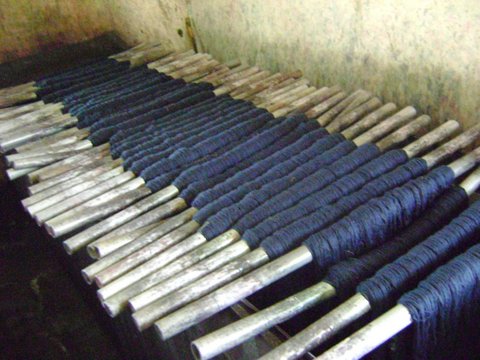
1. Yarn is taken in hank form and is kept in water tanks for two days for them to wet properly. Then the yarn is scoured in hank form itself.

Label on a Hank Yarn


2. Yarn dyeing is done using either reactive or vat dyes. Yarn dyeing is done manually.
Color Kitchen

Dyeing Bath for Hank Yarn - Reactive Dyes
  

3. Yarn is then subjected to sizing using Maida and Gum as components. The yarn is subjected to alternate dyeing and sizing three times.
Yarn Being Dried after Sizing

4. Yarn is then prepared for warping using an ingenious creel and then wound onto a weavers beam using a conventional sectional warping machines. 


5. Pirns are prepared using an indigenous contraption.


6. Yarn is then worked on powerloom having warp stop and weft stop motion.


6. Primitive dobbies are used for woven and zari borders.
 
7. The yarn is then subjected to finishing using water, sometimes in a padding mangle using softner and desizing agent.


Thanks for your attention. Did you find the information you were looking for ? Please leave a comment. Do you need to know more ? Please suggest a topic in the comments. You can also join the Forum for your specific queries.

Wednesday, 2 March 2011

A review of Cotton Spinning- Process Control Perspective


Update Note: This article was originally written in 2011. One of the external reference links used at that time is no longer active. I have retained the article because the broad ideas related to cotton spinning and process control may still be useful to students and textile professionals. I may update this article with fresh references in the future.

Sunday, 29 November 2009

Influence of Fiber Fineness and Maturity in spinning Process


Influence of Fiber Fineness and Maturity on spinning Process


Fiber Fineness

Fiber fineness determine how many fibers are present in the cross section of a yarn of given thickness. Additional fibers in the cross section not only provide additional strength but also a better distribution in the yarn. Minimum 30 fibers are needed, usually over 100 fibers are required. Fiber fineness influences spinning limit, drape of the fabric, yarn strength, luster, yarn evenness, handle, yarn fullness and productivity. Productivity is influenced by reduced end breakage rate.

In a conventional spinning process, fine fibers accumulate to the core and coarse fibers in the periphery.

Fiber fineness is measured in dtex which is equal to ratio of mass in dgrams and length in km. Decitex is equal to the product of Micronaire value of the cotton and 0.394.

Cotton fibers are generally classified as very fine if they have a micronaire value upto 3.1; fine if they have value between 3.1 to 3.9; medium if they have it between 4.0 to 4.9; slightly coarse between values of 5 to 5.9 and coarse if they have a micronaire value above 6.


Fiber Maturity

Cotton fiber consists of cell wall and lumen. The maturity index depends upon the thickness of the cell wall. The fibers are considered ripe if they have maturity index between 50-80 percent, unripe if they have MI between 30 to 45% and dead when they have it less than 25%.

Unripe fibers have neither adequate strength nor adequate longitudinal thickness. They lead to loss of yarn strength, neppiness, high proportion of short fibers, varying dyeability, processing difficulties mainly at the card.


Now that you've finished reading this post, what are you going do? You should go join the Forum.
Reblog this post [with Zemanta]

Wednesday, 25 November 2009

Fiber Identification - Burning Test- Man-made Fibers


All viscose including High Wet Modulus scorch and ignite quickly when brought near the flame. Like cotton they burn quickly with yellow flame when in the flame. When removed from the flame they continue to burn. There is no afterglow unlike cotton. The smell is that of burning paper. They leave a light gray and feathery ash.

Acetate Rayon  ( And Triacetate Rayon)

When brought near the flame, it fuses away from flame turning black. When in the flame, it flames quickly. The fabric puckers, sputters and melts. It drips like burning tar. When removed from the flame, it continues to burn and melt. It smells like vinegar. It leaves a brittle hard, irregular black ash which is difficult to crush.


3D diagram showing the variants nylon 6 and ny...Image via Wikipedia


Nylon fuses and shrinks away from the flame when brought near the flame. In flame, it burns slowly without melting. When removed from flame the flame diminishes and tends to die out. It has somewhat pungent odor. It leaves a hard, round, tough and gray bead.


When brought near the flame, it shrinks away from the flame. When in the flames it puckers and chars. When removed from flame, it extinguishes by itself. It has no smell and it leaves a hard black bead.


Scanning electron microscope image of a bend i...Image via Wikipedia

Polyester fuses and shrinks away from flame. When in flame, it burns slowly with melting. When removed from the flame, it burns with difficulty. It has slightly sweetish smell. It leaves a hard round brittle, black bead.


Orlon, Acrilan and Creslan and Zefran fuse and melt away from Flame when brought near the flame. When in flame Orlon flames rapidly. The fiber puckers, sputters and melts. Acrilan flames rapidly and melts. Creslan flames and melts and Zefran sputters slightly and flames. When removed flame all of acrylics continue to burn and melt. Orlon has a slightly burning meat-like smell. Acrilan has a buring steak smell. Creslan has sharp sweet smell and Zefran has a turmeric like smell. Orlon, Acrilan and Cresla have hard, brittle and irregular black bead. Zefran has irregular black ash that can be crushed easily.

Modacrylics

Verel and SEF fuse and shrink away from the flame when approached near a flame. When in flame, Verel burns very slowly with melting. SEF shrinks, melts and smolders. When removed from flames, all modacrylics are self extinguishing. Verel has a gunpower smell whereas SEF has a sharp sweet smell. Verel leaves a hard and irregular black bead whereas SEF leaves a hard and irregular black bead.


Fuses but doesn’t shrinks away from the flame when approached near the flame. When in flame, it burns with melting. It has an acrid smell. It leaves a soft, fluffy black bead.

Now that you've finished reading this post, what are you going do? You should go join the Forum.


Reblog this post [with Zemanta]

Sunday, 22 November 2009

Identification of Natural Fibers by Burning Test


Identification of Natural Fibers by Burning Test


Cotton

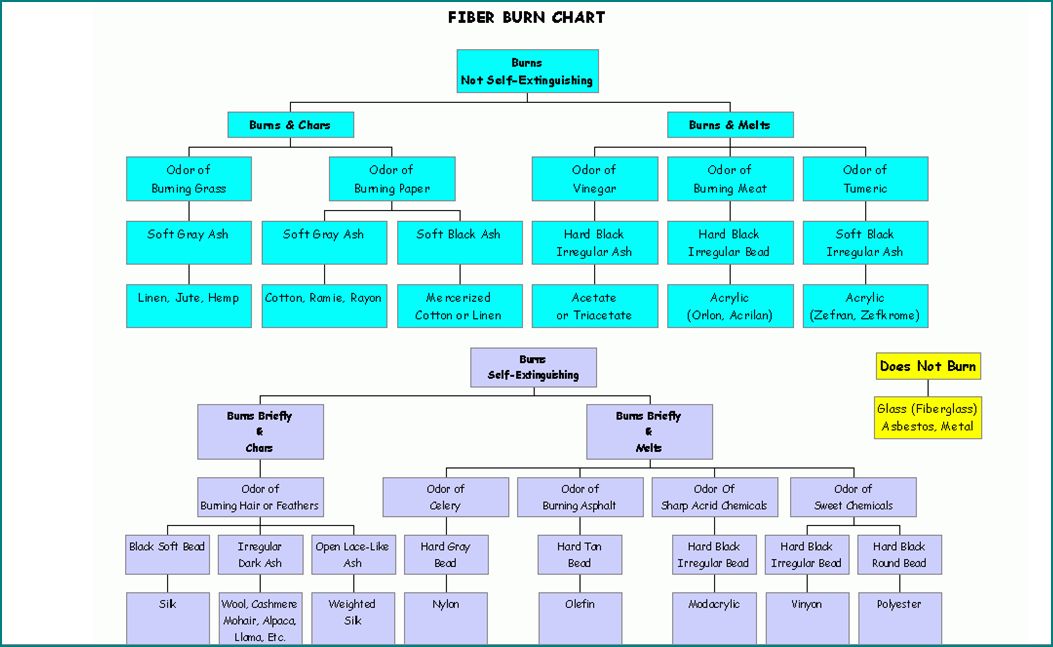
When cotton is brought near the flame it scorches and ignites readily. In the flame it burns quickly with yellow flame. Upon removing from flame it continues to burn rapidly and shows afterglow. It emits a smell of burning paper. The Ash is light, feathery and grayish. If the ash is black it denotes mercerized cotton.

Linen

Linen like cotton when brought near the flame scorches and ignites easily. In the flame it burns slower than cotton with yellow flame. Upon removing from flame it continues to burn with a smell of burning paper. The ash residue is feathery and gray.

Wool

Wool when brought near the flame smolders. In flame it burns with small and slow flickering flame. Also in flame it sizzles and curls. When removed from flame it ceases to burn. The Odor is like that of burning feather or hair. It gives crisp, dark and irregular shaped ash that can be crushed easily.

Pure Silk

Pure silk smolders when brought near the flame. In the flame it burns slowly with sputtering. When removed away from flame it continues to burn but with difficulty and ultimately extinguishes. The smell that is emitted is like that of burning feathers or hair but it is less pronounced than wool. It gives out a round, crisp, shiny black beads that can be crushed easily.


Weighted Silk

Weighted Silk smolders when brought near the flame. In the flame it burns with a glow. When removed from flame the burned part becomes briefly incandescent then it slowly chars. The smell is like that of pure silk i.e. burning feather or hair. The ash brings a screen like skeleton of original sample.

The following guide is very handy in identifying the fibers by burning test:


Now that you've finished reading this post, what are you going do? You should go join the Forum.
Reblog this post [with Zemanta]

Thursday, 11 September 2008

FAQ in cotton spinning-8


Comber

Q. What is a comber
Answer: Comber is a machine where short fibres below a certain predetermined length can be easily separated out.

Q. What are the objects of combing
Ans: After combing the fibres are more or less uniform, well straightened or parallelised and free of neps and particles of trash that escaped carding.

Q. What will happen if carded material is presented as such to comber.
Ans: Majority of the fibre hooks in a carded sliver are trailing. Hooks can be straightened out by comber needles provided they are presented in leading position. If the trailing hooks are presented as such, they behave like short fibres and escape into noil.

Q. How we can make majority hooks (trailing) from card sliver to present as leading hooks to comber.
Ans: In order to make the major hooks take the leading position, there should be even passages or even reversals between the card and the comber.

Q. What is lap preparation for comber
Ans: 'Lap preparation' can be taken as a general term which includes all the passages between the card and the comber.

Q. What is backward feed
Ans: On conventional combers the feed usually takes place when the nippers are going backwards. This is known as backward feed.

Wednesday, 21 May 2008

Vendor Evaluation for Cotton supplies for Denim


Vendors are evaluate quartly on the basis of the quality of material supplied while at the end of year, other parameters are also taken into consideration.


Quality Evaluation

The number of lots whose sample test reports show total conformance to the standard parameters of strength, micronaire and staple length will be determined, then a rating is given as:


A. % of accepted but non-conforming lots

Nil=5

<10%=4

10-15%=3

16-25%=2

26-35%=1

>35%=0


B. Non Conforming lots rejected

Nil= 5

<3%=4

3-5%=3

6-7%=2

8-10%=1

>10%=0


Sum Total will give the overall rating

Excellent-->10

Good-->8-9

Fair-->6-7

Poor-->2-5

V. poor--> <2

Annual Evaluation Procedure

1. Quality-->60% weightage

2. Delivery --> 15% weightage

3. Price-->10%

4. Service-->15%

1. Quality with respect to Standard Parameters

A. % of lots above

0-10=1, 10-20=2, 20-30=3, >30=4

B. % of lots adhering

0-25=1, 25-50=2, 50-60=3, 60-70=4, 70-80=5, 80-90=6, >90=7

C. % of Lots below

0-10=1, 10-20=2, 20-30=3, >30=4

Total Score= A+B-C

2. Delivery Schedule

100% compliance-->5, 90-99%-->4, 80-89%-->3, 70-79%-->2, 60-69%-->1, <60%=>

3. Price: 1-5 scale basis

4. Service: 5 point scale

Overall rating

Excellent=6.4-7.4, Good=4.4-6.3, Average= 3.4-4.3, Poor= 7.4-3.3, V. Poor= <2.3

Wednesday, 29 August 2007

Selling Points of Different fibres-1


Selling Points of Different Fibres


Every textile fibre has its own personality. Some fibres are valued for comfort, some for luxury, some for warmth, some for strength, and some for technical performance. For textile students, merchandisers, designers, buyers, and retailers, it is useful to understand fibres not only by their technical classification, but also by the benefits they offer to the final user.

A fibre’s selling point is the reason why a customer, designer, or manufacturer may prefer it over another fibre. Cotton is sold for comfort, silk for luxury, wool for warmth, nylon for strength, polyester for easy care, and spandex for stretch. In this way, fibre knowledge becomes a practical tool for fabric selection, product development, merchandising, and retail selling.

Cotton: The Comfortable and Economical Fibre

Cotton is one of the most widely used textile fibres because it is economical, versatile, comfortable, absorbent, durable, and easy to care for. It is suitable for shirts, dresses, sarees, bedsheets, towels, denim, children’s wear, innerwear, and summer garments. Cotton feels pleasant against the skin and is especially useful in hot and humid climates because of its moisture absorbency. CottonWorks notes that cotton is well suited for apparel and home textiles because of its combination of strength, durability, comfort, and temperature resistance.

The main selling point of cotton is everyday comfort. It may wrinkle more than some synthetic fibres, but consumers still accept cotton because it feels natural, breathable, familiar, and skin-friendly.

Linen: The Cool and Hygienic Fibre

Linen is made from flax and is valued for its cool touch, crisp handle, natural freshness, and hygienic character. It is a vegetable fibre and is especially suitable for summer clothing, shirts, dresses, trousers, sarees, table linen, napkins, and premium lifestyle products. Linen fibres are longer and stronger than cotton, and linen becomes stronger when wet, which makes it suitable for repeated laundering.

Linen wrinkles easily, but its wrinkles are often accepted as part of its natural charm. In fashion, linen is not expected to look perfectly pressed all the time; instead, it communicates relaxed elegance. Its selling point is cool, crisp, clean comfort.

Silk: The Luxurious Fibre

Silk is valued for its beauty, lustre, softness, drape, and graceful appearance. It can be made into sheer, dainty, rich, heavy, or elaborate textures depending on yarn, weave, and finishing. Silk drapes beautifully in graceful folds and gives garments a refined appearance. It is also warm in proportion to its weight, which means that a relatively light silk fabric can still feel comfortable and protective.

Silk is one of the strongest natural fibres in commercial use and has a special place in luxury textiles. In Indian textiles, silk is associated with Kanjivaram, Banarasi, Paithani, Patola, Muga, Tussar, Baluchari, Mysore silk and many other traditional fabrics. Its selling point is not merely softness; it is richness, elegance, and cultural value.

Wool: The Warm and Comfortable Fibre

Wool is best known for warmth, softness, comfort, elasticity, and attractive appearance. Wool fibres have natural crimp and bulk, which help trap air within the fabric structure. Since still air is an excellent insulator, wool fabrics are able to provide warmth without needing to be extremely heavy. Wool can also absorb and release moisture vapour, which contributes to its comfort in changing climates.

Woollen fabrics made from shorter, more elastic fibres and slack-twisted carded yarns often have a fuzzy, hairy, and cushion-like surface. They are warm, soft, and comfortable. Wool also takes deep and rich colours well, and its draping quality makes it useful for shawls, coats, suits, blankets, sweaters, carpets, and winter accessories. Its selling point is intelligent warmth with comfort.

Worsted: The Firm and Tailored Wool Fabric

Worsted fabrics are made from longer wool fibres that are combed, aligned, and spun into tighter, smoother yarns. Compared with woollen fabrics, worsteds have a firmer handle, harder surface, clearer appearance, and better crease retention. They are commonly used for suits, trousers, formal wear, uniforms, and tailored garments.

The selling point of worsted is smartness and durability. Because of the longer fibres, higher yarn twist, closer weave, and cleaner surface, worsted fabrics keep their shape well and are easier to keep pressed. They are ideal when a garment must look neat, formal, and structured.

Rayon and Acetate: The Beautiful Man-Made Cellulosic Fibres

Rayon and acetate are man-made fibres derived from cellulose. They are valued because they can imitate the look and feel of natural fibres such as silk, cotton, or linen, depending on how they are manufactured and finished. They take dyes well, can produce attractive colours, and are often used in dresses, linings, blouses, scarves, saree-like fabrics, fashion fabrics, and decorative textiles.

Acetate is especially valued for its beauty, lustre, and graceful drape. It should be ironed carefully with a warm iron rather than a very hot one. Rayon and acetate may lack the elasticity of some fibres, so garments can sometimes bulge or break at points of strain. Their selling point is attractive appearance, smooth handle, and the ability to create natural-fibre-like effects at accessible price points.

Nylon: The Strong Fibre

Nylon is known for strength, elasticity, toughness, abrasion resistance, quick drying, and durability. It is useful in hosiery, activewear, swimwear, sportswear, luggage, ropes, carpets, technical textiles, and performance apparel. Nylon filaments can be very strong while still being light in weight, which is why nylon hosiery can be sheer yet durable.

Nylon does not mildew easily, can be dyed, dries quickly, and can be heat set. This makes it useful for products that need flexibility, strength, shape retention, and resistance to wear and tear. Its selling point is lightweight strength with excellent wear performance.

Acrylic: The Warm, Lightweight Wool-Like Fibre

Acrylic is often used as a wool-like synthetic fibre. It is soft when made from spun yarn, warm when made into high-bulk yarn, bulky without being very heavy, and comfortable in many winter products. It is used in sweaters, shawls, blankets, socks, fleece-like fabrics, knitwear, and winter accessories.

Acrylic can create varied textures and attractive colours. It has good resistance to sunlight and is generally easy to care for. It may not have the same moisture management or luxury feel as wool, but it is useful where a warm, lightweight, wool-like effect is required at a more accessible price. Its selling point is warmth without heaviness.

Modacrylic: The Soft, Fleecy and Fur-Like Fibre

Modacrylic fibres are warm, soft to touch, resilient, and useful where a fur-like or pile surface is required. They are used in faux fur, wigs, coat collars, mittens, toys, furnishings, protective textiles, and stuffing applications. Since they are non-absorbent, they do not weaken or flatten easily in some end uses.

Modacrylics are also valued for resistance to sunlight, flame, inorganic acids, bacteria, and abrasion. Their selling point is a soft, fleecy, fur-like appearance combined with functional resistance properties.

Polyester: The Easy-Care and Wrinkle-Resistant Fibre

Polyester is one of the most commercially important fibres because it is wrinkle resistant, strong, light in weight, durable, easy to care for, and resistant to dirt, stains, moisture, sun, abrasion, and moths. It can remain smooth and crisp-looking even in humid weather, which makes it suitable for garments that need easy maintenance.

Polyester is used in shirts, sarees, dress materials, sportswear, uniforms, curtains, upholstery, home textiles, technical textiles, and blends with cotton, viscose, wool, and other fibres. It dries quickly and often needs little or no ironing. Its selling point is durability, easy care, and shape retention.

Vinyl Plastic Fibres: The Tough Utility Fibres

Vinyl-based fibres and plastics are valued in applications where toughness, strength, quick drying, and easy cleaning are required. They are resistant to moths, dirt, soil, grease, and many chemicals. These materials are more common in utility and industrial applications than in ordinary apparel.

Their selling point is not luxury or softness, but practical performance. They are useful where the textile or flexible material must face rough handling, outdoor use, or repeated cleaning.

Spandex: The Stretch and Form-Fitting Fibre

Spandex, also called elastane, is the fibre of stretch, recovery, fit, and movement. It is rarely used alone; instead, it is blended in small percentages with cotton, polyester, nylon, viscose, wool, or other fibres to give elasticity to fabrics. It is used in leggings, jeans, sportswear, innerwear, swimwear, shapewear, stretch blouses, socks, medical textiles, and body-fit garments.

Spandex allows garments to stretch and return to shape. Its selling point is comfort through movement. In modern apparel, spandex has changed consumer expectations because people now expect garments to move with the body rather than restrict it.

Metallic Fibres: The Luxury-Look Fibres

Metallic fibres and metallic yarns are used when fabric needs shine, sparkle, glamour, or decorative richness. They may be used in embroidery, laces, ribbons, labels, brocades, partywear, upholstery, curtains, and festive garments. In Indian textiles, metallic effects are closely associated with zari, Banarasi brocades, festive sarees, lehengas, dupattas, and wedding textiles.

Metallic fibres are valued for luxurious appearance, durability, and resistance to sunlight, abrasion, and some chemicals. Their selling point is visual richness rather than comfort. They make a fabric look festive, ceremonial, decorative, and premium.

Glass Fibre: The Fire-Resistant Technical Fibre

Glass fibre is an inorganic technical fibre valued for fire resistance, non-absorbency, strength, dimensional stability, limited stretch, and resistance to microorganisms, insects, sunlight, and water. It is used in fireproof curtains, theatre interiors, insulation, filtration, industrial textiles, protective textiles, and composite reinforcement.

Glass fibre is not normally chosen for skin comfort, but it is extremely useful where ordinary fibres cannot survive heat, flame, industrial stress, or technical performance demands. Its selling point is protection where ordinary fibres fail.

Rubber: The Elastic Fibre

Rubber is valued for elasticity, stretch, recovery, and form-fitting performance. Traditionally, rubber threads were used where high stretch was needed, such as in elastic bands, waistbands, foundation garments, and certain medical or support textiles.

Today, spandex has replaced rubber in many apparel uses because it gives better performance, comfort, and durability in stretch fabrics. Still, rubber remains important as a historical and functional elastic material. Its selling point is simple: stretch and recovery.

Quick Reference Table: Selling Points of Fibres

Fibre Main Selling Point Useful Consumer Language
Cotton Comfort, absorbency, durability Everyday breathable comfort
Linen Coolness, crispness, hygiene Fresh, cool and elegant
Silk Luxury, lustre, drape Rich, graceful and premium
Wool Warmth, comfort, resilience Warm without feeling flat
Worsted Firmness, tailoring, crease retention Smart, formal and structured
Rayon / Acetate Drape, colour, beauty Soft, smooth and graceful
Nylon Strength, elasticity, abrasion resistance Strong, light and hard-wearing
Acrylic Wool-like warmth and lightness Warmth without heaviness
Modacrylic Fur-like softness and resistance Soft pile with safety performance
Polyester Easy care and wrinkle resistance Durable and low maintenance
Vinyl Plastic Toughness and chemical resistance Built for utility
Spandex Stretch and recovery Moves with the body
Metallic Shine and luxury appearance Festive and decorative richness
Glass Fire resistance and technical performance Protection where ordinary fibres fail
Rubber Elasticity Stretch and form-fitting performance

Practical Note for Merchandisers

A fibre should not be sold only by its technical name. It should be sold by the benefit it gives to the wearer or user. Customers understand words such as comfortable, warm, luxurious, washable, wrinkle-free, stretchable, lightweight, festive, durable, and quick-drying. Therefore, the best fibre communication converts science into benefit.

Instead of saying “polyester has dimensional stability,” one may say “the garment holds its shape.” Instead of saying “spandex has elastic recovery,” one may say “the garment stretches and comes back.” Instead of saying “wool has crimp,” one may say “it traps warmth.” This is the bridge between textile knowledge and retail selling.

Conclusion

Every fibre has a role to play. No fibre is universally good or bad. Cotton wins in comfort, silk in luxury, wool in warmth, linen in freshness, nylon in strength, polyester in easy care, acrylic in affordable warmth, modacrylic in soft pile effects, glass in fire-resistant technical applications, metallic fibres in decorative richness, and spandex in stretch. The art of textile understanding lies in knowing which fibre to use for which purpose.

Fibres are not just materials; they are promises. Cotton promises comfort, silk promises luxury, wool promises warmth, polyester promises easy care, and spandex promises movement.

References

  1. CottonWorks. Textile Fibers. https://www.cottonworks.com/wp-content/uploads/2017/11/Fibers_Booklet_edited-1.pdf
  2. Woolwise. The Wool Fibre and its Applications. https://www.woolwise.com/wp-content/uploads/2017/05/02.1-The-Wool-Fibre-and-its-Applications-Presentation.pdf
  3. University of Georgia Extension. Understand Your Fibers. https://site.extension.uga.edu/textiles/textile-basics/understand-your-fibers/
  4. International Wool Textile Organisation. Wool Notes 2024. https://iwto.org/wp-content/uploads/2024/06/IWTO-Wool-Notes-2024.pdf

Selling Points of Different fibres


Selling Points of Different Fibres: A Practical Guide for Textile Students, Designers and Merchandisers

Every textile fibre has a personality. Some fibres sell through beauty, some through comfort, some through warmth, some through strength, and some through technical performance. For a textile student, designer, merchandiser, retailer, or buyer, understanding these selling points is very important because fibres are not merely raw materials. They are the foundation of how a fabric feels, behaves, performs, and finally appeals to the customer.

A good fibre story converts technical properties into consumer language. Cotton is not only a cellulose fibre; it is a comfort fibre. Wool is not only a protein fibre; it is a warmth and insulation fibre. Silk is not only a natural filament fibre; it is a luxury and lustre fibre. Polyester is not only a synthetic fibre; it is an easy-care and resilient fibre. In this way, each fibre can be understood through its strongest consumer-facing advantage.

1. Silk: The Luxurious Fibre

Silk is one of the most admired textile fibres because it combines beauty, softness, lustre, drape, and comfort in a way very few fibres can match. Its natural sheen gives it a rich and elegant appearance, making it suitable for sarees, bridalwear, scarves, stoles, ties, luxury garments, and premium home textiles. Silk is also valued because it takes dyes beautifully, producing deep and glowing colours. In Indian textiles, silk has special cultural importance in Kanjivaram, Banarasi, Paithani, Patola, Muga, Tussar, Baluchari, Mysore silk and many other traditional fabrics. Technically, silk is valued for its tensile strength, lustre, dye affinity, and mechanical properties. Its strongest selling point is simple: silk makes fabric look precious. [1]

2. Wool: The Warm Fibre

Wool is best sold as the fibre of warmth, insulation, comfort, and natural protection. Wool fibres have natural crimp and bulk, which help trap air inside the textile structure. This trapped air gives woollen fabrics their famous warmth, making wool suitable for winterwear, shawls, coats, suits, blankets, carpets, and knitwear. Wool can also absorb and release moisture vapour according to surrounding conditions, which helps it feel comfortable in changing climates. Its selling point is not merely “warmth”; it is intelligent warmth — warmth with moisture management, resilience, body, and comfort. [2]

3. Cotton: The Comfortable and Economical Fibre

Cotton is perhaps the most familiar fibre to the consumer, and its selling points are comfort, absorbency, durability, washability, and everyday usability. Cotton is widely used in shirts, dresses, sarees, bedsheets, towels, denim, children’s wear, innerwear, and summer garments because it feels pleasant against the skin and performs well in regular use. CottonWorks describes cotton as suitable for many apparel and home textile uses because of its combination of strength, durability, comfort, and temperature resistance. For hot climates like India, cotton has a strong emotional and practical value: it is associated with coolness, simplicity, hygiene, and ease of wear. Cotton’s strongest selling point is: the fibre of daily comfort. [3]

4. Flax / Linen: The Hygienic and Cool Fibre

Flax, from which linen is made, is a strong bast fibre known for its crisp handle, cool touch, absorbency, and freshness. Linen fabrics are valued for shirts, dresses, trousers, sarees, table linen, napkins, and premium lifestyle textiles. A useful technical point is that flax is stronger than cotton and becomes stronger when wet, which supports its reputation for laundering and durability. Linen also has a natural freshness because it does not cling closely to the skin and allows air movement around the body. Its wrinkles are often not treated as a defect; in fashion language, they are part of linen’s relaxed elegance. Linen’s selling point is: cool, crisp, clean elegance. [4]

5. Acetate: The Beautiful Fibre

Acetate is a manufactured regenerated cellulose-based fibre valued mainly for beauty, drape, softness, silk-like appearance, and lustre. It is often used in linings, dresses, blouses, eveningwear, scarves, ribbons, decorative textiles, and fashion fabrics where surface appearance is very important. Compared with rugged performance fibres, acetate should be presented more as an aesthetic fibre. It gives a graceful look and smooth hand, but it is not normally chosen where high abrasion resistance or heavy-duty durability is required. Its selling point is: silk-like beauty with graceful drape. [5]

6. Azlon: The Soft Blender

Azlon is a lesser-known manufactured fibre made from regenerated protein sources. It is historically interesting because it represents an attempt to make soft textile fibres from natural protein raw materials. According to Britannica, azlon has been used in apparel fabrics and is soft and warm to the wearer. It absorbs moisture, does not accumulate static electricity, and does not become matted. However, it has had limited commercial success, partly because of weakness when wet and recovery limitations. Its selling point is: a soft, protein-based blending fibre with a natural-origin story. [6]

7. Glass Fibre: The Non-Flammable Technical Fibre

Glass fibre is very different from apparel fibres like cotton, silk, or wool. It is an inorganic technical fibre known for heat resistance, non-combustibility, dimensional stability, and industrial performance. Glass fibres are used in heat-resistant fabrics, insulation, fire barriers, filtration, industrial curtains, protective textiles, and composite reinforcement. In apparel, it is not valued for comfort, because glass fibre is not soft or skin-friendly in the way cotton or wool is. But in technical textiles, it has a powerful role. When the requirement is protection from heat, flame, chemicals, or industrial stress, glass fibre becomes highly valuable. Its selling point is: protection where ordinary fibres fail. [5]

8. Metallic Fibre: The Luxury-Look Fibre

Metallic fibres and metallic yarns are used when a fabric needs shine, sparkle, glamour, or decorative richness. They may be made from metal, metal-coated plastic, plastic-coated metal, or metallic films, and they are used in fashion textiles, smart textiles, decorative fabrics, embroidery, laces, ribbons, labels, upholstery, and ceremonial garments. In Indian textiles, the metallic effect is deeply connected with zari, brocade, Banarasi fabrics, festive sarees, lehengas, dupattas, and wedding textiles. The selling point of metallic fibre is not absorbency or comfort; it is visual richness, festive appeal, and luxury surface effect. [7]

9. Nylon: The Strong Fibre

Nylon is a synthetic polyamide fibre known for strength, toughness, abrasion resistance, elasticity, and durability. It is widely used in hosiery, activewear, swimwear, luggage, ropes, carpets, industrial fabrics, and performance apparel. Nylon’s commercial value lies in its ability to withstand wear and mechanical stress. It is lightweight yet strong, making it useful where fabric must be flexible but durable. In fashion, nylon is used where smoothness, strength, and lightness are required. In technical textiles, it is valued for rugged performance. Its selling point is: lightweight strength with excellent wear resistance. [5]

10. Acrylic: The Warm, Lightweight Wool-Like Fibre

Acrylic is often described as a wool-like synthetic fibre. Its selling points are warmth, light weight, bulk, softness, colour brightness, and resistance to moths. Acrylic is widely used in sweaters, shawls, blankets, knitwear, fleece-like fabrics, socks, and winter accessories. It can imitate the bulky and warm feel of wool while usually being lighter and easier to care for. Acrylic may not have the same moisture management or luxury feel as wool, and it may pill in use, but it remains important because it offers a warm, soft, wool-like handle at accessible price points. Its selling point is: wool-like warmth without heaviness. [5]

11. Modacrylic: The Fleecy and Fur-Like Fibre

Modacrylic is closely related to acrylic but has additional performance advantages, especially flame resistance. It is soft, warm, resilient, lightweight, and often used in faux fur, wigs, fleece-type fabrics, pile fabrics, protective clothing, furnishings, and toys. Modacrylic’s ability to imitate fur makes it important in fashion and home furnishing, while its flame-resistant character gives it value in protective and technical textiles. It is useful where appearance, softness, and safety are required together. Its selling point is: soft fur-like appearance with flame-resistant performance. [8]

12. Polyester: The Resilient and Easy-Care Fibre

Polyester is one of the most widely used textile fibres in the world because of its strength, wrinkle resistance, dimensional stability, abrasion resistance, quick drying, easy care, and blending ability. It is used in shirts, sarees, dress materials, sportswear, home textiles, upholstery, curtains, uniforms, technical textiles, and blends with cotton, viscose, wool, and other fibres. Polyester has low moisture absorbency, which can be a comfort limitation in hot climates, but the same property helps it dry quickly. Its greatest commercial strength is that it performs consistently and is easy to maintain. Its selling point is: durability, wrinkle resistance, and easy maintenance. [9]

13. Saran: The Hard-Wearing Fibre

Saran is associated with polyvinylidene chloride and has historically been used where hard wear and durability were required. One historical advertisement describes Saran fabric made from Saran textile monofilaments and promotes it for automobile seat covers and luggage. This gives us a useful clue about the way the fibre was positioned: not as a soft apparel fibre, but as a utility fibre for surfaces that face abrasion, handling, and regular wear. Saran is not a mainstream clothing fibre today, but it remains useful to understand as an application-specific fibre. Its selling point is: hard wear for upholstery and utility applications. [10]

14. Vinyon: The Industrial Fibre

Vinyon is a synthetic fibre made mainly from vinyl chloride polymers. It has been used in industrial applications such as bonding fibres, nonwovens, filtration, and other functional textile areas. One important feature of vinyon is that it softens at relatively low temperatures, which allows it to be used as a bonding fibre in nonwoven fabrics. It also has resistance to chemicals, bacteria, and insects. However, because of its heat sensitivity and limited apparel comfort, it did not become a major clothing fibre. Its selling point is: industrial usefulness, especially where bonding or chemical resistance is required. [5]

15. Olefin: The Lightweight Fibre

Olefin, especially polypropylene, is a lightweight synthetic fibre known for low density, quick drying, low moisture absorption, chemical resistance, stain resistance, and practical utility. It is used in carpets, ropes, upholstery, automotive textiles, geotextiles, nonwovens, thermal underwear, and outdoor textiles. One of its attractive consumer-facing ideas is “warmth without weight,” because the fibre has low specific gravity and good bulk. Since it absorbs very little water, it dries quickly and resists mildew. However, olefin is not easy to dye after fibre formation, so colour is often added during fibre production. Its selling point is: lightweight, quick-drying, stain-resistant utility. [5]

16. Spandex / Elastane: The Stretch Fibre

Spandex, also called elastane, is the fibre of stretch, recovery, fit, and movement. It is rarely used alone; instead, it is blended in small percentages with cotton, polyester, nylon, viscose, wool, or other fibres to give fabrics elasticity. It is essential in sportswear, leggings, jeans, innerwear, swimwear, shapewear, stretch saree blouses, socks, medical textiles, and body-fit garments. Spandex introduces stretch behaviour into fabrics, improving comfort, flexibility, and fit. In modern apparel, spandex has changed consumer expectations because people now expect garments to move with the body. Its selling point is: comfort through stretch and recovery. [5]

Comparative Selling Point Table

Fibre Main Selling Point Best Consumer Language
Silk Lustre, luxury, drape Elegant, rich and graceful
Wool Warmth, insulation, resilience Warm without feeling flat
Cotton Comfort, absorbency, washability Everyday breathable comfort
Flax / Linen Coolness, crispness, wet strength Fresh, cool and naturally elegant
Acetate Beauty, drape, silk-like appearance Luxury look at accessible cost
Azlon Soft protein-based blending fibre Soft natural-origin novelty fibre
Glass Heat and flame resistance Protection in extreme conditions
Metallic Shine and decorative richness Festive sparkle and luxury surface
Nylon Strength and abrasion resistance Strong, light and hard-wearing
Acrylic Wool-like warmth and lightness Warmth without heaviness
Modacrylic Flame resistance and fur-like softness Soft pile with safety performance
Polyester Easy care, resilience, wrinkle resistance Durable and low maintenance
Saran Hard wear and utility use Built for tough utility
Vinyon Industrial bonding and chemical resistance Functional industrial fibre
Olefin Lightweight, quick drying, stain resistance Light, practical and fast-drying
Spandex Stretch and recovery Freedom of movement and fit

Practical Note for Merchandisers

A fibre should not be sold only by its technical name. It should be sold by the benefit it gives to the wearer or user. A customer may not immediately care whether a fibre is cellulose, protein, polyamide, polyester, polyolefin, or regenerated protein. But customers understand words like comfortable, warm, luxurious, washable, wrinkle-free, stretchable, lightweight, festive, durable, and quick-drying. Therefore, the best fibre communication converts science into benefit.

For example, instead of saying “polyester has dimensional stability,” one may say “the garment holds its shape.” Instead of saying “spandex has elastic recovery,” one may say “the garment stretches and comes back.” Instead of saying “wool has crimp,” one may say “it traps warmth.” This is the bridge between textile knowledge and retail selling.

Conclusion

Every fibre has a role to play. No fibre is universally good or bad. Cotton wins in comfort, silk in luxury, wool in warmth, linen in freshness, nylon in strength, polyester in easy care, acrylic in affordable warmth, modacrylic in soft flame-resistant pile, glass in heat protection, metallic fibres in decorative richness, olefin in lightweight utility, and spandex in stretch. The art of textile understanding lies in knowing which fibre to use for which purpose.

Fibres are not just materials; they are promises. Cotton promises comfort, silk promises luxury, wool promises warmth, polyester promises easy care, and spandex promises movement. Understanding these promises is the first step in understanding textiles.

References

  1. ScienceDirect Topics. Silk Fibre. https://www.sciencedirect.com/topics/engineering/silk-fibre
  2. Woolwise. The Wool Fibre and its Applications. https://www.woolwise.com/wp-content/uploads/2017/05/02.1-The-Wool-Fibre-and-its-Applications-Presentation.pdf
  3. CottonWorks. Textile Fibers. https://www.cottonworks.com/wp-content/uploads/2017/11/Fibers_Booklet_edited-1.pdf
  4. Home Science College. Flax (Linen). https://homescience10.ac.in/writable/uploads/media/1723109452_82ca254e0076117a80e3.pdf
  5. University of Georgia Cooperative Extension. Understand Your Fibers. https://site.extension.uga.edu/textiles/textile-basics/understand-your-fibers/
  6. Encyclopaedia Britannica. Azlon. https://www.britannica.com/technology/azlon
  7. Kumar, G. M. Metallic Yarns and Fibres in Textile. Fibre2Fashion. https://static.fibre2fashion.com/articleresources/PdfFiles/55/5437.pdf
  8. Goonvean Fibres. Modacrylic. https://goonveanfibres.com/products-services/modacrylic/
  9. ScienceDirect Topics. Polyester Fiber. https://www.sciencedirect.com/topics/engineering/polyester-fiber
  10. Science History Institute Digital Collections. Saran Seat Covers... Smart, Modern Patterns Last the Life of Your Car. https://digital.sciencehistory.org/works/mhaye2w

Total Pageviews