Textile Notes related to fiber, yarn, fabric knowledge, spinning, weaving, processing, projects, knitting, Indian Traditional Textiles and denim manufacturing
This is as per a brochure from CSTRI ( Central Silk Board)
Receipe
M:L- 1:30
Dye- X% on the weight of the material
Glauber Salt- 10% on the weight of the material.
Acetic Acid- 4-6% ( 40% strength)
Temperature: 85-90 deg C, pH-4-6, Time- 15 minutes
Procedure
- Preparation of dye solution: Dissolve required dye powder in boiling water in a separate beaker/vessel.
- Set the dye bath with required quantity of water.
- Add Glauber Salt
- Add dye solution.
- Enter the presoaked material at 40 deg C. Work for 10 minutes.
- Take out the material.
- Add acetic acid and stir well.
- Enter the material.
- Gradually raise the temperature to 85-90 deg C.
- Work for 35-40 minutes
- Take out the material followed by cold wash.
- Removal of excess water by using hydro extractor.
- Dyeing under shade.
Thanks for your attention. Did you find the information you were looking for ? Please leave a comment. Do you need to know more ? Please suggest a topic in the comments.
This is as per a brochure from CSTRI ( Central Silk Board)
Bleaching Receipe
M:L- 1:30
Soda Ash- 0.5 GPL or 1% on the weight of the material.
Sodium Silicate- 1.5 GPL
Hydrogen Peroxide- 20 MI/Lit
Temperature- 80 deg C, Time- 60 to 90 Min, pH-9
Procedure
-Take required quantity of water.
-Dissolve soda ash and sodium silicate
- Enter the material at 40 deg C
- Work for 5 min.
- Take out the material and add Hydrogen Peroxide
- Raise the temperature to 80 deg C
-Work for 60-90 min followed by cold wash.
- Removal of excess water by using hydro extractor.
Optical Whitening Receipe
M:L- 1:30
Ranipal WHN-3% on the weight of the material
Hydrose- 2 GPL
Temperature- 60-70 Deg C, Time-15 min, pH-9
Procedure
- Take required quantity of water.
- Add Ranipal WHN and hydrose ( Dissolve Ranipal in hot water)
- Enter the material at 40 deg C.
- Raise the temperature to 60-70 deg C
- Work for 15 minutes followed by cold wash.
- Removal of excess water by using hydro extractor.
- Drying under shade.
Thanks for your attention. Did you find the information you were looking for ? Please leave a comment. Do you need to know more ? Please suggest a topic in the comments.
This is as per a brochure from CSTRI ( Central Silk Board)
Receipe
M:L- 1:30
Soap- 5 GPL or 15% on the weight of the material.
Soda Ash- 1 GPL or 3% on the weight of the material
Temperature- 90-95 deg C., Time- 30 to 45 minutes, pH- 9.5 to 10.5
Methods/Procedure
- Dissolve soap and soda in the required amount of water.
- Enter the material at 40 deg C
- Raise the temperature to 90-95 deg C
- Work for 30-45 minutes
- Take out the material and hot wash for 10 minutes for 60 to 70 deg C.
- Followed by cold wash.
- Removal of water by using hydroextractor.
- Drying under Shade.
Single Bath Degumming and Bleaching
Receipe
M:L- 1:30
Soap- 5 GPL or 15% on the weight of the material.
Soda Ash- 0.5 GPL or 1% on the weight of the material.
Sodium Silicate- 1.5 GPL
Hydrogen Peroxide- 20 MI/Lit
Temperature - 85-90 deg C, Time- 60 to90 min., pH- 10
Procedure
- Take required quantity of water.
- Dissolve Soap, Soda Ash and Sodium Silicate
- Enter the material at 40 Deg C
- Work for 5 minutes
- Take out the material and add hydrogen peroxide.
- Raise the temperature to 85-90 deg C
- Work for 60 to 90 minutes followed by hot wash and cold wash.
- Removal of excess water by using hydro extractor.
- Drying in Shade
Thanks for your attention. Did you find the information you were looking for ? Please leave a comment. Do you need to know more ? Please suggest a topic in the comments.
This is as per a brochure from CSTRI ( Central Silk Board Bangalore)
Receipe
M:L- 1:30
Dye: X% on the weight of material.
Glauber Salt- 20% of the weight of material ( 1st Stage)
Glauber Salt- 20% of the weight of material (2nd Stage)
Soda Ash- 5% of the weight of material ( 1st Stage)
Soda Ash- 5% on the weight of material (2nd Stage)
Temperature ( Cold Brand)- 50 deg C
Temperature ( Hot Brand) - 60 deg C
pH-9, Time: 65-75 minutes
Procedure
Preparation of dye solution:
Dissolve required dye powder in boiling water in a separate beaker/vessel.
Set the dye bath with required quantity of water.
Add dye solution and add 20% Glauber salt and 5% soda ash at 1st stage.
Enter the material and work for 10 minutes.
Add 20% glauber salt and 5% sold ash at 2nd stage and work for 20 minutes.
For Cold brand reactive dyes, work for 45 minutes at 50 deg.
For hot brand reactive dyes, work for 45 minutes at 60 deg.
Take out the material followed by cold wash.
Remove excess water by using hydro extractor.
Dry under shade.
Thanks for your attention. Did you find the information you were looking for ? Please leave a comment. Do you need to know more ? Please suggest a topic in the comments.
It is hypochlorite of calcium and sodium. Bleaching powder on treatment with small quantities of dilute acid liberates hyopchlorous acid, whcih can easliy furnish nascent oxygen and thus acts as an oxidizing and bleaching agent. It is used for the following purposes:
1. As an oxidising agent in garment processing
2. For bleaching cotton, linen and wool.
3. In rendering wool unshrinkable.
2. Hydrogen Peroxide, H2O2
Hydrogen peroxide is a colorless, odorless, syrupy liquid in the anhydrous state. It is a powerful oxidizing agent. It destroys the color of some organic compounds and is used in garment and textile industry for bleaching delicate fabrics like wool, straw and silk.
3. Potassium Chlorate KClO3
Potassium chlorate is a white crystalline solid, which is soluble in water. On heating it decomposes to give oxygen. The ease with which it can lose oxygen, it acts as a strong oxidizing agent. It is used for garment printing.
4. Potassium Chromate
Potassium chromate is available in the form of lemon yellow crystals with no water of crystallization. In garment industry it is used as a mordant.
5. Potassium Dichromate
It is available in the form of orange red crystals. It is soluble in water. In neutral or acidic solution, potassium dichromate furnishes nascent oxygen and thus acts as an excellent oxidizing agent. It is used in garment industry as an oxidizing agent and as mordant in dyeing.
6. Potassium Permanganate
It acts as a powerful oxidising agent in neutral, alkaline or acidic solution and hence used in the garment industry as an oxidising agent.
7. Sodium Perborate
Sodium perborate is mainly used as a bleaching agent for a variety of fabrics namely wool, cotton, rayon, linen etc. It is also used as an oxidising agent and dye fixing agent.
8. Sodium Hypochlorite
Sodium hypochlorite liberates hypochlorous acid and thus acts as a powerful oxidizing and bleaching agent. It is used in textile and garment industry for bleaching process.
9. Sodium Bisulfite, NaHSO3
An aqueous solution of sodium bisulfite is obtained when an aqueous solution of sodium carbonate is saturated with sulphurdioxide. It is an important reducing agent and is used as an antichlor after bleaching garments with chlorine.
10. Sodium Hydrosulfite
It is used as reducing and bleaching agent in garment and textile industry. 11. Sodium Metabisulfite
On heating, it decomposes into sodium bisulfite and sulfur dioxide and hence it is an important reducing agent. It is used as an antichlor after bleaching garments with chlorine.
12. Sodium Sulfite
It forms colorless crystals very soluble in water. It is decomposed by dilute mineral acids with the evolution of sulfur dioxide. It is used as mild bleaching agent for silk and woollen fabrics and as an antichlor after chlorine bleach.
13. Sodium Sulfide
Its aqueous solution shows and alkaline reaction due to hydrolysis. It is used for manufacture of sulfur dyes and as reducing agent in garment industry.
14. Sodium Sulfoxylate Formaldehyde
It is also known as Rongalite C. It is a powerful reducing agent and exerts its full reducing action only at high temperatures. It finds extensive application in garment and textile industry for printing and stripping dyed fabric prior to re-dyeing.
15. Sodium Thiosulfate
It is also know as hypo. It is a colorless, crystalline and efflorescent substance. It is used as an antichlor after bleaching garments with chlorine.
16. Stannous Chloride: It is used as mordant in garment dyeing and printing.
17. Dextrin
It is a modified starch prepared by heat treatment of starch in the dry state, with or without the addition of small quantities of chemicals. It is a white powder, and finds extensive use as sizing and finishing agent.
18 Glucose
It acts as a strong and cheap reducing agent in garment industry.
Thanks for your attention. Did you find the information you were looking for ? Please leave a comment. Do you need to know more ? Please suggest a topic in the comments.
Acetic acid is a colorless and corrosive liquid with pungent smell of its own. It is miscible with water, alcohol and ether in all proportions. Acetic acid is used in garment industry for dyeing purposes.
2. Citric Acid
Citric acid is in the form of colorless, translucent crystals or a white granular to fine crystalline powder. It is used as sequestering agent, as mordanting agent in dyeing and cleansing agent for boiler water.
3. Formic Acid
Formic acid is a colorless and pungent smelling mobile liquid. It is miscible with water, alcohol and ether in all proportions. It acts both as an acid and as reducing agent due to presence of both carboxylic and aldehyde group. Formic acid is used in dyeing wool and cotton fabrics.
4. Hydrochloric Acid, HCl
Hydrochloric acid gas is a colorless, pungent smelling gas with acidic taste. It fumes in moist air and is extremely soluble in water.
5. Nitric Acid, HNO3
Nitric acid is a colorless fuming liquid when pure but may be colored yellow due to its dissociation products mainly nitrogen dioxide. It is a strong acid and acts as a powerful oxidizing agent. Nitric acid is used in the manufacture of dyes.
6. Oxalic Acid, HOOC.COOH.2H2O
Oxalic is a colorless, crystalline solid with two molecules of water of crystallization. Oxalic acid is used in garment and textile industry for the removal of ink stains from cloths and bleaching of straw for hats. Its antimony salts are used as mordant for dyeing and printing.
7. Liquid Ammonia, NH4OH
Ammonia is a colorless gas with characteristic pungent odor and an alkaline taste. It is used as a cleansing agent for removing grease in dry cleaning.
8. Caustic Soda ( Sodium Hydroxide), NaOH
Caustic soda is a deliquescent white crystalline solid, which readily absorbs moisture and carbon dioxide from the atmosphere. It is used for mercerizing cotton.
9. Soda Ash ( Washing Soda), Na2CO3
Sodium carbonate is a white crystalline solid containing water of crystallization. It is used in laundry as washing soda. It is also used for softening water.
10. Sodium Bicarbonate ( Baking Soda), NaHCO3
Sodium bicarbonate is available in the form of white crystals, sparingly soluble in water. It is alkaline in nature.
11. Sodium Silicate
Liquid alkaline Sodium silicate is mostly used in garment industry as a fixing agent and for rendering the garments fire proof.
12. Trisodium Phosphate, Na3PO4
It is a white crystalline solid soluble in water. It is used as detergent in garment processing.
13. Common Salt
It is used as to exhaust dyeing with direct and reactive dyes.
14. Diammonium Hydrogen Phosphate
It is used in printing paste as an acid liberating agent.
14. Glauber Salt, Na2SO4.10H2O
It is used in dyestuff, textile and garment industry. In textile and garment industry, it is added to the dye bath for cotton fabrics to promote dye exhaustion.
15. Magnesium Chloride
It is a colorless, crystalline deliquescent substance soluble in water. It is used in textile and garment industry for sizing, dressing and filling of cotton and woollen fabrics, for thread lubrication or carbonization of wool.
16. Tatar- Emetic
Potassium Antimonyl Tartarateis known as Tartar-emetic. It is used as mordant in large quantities in garment and textile industry. 17. Zinc Chloride
It is a white deliquescent solid exceedingly soluble in water. The concentrated aqueous solution of zinc chloride dissolves cellulose.
18. Zinc Sulphate ZnSO4.7H2O
It is a crystalline solid very soluble in water. It is used as mordant in printing.
---to be continued---
Thanks for your attention. Did you find the information you were looking for ? Please leave a comment. Do you need to know more ? Please suggest a topic in the comments.
I happen to attend the meet as a buyer. It was an experience to be remembered for a long time.
The event was organised after much thought had been put into place, as is evident by the arrangements. The idea of prefixed B2B meetings was novel and ensured that the participants really engaged into business interactions.
As the first effort, kudos to the organisers who managed to bring in more than 350 foreign and domestic buyers and provided for the hospitality. The results were encouraging as more than 350 million US dollar worth of business was transacted in those four days.
A very interesting idea was of business fashion shows. That brought in lots of crowed and the buyers could see the garments in action.
I managed to meet more than 40 sellers all across the Rajasthan. More than that interaction with more than 100 foreign buyer gave me a pulse of the market and trends.
There is a need to bring in more exhibitors of traditional fabrics.
Thanks for your attention. Did you find the information you were looking for ? Please leave a comment. Do you need to know more ? Please suggest a topic in the comments.
The percentages of various costs that add up to the garment cost are as follows:
1.Raw Material cost: 50%
2.Direct labour Cost: 20%
3.Indirect Labour charges and factory overheads: 30%
The raw material cost ranges from 40% for hosiery to 60% for lingerie. The cost of fabrics is 80% of the cost of raw material.
The fabrics can be broadly divided into the following three categories:
1.Tubular Knitted Fabric
2.Narrow open width fabric: The fabric width can accommodate two body pieces. Maximum market efficiency can be achieved if the number of smaller pattern pieces in the garment are relatively more.
3.Wide open width fabric: This type of fabric is having a width of 1.5 meters and three body pieces can be placed in the width of the fabric.
Fabric Losses
During the cutting process two types of fabric losses occur:
1.Marking Loss
2.Spreading Loss
Marking Loss arises due to the gap and the nonuseable areas at places between the pattern pieces of a marker. Marker efficiency indicates the amount of marking loss.
Spreading loss is the fabric loss outside the marker. The various fabrics outside the marker are classified into different groups:
1.End of Ply Loss
2.End of Piece Losses
3.Edge Losses
4.Splicing Losses
5.Remnant Losses
6.Ticket length Losses
1. End of Ply loss: The flexibility, limpness, extensibility alongwith the limitation of the spreading machinery necessitates an allowance of some fabric at the end of each ply. These losses may be upto 2 cm at each end or 4 cm per ply.
The end of ply loss is 1-2% of the total fabric usage.
2. End of Piece(Thaan) Losses: In textile industry, fabrics are produced and processed in different batches. This makes the fabric ends unsitable for use due to marks or distortions created.
The end of piece varies from 0.5-1% of the total fabric usage.
The loss is minimized if the average length of pieces that are purchased is increased.
3. Edge Losses: In normal practice during marker planning, the width of the marker is kept a few centimeters less than the edge-to-edge width of the fabric. The marker is made according to the usable width of the fabric. The usable fabric width depends upon the quality of the selvedge, the consistency of fabric width, and also on the precision of edge control during spreading. Let the fabric edge-to-edge width is 100 cm, and the marker width is 3 cm less than the fabric width. The edge loss is 3%. If the fabric edge-to-edge width is 150 cm, the loss is 2%.
Thus wider width has other benefits besides improved marker efficiency.
4. Splicing Losses: Splicing is the process of overlapping cut ends ( the end of one length of the fabric and the beginning of the other) of two separate pieces of the fabrics so that the spreading is continuous. Splicing is necessary as one roll of fabric is finished and the next taken into use.
Also during spreading there may be some objectionable fabric faults, which make the product unsalable or substandard. These fausts are removed by cutting the lay at the fault point and incorporating splicing position into marker plans.
During splicing the splicing line should be so selected that none of the pattern pieces contains the fault is incomplete.
The position of the splice lines also dependent on the quality of the fabric being spread. If cutting out faulty material at the lay is a regular requirement, it is vital that the markers are provided with clearly defined splice lines.
The splicing losses may vary up to the 5% of the total fabric usage.
5. Remnant Losses: Remnant lengths are produced whenever companies separate different shades of fabric pieces and lay up only complete plies.
Remnants are also generated when short lengths of material are left over after the completion of the lay, and are returned to the stores.
All remnants are put to one side and cut separately.
6. Length Losses ( L Losses): Woven fabrics and some knitted fabrics are sold by length. Each fabrics piece is measured by the fabric supplier and a ticket is attached to each piece indicating the length for which the customer is invoiced. In many cases the gross length and the net length are marked in the ticket. This loss can be reduced by inspecting the length of the incoming fabric and reporting the fabric supplier in case of yardage short.
What is FPT and GPT in Garment and Fabric Testing?
In garment manufacturing, the product is not judged only by how it looks at the time of shipment.
A garment may look perfect on the inspection table, but the real test begins when the customer
starts using and washing it. This is where FPT and GPT become important.
FPT means Fabric Package Test or Fabric Performance Test.
It checks whether the fabric is suitable for garment production.
GPT means Garment Package Test or Garment Performance Test.
It checks whether the finished garment will perform satisfactorily after washing and use.
Simple difference:
FPT asks: “Is this fabric technically fit for production?”
GPT asks: “Will the finished garment behave properly after customer use?”
Visual 1: Flow from fabric testing to garment performance testing.
Why are FPT and GPT Required?
In apparel production, many problems are not visible in the beginning. A fabric may shrink after
washing. A seam may open. A dark colour may bleed. A print may fade. A button may come off.
A zipper may not move freely after wash. These failures may not be noticed during normal visual
inspection, but they can lead to customer complaints, returns and brand damage.
FPT and GPT are therefore preventive tests. They help the buyer, manufacturer and merchandiser
identify risk before bulk production or before shipment.
What is GPT: Garment Package / Performance Test?
GPT is performed on finished garments. The main purpose is to check how the garment performs
after washing as per the care label. The test tries to simulate the way a customer will wash and use
the garment at home.
Generally, three identical garments are required for GPT:
One garment for dimensional stability — to check shrinkage or growth after washing.
One garment for appearance evaluation — to observe change in look, handle, pilling, puckering, twisting or other defects.
One garment for seam slippage and seam strength — to check whether seams remain secure after washing and stress.
For button pull testing, a mock placket or mock patti may be prepared with buttons attached to it.
This helps test button attachment strength without depending only on the garment sample.
Important Points Checked in GPT
Dimensional stability: Does the garment shrink or grow after washing?
Appearance after wash: Does the garment still look acceptable?
Puckering: Are seams or panels showing unwanted wrinkling?
Pilling: Are small fibre balls appearing on the surface?
Seam strength: Are seams strong enough for normal use?
Seam slippage: Are yarns slipping near the seam?
Zipper movement: Does the zipper still move freely?
Button attachment: Are buttons securely attached?
Colour change: Has the garment faded after washing?
Staining: Has colour transferred to other parts or adjacent fabrics?
Practical note for merchandisers:
GPT is not only a laboratory formality. It tells whether the customer will receive a garment that
remains wearable and presentable after washing.
Visual 2: Key checkpoints in Garment Performance Testing.
How Many Washes are Done in GPT?
The number of washes depends on the buyer’s requirement, product type and market. In many cases,
GPT may be done after one wash or after three washes.
A general industry observation is that some buyers require testing after one wash, while others may
ask for three washes. The important point is that the washing method should follow the care label
and the buyer’s approved test protocol.
For example, if the care label says machine wash at 40°C, the garment should be tested according
to that instruction. If the garment is labelled dry clean only, the test route will be different.
What is FPT: Fabric Package / Performance Test?
FPT is performed on fabric before or during the approval stage. It helps decide whether the fabric
is technically suitable for making garments. If the fabric itself is weak, unstable or colourfastness is
poor, then the finished garment will also carry those risks.
Usually, around 3 metres of fabric may be required for a complete fabric testing package, although
the exact requirement depends on the laboratory and buyer protocol.
Common Tests Included in FPT
Test
What it Checks
Why it Matters
Yarn Count
Fineness or coarseness of yarn used in the fabric
Helps confirm whether the fabric matches the approved specification
Construction
Ends per inch and picks per inch, or loop structure in knits
Affects weight, strength, cover, handle and appearance
GSM
Grams per square metre
Indicates fabric weight and helps check consistency
Fibre Composition
Actual fibre content such as cotton, polyester, viscose, silk, wool etc.
Important for labelling, costing, performance and legal compliance
Tensile Strength
Resistance of fabric to breaking under pulling force
Important for durability and end-use performance
Tear Strength
Resistance to continuation of a tear
Important for garments exposed to stress, abrasion or snagging
Colourfastness to Washing
Colour change and staining during washing
Prevents customer complaints related to bleeding and fading
Colourfastness to Rubbing
Colour transfer during dry and wet rubbing
Important for dark colours, denim, prints and contrast garments
Colourfastness to Perspiration
Effect of acidic and alkaline perspiration on colour
Important for garments worn close to the body
Colourfastness to Water
Colour bleeding or staining when fabric is exposed to water
Important for wet handling, washing and rainy conditions
Shrinkage
Dimensional change after washing or processing
Critical for garment fit and size stability
FPT vs GPT: The Main Difference
Point
FPT
GPT
Full Form
Fabric Package / Performance Test
Garment Package / Performance Test
Stage
Before or during fabric approval
After garment is made
Sample
Fabric length, often around 3 metres depending on lab requirement
Finished garments, usually multiple identical pieces
Shrinkage, appearance, seam strength, seam slippage, button pull, zipper movement
Purpose
To approve fabric for production
To approve garment performance before shipment
Visual 3: FPT versus GPT — fabric approval compared with garment approval.
Why FPT Alone is Not Enough
A fabric may pass all fabric tests and still create a problem in garment form. This happens because
garment performance depends not only on fabric, but also on pattern, sewing thread, seam type,
fusing, trims, washing method and finishing.
For example, a fabric may have acceptable shrinkage as a flat fabric, but the finished garment may
still twist, pucker or lose shape after washing. This is why GPT is necessary even after FPT approval.
Why GPT Alone is Also Not Enough
If only GPT is done, the problem may be identified too late. By the time the garment is ready, cutting,
stitching and finishing costs have already been incurred. If the garment fails at this stage, the loss is
much higher.
FPT helps catch fabric-related risks early. GPT confirms whether the garment as a complete product
is acceptable.
Best practice:
FPT should be used as an early warning system. GPT should be used as the final confirmation of
product performance.
Common Mistakes in Understanding FPT and GPT
Mistake 1: Thinking that FPT and GPT are the same. They are related, but not the same.
Mistake 2: Doing GPT only for export orders. Domestic customers also wash and use garments.
Mistake 3: Ignoring care label conditions during testing.
Mistake 4: Treating lab testing as paperwork instead of risk control.
Mistake 5: Not comparing the tested garment with the original unwashed garment.
Mistake 6: Forgetting trims such as buttons, zippers, fusing and elastic.
Practical Checklist for Merchandisers
Before approving fabric or garments, a merchandiser should ask:
Has the fabric test report been received and reviewed?
Is the fabric construction matching the approved specification?
Is the GSM within tolerance?
Is fibre composition matching the claim?
Are colourfastness results acceptable for the garment end use?
Is shrinkage within buyer tolerance?
Has the garment been washed according to the care label?
Is the garment appearance acceptable after wash?
Are seams, buttons, zippers and trims performing properly?
Has the report been approved before bulk shipment?
Conclusion
FPT and GPT are two important testing stages in apparel quality control. FPT checks the fabric before
it becomes a garment. GPT checks the finished garment after washing and use simulation. Together,
they help reduce production risk, customer complaints and product failure.
For a merchandiser, buyer or quality professional, the key lesson is simple: do not look at testing as
a formality. Testing is a way of predicting customer experience before the customer actually uses the
product.
Research Findings Related to FPT and GPT
The terms FPT and GPT are commonly used in the apparel industry, but research papers usually discuss the individual performance areas covered under these tests, such as shrinkage, dimensional stability, seam strength, colourfastness, pilling, tensile strength and garment durability.
The following research findings help us understand why Fabric Performance Testing and Garment Performance Testing are important in practical apparel quality control.
Research Area / Article
One Important Finding
Relevance to FPT / GPT
Physical garment durability
Guo et al., “A framework for measuring physical garment durability”
Garment durability is difficult to measure through one simple test because real-life garment use involves washing, wearing, rubbing, stretching and repeated handling.
This supports the need for GPT, because the finished garment should be tested as a complete product, not only as a fabric sample.
Garment failure causes
Cooper et al., “Garment failure causes and solutions”
Common reasons for garment failure include pilling and colour fading, both of which affect the customer’s perception of quality.
This supports including appearance change, pilling and colour change checks in GPT, and colourfastness checks in FPT.
Seam performance of knitted fabrics
Bansal, Sikka and Choudhary, “Seam performance of knitted fabrics based on seam strength and seam efficiency”
Seam strength depends on fabric type, seam angle, needle size and construction. Cotton and cotton/lycra knitted fabrics showed lower seam strength than polyester/cotton fabrics.
This is directly relevant to GPT, because a garment may fail at the seam even when the fabric itself appears acceptable.
Dimensional stability after domestic washing
Longurova et al., “The effect of fabric structure parameters on dimensional stability after domestic washing”
In 100% cotton woven fabrics, shrinkage occurred after domestic washing, and shrinkage was influenced by fabric structure, cover factor and weave factor.
This is relevant to both FPT and GPT. FPT helps predict fabric shrinkage, while GPT confirms whether the finished garment still maintains fit after washing.
Seam strength prediction in denim jeans
Manzoor et al., “Machine learning prediction model for seam strength of five-pocket denim jeans”
Seam strength in denim jeans was strongly influenced by thread count, stitch density, fabric weight and seam type.
This supports GPT because garment durability depends not only on fabric, but also on stitching parameters and seam construction.
Key learning from research:
FPT should not be treated as only GSM, fibre content and construction testing. It should also help predict shrinkage, colourfastness, strength and fabric stability. GPT goes one step further by checking whether the complete garment system — fabric, seam, thread, trims and washing — will perform satisfactorily for the customer.
General Disclaimer
This article is intended for educational and general textile understanding only. Testing requirements,
sample size, wash cycles, acceptance criteria and test methods may vary by buyer, product category,
country, laboratory and applicable standards. For commercial approval, always refer to the latest
buyer manual, applicable ISO/AATCC/ASTM/BIS standards and accredited laboratory reports.
The production process of the three fibers has been convered elsewhere in the blog. Here I would like to discuss some of the properties useful for fabric buyers for comparison.
In dry state viscose is only slight weaker than cotton. However, in the wet state, the strength is about 38% that of cotton. That makes it a very tricky fiber to blend with cotton and subsequent dyeing with cotton. The fabric undergoes changes in shape when wet processing.
Also strength of cotton increases when wet- being 1.14 times that in dry state. However, for viscose it is about 0.5 times that in dry state. This necesssitates that the viscose should be dry cleaned rather than ordinarily washed.
Modal's strength is comparable to cotton in dry state. In wet state, it is about 78% of the cotton strength. For Tencel, it is much more than cotton both in dry and wet state.
A table comparing the properties of the three is given below:
The above table represents three fibers from Birla. VSF is the first generation viscose. Modal is second generation and Tencel is the third generation viscose.
This Link describes the precautions to be followed in viscose processing.
Thanks for your attention. Did you find the information you were looking for ? Please leave a comment. Do you need to know more ? Please suggest a topic in the comments.
I just wish I could use this while I was a student.
Thanks for your attention. Did you find the information you were looking for ? Please leave a comment. Do you need to know more ? Please suggest a topic in the comments.
A very popular fabric is made in the Bijnor cluster where the picks are crammed after every inch or so so as to form distinct cords which in the market is called as pintuck. The fabric has a popularity as a fabric for Indian ethnic garments for mens and ladies.
The technique of weaving uses dobby mechanism on powerloom with four shafts. Two warping beams are used. The upper beam is at lower tension than the lower beam. The upper beam is used to make a shed for the crammed in picks whereas lower beam makes the ground fabric.
The order of drawing in is 1-3-2-4. Shafts Number 1 and 2 ( counted from the front) are used for weaving ground weave whereas 3 and 4 for the pintucking operation.
Here are some pictures. I have also uploaded a video ( some part of it to be seen by looking sideways).
A view of the top warp beam
A view of the bottom warp beam
Dobby and dobby chain
Final Fabric
The two warp beams
Thanks for your attention. Did you find the information you were looking for ? Please leave a comment. Do you need to know more ? Please suggest a topic in the comments.
It was refreshing to see the changed status of women of Khurrampur, using their home stitching machines and making Pyjamas that are going to be sold in the markets at the Metros and T-2 and T-3 cities of India.
Thanks to the initiative taken by the sourcing arm of an ethnic retail company in India, this is one of the many projects undertaken by this company to improve the status of women in this country, besides providing the sustainable means of livelihood.
Traditionally these women are weaving handspun khadi in their homes getting some meagre wages from the middlemen on the pitlooms. With the direct intervention their economic situation will undoubtedly improve.
Here are some of the pictures of that village. They have completed their orders of khadi for this season. Hence all the looms are without warps. However, thanks to the pyjama project, women can continue to earn their livelihood by stitching.
Look at the Pit and Small Khadi Loom
A view of the Rainbow in Khurrampur Village
Grandson and Proud Grandfather- Khurrampur
Notice the cord to lift the frames
Wooden Warpers beam
One More Khadi weaving Pitloom
Pitlooms are a part of every family in Khurrampur village
Drying happens when liquid is vaporized from a product by
the application of heat. Heat may be supplied by convection (direct dryers), by
conduction (contact or indirect dryers), radiation or by placing the wet material in a
microwave or radio frequency electromagnetic field. Over 85 percent of
industrial dryers are of the convective type with hot air or direct combustion
gases as the drying medium. Over 99 percent of the applications involve removal
of water.
This is one of the
most energy-intensive unit operations due to the high latent heat
of vaporization and the inherent inefficiency of using hot air as the
(most common) drying medium.
Drying Curve
The figure above is a typical curve, in the initial period,
drying rate is high; later, drying rate decrease because of interference of
free moisture on the surface of the product.
Type of Dryers
1.Hot Air Dryer- Stentor
Fabric drying is usually carried outon either drying cylinders (intermediate
drying) or on stenters (final drying). Drying cylinders are basically a series
of steam-heated drums over which the fabric passes. It has the drawback of
pulling the fabric and effectively reducing its width. For this reason it tends
to be used for intermediate drying.The
stenter is a gas fired oven, with the fabric passing through on a chain drive,
held in place by either clips or pins. Air is circulated above and below the
fabric, before being exhausted to atmosphere. As well as for drying processes,
the stenter is used for pulling fabric to width, chemical finishing and heat
setting and curing.
Contact Drying- Steam Cylinders/Cans
This
is the simplestand cheapestmode ofdrying woven fabrics. Itis
mainly used for intermediate drying rather than final drying (since there is no
means of controlling fabric width) and for predrying prior to stentering.
Fabric is passed around a series of steam heated cylinders using steam at
pressures varying from 35 psi to 65 psi. Cylinders can be used to dry down a wide
range of fabrics, but it does give a finish similar to an iron and is therefore
unsuitable where a surface effect is present or required
Thanks for your attention. Did you find the information you were looking for ? Please leave a comment. Do you need to know more ? Please suggest a topic in the comments.
Thanks for your attention. Did you find the information you were looking for ? Please leave a comment. Do you need to know more ? Please suggest a topic in the comments.
The word batik has been derived from the word "Ambatik" which translates as "Cloth with little dots".
An amazing video has been uploaded by Moda to depict the process of Batik as practiced in South Asian country. The process is painstakingly long and involves several processes of dyeing, applying wax, washing and drying. Briefly the process involves the following stages:
1. First of all the fabric is dyed with base color.
2. Then base color combination is applied on the fabric with the help of sponge.
3. Then the fabric is dried in the sunshine.
4. Soda is sprinkled on the fabric while it is drying to get the salt effect.
5. The fabric is then covered with wax using copper stamps on wooden blocks.
6. Then the first color combination is removed from the fabric by dipping it into a solution.
7. The fabric is then made wet and put onto a flat surface.
8. Second color combination is then prepared and applied on the fabric with the help of a sponge, the fabric is crinkled carefully before this application.
9. Again the fabric is kept for drying and soda is sprinkled on it to get the salt effect.
10. Then it is dried in the sunshine by hanging.
11. The fabric is then dyed in water glass ( A solution of sodium or potassium silicate, it solidifies on exposure to air and is used to make silica gel). Until it is applied the batik colors are water soluble. Water glass fixes all the colors.
12. Then it is washed with water twice.
13. Then it is subjected to boiling to remove the wax that covered the first color combination.
14. Then it is washed with water and dried to get the final finished fabric.
You can watch the video here:
Thanks for your attention. Did you find the information you were looking for ? Please leave a comment. Do you need to know more ? Please suggest a topic in the comments. You can also join the Forum for your specific queries.
Just stumbled upon a few reports on the condition of women working in textile mills in South India. The reports called "Maid in India" and "Captured by Cotton" depict vividly the plight of women enrolled under the Sumangali Schemes of various Textile Mills.
The reports go to show the low cost fashion available in high streets which can be due to the conditions under which workers work in textile and garment factories.
There is another report depicting the prevalence of child labour in the sequin units in Tuglakabad and Sangam Vihar district of Delhi and how the laws are flouted by bribing off the officials.
Thanks for your attention. Did you find the information you were looking for ? Please leave a comment. Do you need to know more ? Please suggest a topic in the comments. You can also join the Forum for your specific queries.
Mills in India, the world's second biggest cotton producer have already imported 500,000 bales and have signed contracts for around 1 million bales at 75-80 cents per lb, compared with the local price of about 88 cents. This can be attributed to the following two reasons.
a. Tight Domestic Supplies of Cotton
- Poor rainfall in top producing Gujarat State. Saurashtra and Kutch regions of Gujarat, the country’s largest producer, have received 72% less than the usual rainfall by this time
- A rally in Soyabean prices is prompting some farmers to ditch cotton for Soyabean.
- Record export of good quality cotton earlier this year, with lower quality cotton left this year.
- Harvesting is getting delayed because of late arrival of Monsoon. If it gets delayed beyond Sep, the domestic cotton prices will sky rocket.
b. Lower Prices Abroad
- Domestic cotton prices are ruling around 88 cents per pound, freight on board, around 14% higher than the African fibre and 10% than the crop in the US, the world’s largest cotton exporter
Thanks for your attention. Did you find the information you were looking for ? Please leave a comment. Do you need to know more ? Please suggest a topic in the comments. You can also join the Forum for your specific queries.
Tussar Cocoons from Saal Tree are called Reilly and those from Saaja Tree are called Daba.
Thanks for your attention. Did you find the information you were looking for ? Please leave a comment. Do you need to know more ? Please suggest a topic in the comments. You can also join the Forum for your specific queries.
This is an amazing blog on everything abut garment washing. It has covered enzyme wash, silicon wash, super white wash, acid wash, stone wash and much more with ideal recipes. Plus it has much more that I haven't explored yet.
Thanks for your attention. Did you find the information you were looking for ? Please leave a comment. Do you need to know more ? Please suggest a topic in the comments. You can also join the Forum for your specific queries.
This fabric is woven on the border areas of Andhra Pradesh and Tamil Nadu states of India and has a widepopularity as a dress material for ladies ( Kurtis and Salwars). It has the potential to be printed or embroidered.
The count for this fabric is 40s both warp and weft and constructions is 72 and 68. It is available in both 44 inches and 56 inches.
The following are the broad steps in making the fabric
1. Yarn is taken in hank form and is kept in water tanks for two days for them to wet properly. Then the yarn is scoured in hank form itself.
Label on a Hank Yarn
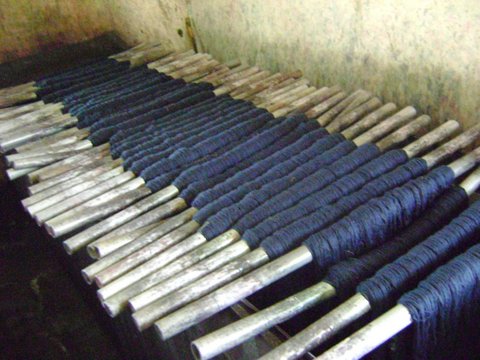
2. Yarn dyeing is done using either reactive or vat dyes. Yarn dyeing is done manually.
Color Kitchen
Dyeing Bath for Hank Yarn - Reactive Dyes
3. Yarn is then subjected to sizing using Maida and Gum as components. The yarn is subjected to alternate dyeing and sizing three times.
Yarn Being Dried after Sizing
4. Yarn is then prepared for warping using an ingenious creel and then wound onto a weavers beam using a conventional sectional warping machines.
5. Pirns are prepared using an indigenous contraption.
6. Yarn is then worked on powerloom having warp stop and weft stop motion.
6. Primitive dobbies are used for woven and zari borders.
7. The yarn is then subjected to finishing using water, sometimes in a padding mangle using softner and desizing agent.
Thanks for your attention. Did you find the information you were looking for ? Please leave a comment. Do you need to know more ? Please suggest a topic in the comments. You can also join the Forum for your specific queries.