Sunday, 3 June 2012

Manufacturing of Powerloom 40s x 40s 72 x 68 Fabric


This fabric is woven on the border areas of Andhra Pradesh and Tamil Nadu states of India and has a widepopularity as a dress material for ladies ( Kurtis and Salwars). It has the potential to be printed or embroidered.

The count for this fabric is 40s  both warp and weft and constructions is 72 and 68. It is available in both 44 inches and 56 inches.

The following are the broad steps in making the fabric

1. Yarn is taken in hank form and is kept in water tanks for two days for them to wet properly. Then the yarn is scoured in hank form itself.

Label on a Hank Yarn


2. Yarn dyeing is done using either reactive or vat dyes. Yarn dyeing is done manually.
Color Kitchen

Dyeing Bath for Hank Yarn - Reactive Dyes
  

3. Yarn is then subjected to sizing using Maida and Gum as components. The yarn is subjected to alternate dyeing and sizing three times.
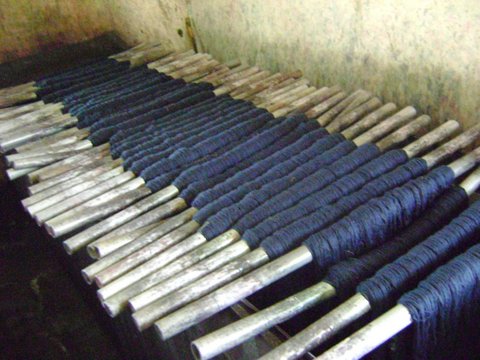
Yarn Being Dried after Sizing

4. Yarn is then prepared for warping using an ingenious creel and then wound onto a weavers beam using a conventional sectional warping machines. 


5. Pirns are prepared using an indigenous contraption.


6. Yarn is then worked on powerloom having warp stop and weft stop motion.


6. Primitive dobbies are used for woven and zari borders.
 
7. The yarn is then subjected to finishing using water, sometimes in a padding mangle using softner and desizing agent.


Thanks for your attention. Did you find the information you were looking for ? Please leave a comment. Do you need to know more ? Please suggest a topic in the comments. You can also join the Forum for your specific queries.

Sunday, 8 April 2012

Trip to Bhagalpur- Pureni and Miranchak Clusters


 Visit to Pureni 


Pureni, a place about 12 km from Bhagalpur, is known for its thicker deniers of Silks. At one time, it was feeding to a lot of exporters, but now only a few have remained.

A lot of government initiative has gone into the development of those clusters. One of those is the opening of several of these centers where handloom general facilities and dyeing facilities are provided.


In Pureni, a lot of weavers are working for master weavers based in Nathnagar and Bhagalpur. The picture below shows a Dupatta in Viscose and Dupion being woven for an exporter. 


A very heavy sheeny fabric is in demand for home furnishing. The picture below depicts one such fabric made in dupion. With a price of Rs. 500 plus per meter in production, it is turly for the discerning.


In handloom, different methods are used at different places to hold on the fabric. The picture below shows a typical cross style of gripping the fabric.


A look at the chamber dyeing machines at weavers service center. The machines are so new that it is evident that these are hardly used. 


A look at the sari woven at the service center. The motif is in Jamdani style, where the extra weft is inserted using big sewing needles.


Type of Yarns

This yarn is a single Matka yarn. Matka yarn is made from waste of Mulberry Silk


The yarn below is ghicha yarn from Pureni. Ghicha from Pureni is finer than that from Baghaiya.

The yarn below is a twist of Matka yarn and Dupion yarn.

Yarn below is called Matka Throwester Also called ( 27/1). It is made up from Waste of Katan Silk. It is also called Matka 85, as it was first used in 1985. Second picture is a close of the yarn. The yarn is very slubby and very soft.


The yarn below is the twisted Throwster ( 27/2).


The yarn below is Dupion yarn. Characterized by soft twist and feel, it adds sheen to any thing it is woven with. 


The fabric below is made up of Valkal, the yarn obtained from the link by which cocoon is held on the tree. Very costly.


Visit to Miranchak 


Picture below is that of a cho cho yarn. Generally it is made from waste silk. However the yarn below is that of viscose.


The picture below depicts the mat made out of cho-cho yarn.


A look at the weaver community there. 


A sari being woven there using polyester in weft.


A look at the school at Miranchak


A fabric using Matka 85+Dupion and matka.


Thanks for your attention. Did you find the information you were looking for ? Please leave a comment. Do you need to know more ? Please suggest a topic in the comments. You can also join the Forum for your specific queries.

Thursday, 15 March 2012

...they learned to spin and spool...Textile Songs


I happen to come across some of the songs written on the theme of textile mills. Sadly, almost all of them show the toil and hard work in a textile mills.

This songs depicts the plight of child workers used to work in the Textile Mills of America. A few lines (Source):

....Those babies all grew up unlearned, they never went to school.
They never learned to read or. write. They learned to spin and spool.
Every time I close my eyes, I see that picture still
When textile work was carried on by babies in the mill.... 


See the complete video here...


The other one, written on the Carolina Mills of Denim, depicts the similar theme of hard work at mills:


I am sure there are more. Looking forward to your suggestions.

Thanks for your attention. Did you find the information you were looking for ? Please leave a comment. Do you need to know more ? Please suggest a topic in the comments. You can also join the Forum for your specific queries.

Sunday, 11 March 2012

GK Questions on Apparels


The following Questions are taken from my son's GK book, who is in 8th Standard. Out of twelve questions, I could answer only two. Lets see how many can you answer:


1. A Welsh country town gave its name to a warm long sleeved woollen garment. Name it.

2. Smocking is a popular form of decoration on clothes. What is the name of the stitch in which smocking is worked ?

3. Which item of clothing did James Belcher give his name to in the nineteenth century.

4. What name is given to the thin veil worn by Muslin women in public ?

5. What was the name of the very narrow skirt introduced in 1910 which made it difficult for the wearer to walk?

6. An anorak is a long hooded jacket of skin or cloth. From what language does the word "anorak" come ?

7. Who would wear an Orphrey, Morse and Cope and carry a cozier ?

8. What is the name of the kind of pouch which Scotsmen wear in front of their kilts.

9. What is the name of a loose tunic worn in Arabia, Persia and Malaysia.

10. What were known as Oxford Bags ?

11. On which part of the body is a wimple worn and who would normally be seen wearing it ?

12. One of the British Channel islands gave its name to to a knitted woollen garment. Name it.

Answers


1. Cardigan
2. Honeycomb Stitch
3. Scarf
4. Yashmak
5. Hobble Skirt
6. Eskimo
7. Bishop
8.Sporran
9. Kabaya
10. Extremely wide bottomed trousers.
11. On the head, a nun
12. Jersey

Find more Quiz Questions here.  ( Please type "Dress" in the filter)

Thanks for your attention. Did you find the information you were looking for ? Please leave a comment. Do you need to know more ? Please suggest a topic in the comments. You can also join the Forum for your specific queries.

Thursday, 8 March 2012

Textile Testing without instruments


The tests as given below can be used to arrive at a preliminary conclusion. Definitive conclusions must be drawn by the standard test methods.


Difference between carded and combed yarns (Or woollen and worsted yarns) of the same count

Untwist the yarn and note the arrangement in the fibers. In carded yarns, the fibers are spread unevenly across the length. In combed yarn, they will lie parallel to the yarn surface. Similar test can be done to distinguish between woollen and worsted yarns.

Closeness of the Weave

Hold the cloth to the light and look through it. It can be determined to find if the weave is loose or close. It can also give you an idea about the uniformity of yarns.

Also run your thumbnail diagonally across the cloth. Any loose weave will manifest itself in the form of pathway made across the cloth after the thumbnail.

Elasticity

Crumple the fabric and note the behavior when the pressure is removed. The fabric should spring back to its former shape quickly.

Starch

Rub the fabric together, starch will come out in the form of dust. Or tear the fabric, dust will fly.

Strength

Grasp the cloth in both hands about an inch apart and pull steadily.

Drape 

Just spread the fabric over a surface so that it hangs down all around it and note the drape.

Colorfastness to Washing and Rubbing

Simply wash it or rub with a cloth.

Fastness to spotting- Used for Silk

Sprinkle a drop of water with little lime added to it. Allow it to dry then brush off.

Strain Resistance on Seam


Push the warp and weft with the finger nails, if they are pushed easily, the material will fray at seam. Another way to teat is to weave a needle in and out of the double of the material as if making a tuck. the Single cloth is then drawn away from each side of the needle and if a row of holes shows clearly alongside of the needle the material will not bear a strain.

Fastness to Perspiration

To test the change of color, dip it in a little warm vinegar and drying between tissue papers without rinsing.

Burn test methods to detect fiber composition are covered elsewhere in this blog.

Source

Thanks for your attention. Did you find the information you were looking for ? Please leave a comment. Do you need to know more ? Please suggest a topic in the comments. You can also join the Forum for your specific queries.

Sunday, 4 March 2012

Can you Recognise these Cellulosic Fibers


A.

B. 


C.


D.


Answers:
A. Cotton
B. Flax
C. Jute
D. Ramie

You can find other pictures here. 

Thanks for your attention. Did you find the information you were looking for ? Please leave a comment. Do you need to know more ? Please suggest a topic in the comments. You can also join the Forum for your specific queries.

Monday, 27 February 2012

After thoughts on the recent Bhagalpur Trip


It was heartening to find the fact from the people there that Bihar is in fact progressing in the regime of Nitish Kumar. According to them, previously it was difficult to be on the roads after 8 pm, now you can easily roam about till 10. 

Bhagalpuri Ghicha
Bhagalpur Ghicha Made of Eri 
The two most glaring problems with Bhagalpur are lack of proper roads and electricity. The fact that it took us more than two and a half hours to reach Bhagiya, only 70 km from Bhagalpur tells about the pathetic conditions of road. Electricity problem is so acute that the entire powerloom industry is run on Diesel Generators with the result that there is too much pollution in the city. 

The roads are too narrow to accommodate so much population. Special efforts need to be done to plan it properly. 

The hotel Sriyash Regency was a good place with quite good facilities as compared to the city.

A room in Hotel Sriyash
One interesting aspects of this city is the emphasis on education. You can find huge showroom showcasing books and competition material. The whole city is filled with posters of Coaching for Bank P.O. and other exams.  

The most beautiful aspects of this trip was the landscape outside Bhagalpur littered with Tar trees. Going by the Ganges at your side was the most refreshing of all.  

They are still using direct dyes for dyeing Tus/Staple fabrics. It was interesting to see the use of synthetic resin ( Jeevan Jod) to be used with Arrowroot starching on the fabric. The people who work on cotton also work on Linen on powerlooms. It was enlightening to see  the weaving of Tussar Ghicha fabric at Bhagiya. The creative use of different Gotis ( Cocoons) to get different colors and textures is amazing. Most of the Silk Gaddis are owned by Vaish and Marwari community. 

Bhagalpuri Sari
There is still a lot to be done. People there just do not care for reservation and encroach freely in the compartments. A lot of chain pulling happens between Patna and Bhagalpur. 

Thanks for your attention. Did you find the information you were looking for ? Please leave a comment. Do you need to know more ? Please suggest a topic in the comments. You can also join the Forum for your specific queries.

Tuesday, 21 February 2012

Textile Softners


Softness of fabric depends upon several factors, these are:
1.       Composition of the Fiber: The more crystalline region a fiber has, the less soft will be the fabric. Thus viscose is more soft than cotton as it has less crystalline region than cotton.
2.       Softness of Yarn: It depends upon the twist. The higher the twist, the less soft will be the yarn and hence less soft will be the fabric.
3.       Weave: Loose weave give more softness to the fabric than closer weave. Thus a fabric made with satin or twill weave will be more softer than that made with plain weave. 
Chemical softening is done by using chemicals which act as a lubricating agent and permits sliding of the fibers in the fabric. However, washing can eliminate these chemicals. Therefore they are applied during the final stage of the treatment.
The most common type of Chemical Softeners are:

1.       Non Ionic softeners: These are less efficient than anionic or cationic softeners, but they can withstand the effects of hard water. They can also sustain themselves in acid and basic environments and thus are most suitable for normal washing.

2.       Anionic Softeners: These are very good and give the fabric a full hand. However they cannot sustain hard water and acid environment. They can also cause yellowing at certain  temperatures.

3.       Cationic Softeners: They are amongst the best of the softeners. However they can cause dye toning. Also they can affect the color fastness to light.

4.       Silicone Based Softeners: These are insoluble in water and therefore must be applied on the fabric after dissolution in organic solvents. They have good fastness to washing. They create a lubricating film on the surface and give fabric a velvety silky hand.

5.        Reactive Softeners: These products have to be cross linked and provide permanent softness and water repellency.               

Sunday, 12 February 2012

Hindi Proverbs related to Textiles-1


Here is a list of proverbs in Hindi which are related to Cloths and Stitching. Textiles being one of the basic necessities of life, the wisdom related to it find its role prominently in the proverbs and idioms in Hindi.


१. आँचल पसारना - भिक्षा माँगना

२. अपनी पगड़ी अपने हाथ - अपनी प्रतिष्टा अपने ही हाथ होती है.

आँख न दीदा काढ कसीदा - किसी कार्य को करने में समर्थ न हो कर उस कार्य को करने की चेष्टा करना.

४. आँखें बिछाना - प्रेम सहित आदर करना

५. आँखों पर पर्दा पड़ना - असावधान हो जाना

६ . आँखों की पट्टी खुलना- सचेत हो जाना

७. आकाश में थेगली लगाना - बड़ी चतुराई करना

८. आकाश फट पड़ना - अति वृष्टि होना

१०. आपस में गिरह पड़ना- मन मुटाव होना.

११. आये थे हरी भजन को औटन लगे कपास - किसी बड़े काम करने के लिए आये थे परन्तु तुच्छ कार्य करने लगे.

१२. आस्तीन चढ़ाना - लड़ने के लिए तैयार रहना

१३. आस्तीन में सांप पालना - छिपे दुश्मन को सहारा देना

१४. आस्तीन का सांप - कपटी मित्र

१५. उधेड़ बुन में लगना- चिंता फ़िक्र करना

१६. क़तर ब्योंत करना - कांट छांट करना

१७. कपडे उतारना - ठगना , लूटना

१८. कपास तौलना- मूर्ख होना

१९. करघा छोड़ जुलाहा जाये नाहक चोट बेचारा खाए - जो मनुष्य अपना काम छोड़ कर दूसरे प्रपंच में पड़ता है वह हानि उठाता है.

२०. कांख में कतरनी रखना - कपट रूप में हानि पहुँचाना

२१. ओढ़नी की बतास लगाना- स्त्री प्रेम में पड़ना

२२. कुन्दी करना - बहुत मारना पीटना

२३. खाइए मन भाता पहरिये जग भाता- अपनी रूचि के अनुसार भोजन और दूसरे की रूचि के अनुसार वस्त्र पहनने चाहिए

२४. गगनभेदी पताका फहराना - प्रभाव सहित शासन करना.

२५. गठरी मारना- माल चुरा लेना

२६. गधा खेत खाए जुलाहा मारा जाये - अपराध कोई करे और दंड किसी दूसरे को दिया जाये

२७. गाँठ में जमा तो खातिर जमा - पास में धन होने से किसी बात की फ़िक्र नहीं रहती.

२८. गाँठ काटना- बहुत महंगा बेचना

२९. गाँठ खुलना- झंझट दूर होना

३०. गाँठ में बांधना - अच्छी तरह से याद रखना

३१. गाँठ लेना - अपने पक्ष में कर लेना

३२. गाँठ पर गाँठ पड़ना - झंझटें बढ़ जाना

३३. गाँठ का पूरा - बड़ा अमीर.

३४. गिरह टटोलना - कुछ लेने की इच्छा करना

३५. गुदरी का लाल - किसी के  रंग रूप से उसके गुणों का पता नहीं चलता

३५. घी भी खाओ और पगड़ी भी रखो - मनुष्य को इतना धन खर्च करना चाहिए कि बाहर मान मर्यादा बनी रहे.

३६. चादर उतार डालना - बेशर्म होना

३७. चादर तानकर सोना - निश्चिन्त हो जाना

३८. चादर के बाहर पैर फैलाना - आय से अधिक खर्च करना

३९. चादर देखकर पाँव फैलाना- शक्ति के अनुसार काम करना

४०. जब तक जीना तब तक सीना - ज़िन्दगी भर संसारी झंझटें लगी ही रहतीं हैं

४१. जूँ के डर से गुदड़ी नहीं जाती - थोड़े से कष्ट के लिए काम नहीं छोड़ा जाता

४२. जेब से जाना - खर्च होना

४३ जैसा देश वैसा वेश बनाना - स्थिति के अनुसार काम करना

४४. ज्यों ज्यों भीजे कामरी, त्यों त्यों भारी होए - कर्ज अदा न करने पर वह बढ़ता ही जाता है.
४५. झंडा गाड़ना - अधिकार स्थापित करना

४६. टांके खोलना - गुप्त बातों को प्रकट करना

४७ टेढ़ी टोपी लगाना - शान दिखलाना

४८. टोपी उछालना - आनंद का प्रदर्शन करना

४९. टोपी बदलना- किसी मनुष्य को अपना मित्र बना लेना.

५०. दरजी की सूई कभी ताश में कभी टाट में - कामकाजी मनुष्य कभी बेकाम नहीं रहता

Updated on 15th Feb, 2012

Contributed by Anonymous

५०    इज्ज़त तार तार होना 
५२   द्रोपदी की साड़ी होना 
५३   धोती का रुमाल होना 
५४   बाँहे चढ़ाना 


Others


५५   सूत न कपास लट्ठम-लट्ठा 
५६   कसीदे काढना 


Contributed by Mr. Arun Aggarwal- Bhagalpur


५७ गज फाड़कर गिरह बचाना - छोटे फायदे के लिए बड़ा नुक्सान करना

Others- 26th February,2012

५८ सूरदास की काली कमरी चढ़े न दूजो रंग- Black will take no other Hue
५९ तेते पाँव पसारिये जेती लम्बी सौर - Cut your coat according to your cloth.
६० नाचने उठे तो घूंघट कैसा - He who would catch fish must not mind getting wet.

27th February 2012

६१. कोल्हू काट कर मोगरी बनाना - कपडे पीटने वाले डंडे को मोगरी कहते हैं. : छोटे फाएदे के लिए बड़ा नुकसान करना .

Thanks for your attention. Did you find the information you were looking for ? Please leave a comment. Do you need to know more ? Please suggest a topic in the comments. You can also join the Forum for your specific queries.

Laboratory Practicals in Dyeing


Following are the documents depicting the laboratory practicals for dyeing. These are extremely useful for students of Textile Chemistry and textile enthusiast.

1. Dyeing with Vat Dyes

2. Simple Color Matching 

3. Dyeing with Direct Dyes

4. Dyeing of Acrylic

5. Dyeing of Polyester

6. Dyeing of Wool with Milling Acid Dyes

7. Dyeing of Wool with Premetallised Dyes

8. Dyeing of Wool with Lavelling Acid Dyes

9.Creation of a successful match prediction database

10. Mercerising Cotton

11. Determination of Milling Shrinkage in Wool

12. Dyeing of P/C blend

13. Dyeing of Polyester with Disperse Dyes

Thanks for your attention. Did you find the information you were looking for ? Please leave a comment. Do you need to know more ? Please suggest a topic in the comments. You can also join the Forum for your specific queries.

Sunday, 5 February 2012

how to check a garment for fitting


Measuring_tape

• Lengthwise grainlines, side seams, center front and center back seams hang straight or at right angles to the floor.

• Crosswise grainlines are parallel to floor.

• Adequate wearing ease is available for sitting, moving and bending.

• Armhole seams curve smoothly over the end of shoulder.

• Darts point to the fullest part of the curve.

• Shoulder seam length comes to end of shoulders.

• Sleeves are comfortable with no wrinkles.

• Hipline fits smoothly.

• Hemline is even.

• Pant legs hang smoothly and do not restrict any part of the legs.

• Crotch depth is right, neither too low and baggy nor too tight and binding.

• Pants hang smoothly from the waist. The waistband fits the body comfortably and stays in place when bending and sitting.

• Pants have no pulls or excess fabric across the front or back crotch level.

• The length of the garment is becoming.

Source


Sunday, 29 January 2012

Some Common Synthetic and Blended Fabrics-2


Chiffon


Chiffon Fabric is a lightweight, sheer and plain woven fabric.It is a textile made from silk, cotton, nylon, polyester, or rayon.This fabric can be difficult to work with because of its light and slippery textures. Due to this delicate nature, chiffon must be hand washed very gently. This fabric is a good choice for manufacturing blouses,dupattas and various types of ladies dresses. It is also used for making bridal gowns,scarves and evening and formal wears.

Polyester Chiffon

It is available in the GSMs of 35, 40, 50, 60 and 70 with widths of 42", 44" and 56"


A typical polyester chiffon has the following specifications: 30D/14/2000 Flat S+Z - 30D/14/3200 Flat `s` 88/80

Nylon Chiffon

This can be hand dyed and dip dyed which can give unique coloring effects. It is available in 30, 35 and 40 GSM and in widths of 36", 38", 40", 42" and 44"


Cationic Chiffon

Cationic Chiffon is a polyester fabric woven with 2 colors of thread. The different colored thread in the weave of the fabric provides an elegant iridescent quality giving this chiffon greater depth of color and character over the regular polyester chiffon.


Cationic is a  type of dye used on acrylic or on modified polyester or modified nylon yarn. It is often used to achieve cross dyed effects.  Cationic dyeable yarn is woven in a pattern with regular yarn in the same fabric. The pattern becomes visible by dyeing the fabric in 2 baths, one for each of the types of yarn.


Silver Chiffon

A typical silver chiffon fabric has the following specifications:

 It has 100% polyester, with 30D x 30D with a pick density of 177 x 109 and with a weight of 53 GSM.


Viscose Chiffon

It is composed of 100% viscose. It can be hand dyed and dip dyed. It has extra smoothness, comfort and delicacy because of viscose. It is available in 30, 35 and 40 GSM with widths of 40 and 42 inches. Also known as Japan. A typical fabric has the following configurations.


Here is a video that depicts how to illustrate Chiffon and other sheer fabrics, enjoy !!


Thanks for your attention. Did you find the information you were looking for ? Please leave a comment. Do you need to know more ? Please suggest a topic in the comments. You can also join the Forum for your specific queries.

Saturday, 28 January 2012

Some Common Synthetic and Blended Fabrics-1


Here is a list and pictures of some synthetic and blended fabrics

Satin


Satin is a type of glossy fabric.

It is commonly used in apparel : satin baseball jackets, athletic shorts, women's lingerie, nightgowns, blouses and evening gowns, but also in some men's boxer shorts, shirts and neckties.Other uses include interior furnishing fabrics, upholstery, and bed sheets.

Polyester Satin

They are available in the following weights:

GSM: 85, 100, 140, 160, 210, 230


Lycra Satin

A typical fabric has a composition of 97% Polyester with 3% Spandex, with specifications of 50D*75D+40S and with a fabric density of 250*104. Available in widths of 57"/58" with a weight of 90GSM .  Also available in 100, 120 and 140 GSM and widths of 42" and 44". 


Nylon Satin

 It is available in the GSM: 80, 100 with width of 42”, 44”. 


You can have a look here at the qualities running in grey fabric, yarns and finished products in Surat.

The following is a video depicting how to illustrate satin


Total Pageviews