Textile Notes related to fiber, yarn, fabric knowledge, spinning, weaving, processing, projects, knitting, Indian Traditional Textiles and denim manufacturing
The website of All India Artisans and Craftworkers Welfare Association (AIACA) is an amazing resource of information about the traditional craft processes. This organization has introduced Craftmark certification. It prohibits child labor, and guarantees that hand-made aspect of the craft processes are used. They have done extensive research in the craft regions of the country and have come up with diagnostic studies on the regions. All the studies are available on this site for reference. They have also listed, documented and kept for reference the traditional craft process such as Ajrak, Kalamkari, Maheshwari and Chanderi printing. This site is a must for Indian traditional craft enthusiast.
"We have difficulties in getting the required width and weight of the knitted fabric we make. In our knitting machine we are using guage 24, 100% cotton yarn, Ne 30/1.
1) What is the weight of the unfinished fabric we should make ?
2) shall we keep the unfinished knitted fabric (100% cotton) for a certain period of time prior the dyeing or bleaching process ? If yes, then how many hours ?
3) In the calendering process: shall we change the width of the fabric which we recieve from the dyeing process ?? For example, if the width of the knitted fabric after dyeing/bleaching is 88 cm. Shall we keep the same width during the calenderig process or shall we increase it ??
4) Shall we keep the unfinished knitted fabric for a certain period of time prior we transfer it to production (cutting & sewing) ??? if yes, how many hours ??
5) When is the best time for measuring knitted fabric weight ?? Is it immediately after the knitting process and after the bleaching process ?? or shall we wait for some hours or days till the fabric take it's final shape after both processes ??? "
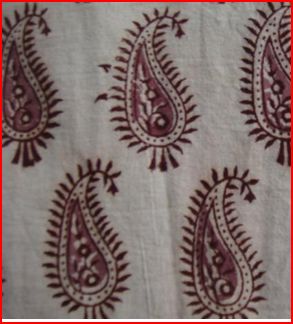
The process broadly is the same. First of all Tannin is applied on the cloth by dipping it into myrobalan. Then black outline, filling is done using Ferrous acetate solution using indigenous methods. Then alum is applied on the portion where red is desired. Then solution is boiled with Alizarin to get the red colors.
After that the cloth is dried, and yellow is applied by mixing myrobalan with Alum. Blue is applied by mixing Indigo solution in an alkaline solution of Lime and Fuller's earth. To get a green, blue is applied on the solutions which are already yellow.
Now that you've finished reading this post, what are you going to do? You should join the Forum.
“ I want to know how to calculate max EPI and PPI of the given count. For Example, if we take 50s pv warp X 150 D 100% polyester weft, what will the max EPI and PPI if we weave it for plain, 2/2 twill,and satin.”
Here Mr. Ashenhurst can rescue us. The following method is based on his book “Textile Calculation and Structure of Fabrics”. Here the assumption is there is only one count of thread in both warp and weft. If there are two different counts of warp and wefts, threads per inch should be found out for both of them and then suitably adjusted.
The General formula to calculate Maximum EPI and PPI for a Given count of Warp and Weft
Now in a plain weave in a repeat there are 2 threads and 2 intersections. For 2/2 Twill in one repeat of 4 threads there will be 4 threads and 2 intersections.
Also as a rule please remember that 40s count yarn diameter is 1/165 of an inch.
To convert it to the yarn diameter of 50s warp we use the following formula
Which means for 50s PV Warp the diameter will be
Thus the Maximum Threads per inch for a plain weave will be 184 as this will be the diameter of the Yarn.
For 2/2 Twill be they will be ( From the Formula above)
Which means x will be equal to 122 threads per inch
Similarly for Satin weave one can find out the maximum ends and picks per inch
Please remember however that this is theoretical construct. Actual threads per inch are generally less than that.
To Calculate the Cotton Equivalent of 150 D, We use the formulaà count= 5315/denier, Which means it is equal to 35.43 or 35 count.
The Diameter for 35 count yarn will be ( Using the formula above) = 154.34 th of an inch
Then you can use the same equation to calculate the Maximum EPI and PPI
In these examples there is no allowance for bending, shrinkage or compression, the threads should be reduced or increased proportionately in case the fabric is subjected to bending, shrinkage or compression.
The Sindhi Taropa denotes the interlacing stich embroidery-- the basic structure which is first built up with the use of long thread stitches into the surface and entire structure being built up thereafter by looping these threads, the overall effect produced is geometrical; floral patterns or figures, whatever is worked out through this type of stitch become-somewhat stylized. Practically the stitch is used as a means of achieving only an impression of the figure or motif which is aimed at.
How to Calculate the Weight of Fabric from Count, EPI, PPI and Width
One very common practical question in fabric sourcing is:
“If I know the yarn count, fabric width, ends per inch and picks per inch, can I estimate how much warp and weft yarn is required for 100 metres of fabric?”
The answer is yes. We can estimate it quite reasonably, especially for cotton woven fabrics, provided we understand the assumptions behind the calculation.
This calculation is useful for merchandisers, fabric buyers, converters, traders and small fabric suppliers because yarn prices change frequently. If the yarn price increases, the fabric price should also move logically. Without a basic calculation, it becomes difficult to judge whether the quoted fabric price is reasonable or inflated.
To calculate the approximate fabric weight, we need the following details:
Warp yarn count
Weft yarn count
Ends per inch, also called EPI or reed
Picks per inch, also called PPI
Fabric width in inches
Warp crimp percentage
Weft crimp percentage
For a quick practical estimate, we may assume:
Parameter
Assumed Value
Warp crimp
10%
Weft crimp
3%
1 metre
1.0936 yards
1 pound
453.59 grams
Cotton count basis
840 yards per hank
Practical Note: Warp crimp and weft crimp are not fixed values. They change with weave, yarn type, fabric density, finishing and shrinkage. The values of 10% and 3% are only working assumptions.
The Basic Cotton Count Formula
In the English cotton count system:
\( \text{Cotton Count} = \frac{\text{Length in yards}}{840 \times \text{Weight in pounds}} \)
Therefore:
\( \text{Weight in pounds} = \frac{\text{Length in yards}}{\text{Count} \times 840} \)
This is the foundation of the fabric weight calculation.
Warp Weight per Metre
The warp weight per running metre can be calculated as:
\( \text{Warp weight per metre in grams} =
\frac{\text{EPI} \times \text{Width in inches} \times \text{Warp crimp factor}}
{\text{Warp count} \times 840}
\times 1.0936 \times 453.59 \)
\( \boxed{11.25 \text{ kg of yarn is required for 100 metres of fabric}} \)
How to Calculate GSM from This
Many people confuse grams per metre with GSM.
Grams per metre tells us the weight of one running metre of fabric.
GSM means grams per square metre.
\( \text{GSM} =
\frac{\text{Weight per running metre in grams}}
{\text{Width in metres}} \)
For 47 inches width:
\( 47 \text{ inches} = 1.1938 \text{ metres} \)
Therefore:
\( \text{GSM} =
\frac{112.52}{1.1938} \)
\( \text{GSM} = 94.25 \)
So this fabric is approximately:
\( \boxed{94 \text{ GSM}} \)
Common Confusion: A 47-inch fabric and a 60-inch fabric may have different weight per running metre even if their GSM is similar. Running metre weight depends on width; GSM is normalized to one square metre.
Suggested Visual 3: Difference between grams per running metre and GSM.
This gives fabric weight in grams per running metre.
For 100 metres:
\( \text{Weight for 100 metres} =
\text{Fabric weight per metre} \times 100 \)
Important Practical Notes
1. This is an estimate, not the final invoice weight
The formula gives the theoretical yarn weight in the fabric. In real production, the final weight may change due to sizing, desizing, bleaching, dyeing, finishing, shrinkage and moisture regain.
2. Crimp must be adjusted for fabric type
A plain fabric, twill fabric, satin fabric, dobby fabric and heavy canvas will not have the same crimp. Warp crimp and weft crimp should ideally be measured from the actual sample.
3. Width matters
The formula uses fabric width in inches. If the width increases from 47 inches to 60 inches, the yarn requirement increases proportionately.
4. Count system matters
This formula is for cotton count or English count. It should not be directly used for denier, tex or metric count without conversion.
5. Add process wastage separately
If you are calculating yarn purchase requirement, add suitable wastage.
The difference is small, but the corrected version is technically cleaner because it uses more accurate conversion constants.
Final Rule of Thumb
To estimate woven cotton fabric weight:
Fabric weight depends mainly on four things: yarn count, EPI, PPI and width.
Finer yarn means lower weight.
Higher EPI or PPI means higher weight.
Greater width means higher running-metre weight.
Higher crimp means more yarn consumption.
Once this logic is understood, fabric costing becomes much more transparent.
General Disclaimer
The calculations and explanations in this article are intended for educational and practical estimation purposes. Actual fabric weight may vary depending on yarn quality, weave structure, crimp, sizing, finishing, moisture content, shrinkage and testing conditions. For commercial costing, production planning or quality approval, calculations should be verified with actual sample testing and mill-specific data.
This (http://www.ajrakhprinting.co.in) is an amazing website giving in amazing details the process of Ajrak Printing. Owned by Ranamal Khatri, the master craftman, this website can be used as an authentic one to study the process.I met Mr. Ranamal Khatri during my visit to Jodhpur. This site will give you a glimpse of the joy of watching Ajrak Made. This gives in details the process, the receipe, the comparison with the earlier process and a mouth-watering view of the products. To top it all, he has put in the process video wherein one can have a look at the process in action. And last but not the least, a look at the artisans working in his workshop and who have made it possible is given. Here are some pictures from the website:
Receipe
Video of the Process
Ajrak Saris
Artisans
Awards won by Him
There is a very good M.Des. Research done by B. Sinduja. You can access it here
Now that you've finished reading this post, what are you going to do? You should join the Forum.