Nuapatna
This place is known for its Ikat Textiles, specially Sarees. The ikat used is weft Ikat.
When we reached, it was a hot summer day with temperature soaring up to 45 deg C with humidity. But looking at the "cool" weaving, took away some of the heat.
Frame looms are used to weave.




Note the "Comb" used at the selvedge to control the border ends. Note also the absence of warp stop motion. Which means weavers eyes are the only instruments to detect a defect, and it one can only spot a missing end ( Chira) in a 2/100s count cotton only after a few picks have been woven. So expect some missing ends in the warp.


This place is known for its Ikat Textiles, specially Sarees. The ikat used is weft Ikat.
When we reached, it was a hot summer day with temperature soaring up to 45 deg C with humidity. But looking at the "cool" weaving, took away some of the heat.
Frame looms are used to weave.
Look at the "bow" used to control the weft, this gives wavy selvedge to the saree. Considered by some as a defect,this is inherent to the manufacture of this saree.
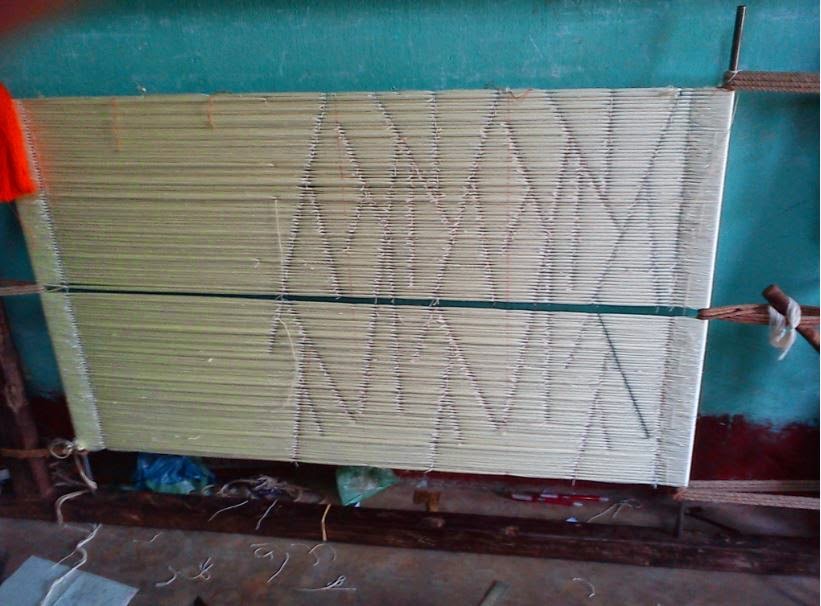
Frame used to tie and dye the weft yarn. The pattern is prepared on the frame then it is transferred to weft spools and then these are used in the loom for weaving.
The count used is 2/100s or 2/120s for cotton. Both mercerised and non mercerised cotton is used. Silk used is Bangalore (20/22 denier degummed) or Maldah Silk (30/33) denier Mulberry. In Nuapatna Generally Bangalore Silk is used in the warp and Maldah is used in the weft.
Note the "Comb" used at the selvedge to control the border ends. Note also the absence of warp stop motion. Which means weavers eyes are the only instruments to detect a defect, and it one can only spot a missing end ( Chira) in a 2/100s count cotton only after a few picks have been woven. So expect some missing ends in the warp.
Throughout India, home made dobby attachements are used to create the design. Here is the Nuapatna version.
Notice the lingos falling down at the border.
To create this design below the following steps are done:
1. White fabric is ties for the first time
2. Then it is dyed in the motif colorr. ( Fawn)
3. Then the motif only is tied.
4. Then it is treated with hydro ( Sod. Hydrosulphide) to take away the color from the remaining portion- if needed.
5 Then the background is dyed.
Generally acid dyes are used for silk and vat dyes for cotton. However, the characteristic "red" of Ikat will bleed as it is dyed in napthol color. For all the bright colors napthol dyes are used, which may bleed. They have also started using the reactive dyes, but is it very rare.
Do you see the little zig-zag line at the left side in the picture above , this is how the weavers control design, they make sure that this zig-zag line is maintained by pinching a small amount of weft. which is shown as a loop in the wrong side of fabric. So mind you, if you get those loops of yarn at the side of the fabric, these are not defects but effects inherent to the weaving technique.
This is Nuapatna No. 1, there are many more such societies. Surprisingly each have a different language of products.
This society has an elaborate stand for checking the sarees against the light.


