Textile Notes related to fiber, yarn, fabric knowledge, spinning, weaving, processing, projects, knitting, Indian Traditional Textiles and denim manufacturing
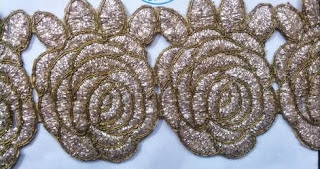
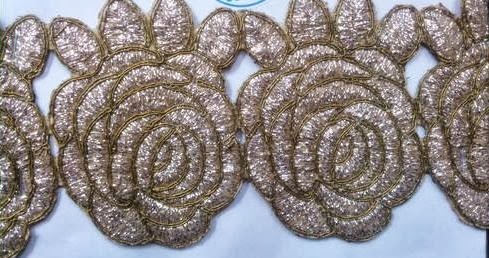
The following laces are commonly used in Indian Ethnic Garments meant for mass market.
1. Embroidered Laces
These are available in sizes ranging from 1 inch to 5 inch and with a packing of 9 meters. These are not dyeable and pre determined color charts are available.
These are available in sizes from 0.5 inches to 5 inches and with a packing of 20 meters. These are not dyeable and pre determined color charts are available.
3. Needle Laces
These are available in sizes ranging from 1/2 inches to 2 inches and with a packing of 9 meters. These are not dyeable and pre determined color charts are available.
4. GPO Laces or Chemical Laces
These are available in sizes from 1 inch to 6 inches and with a packing of 20 meters. These are in cotton and dyeable.
5. Sequence Laces
These are available in 0.5 to 2.5 inches and are not dyeable. These are available in the packing of 9 meters.
This third lace is also called Khajuri Lace.
6. Designer Laces
These are available in 0.5 inches to 2.5 inches. These are multicolored and available in the packing of 9 meters. These are not dyeable.
7. Moti Laces
These are available in the packing of 8 meters. These are not dyeable.
8. Crochet Laces
These are available from 1/4 to 4 inches and are dyeable.
9. Hyderabadi Gota
These are available from 1/2 inches to 3 inches and in a packing of 10 meters.
Thanks to your encouragement, mytextilenotes.blogspot.com is now a reference resource in NPTEL ( National Programme on Technology Enhanced Learning ) which is an initiative by seven Indian Institutes of Technology (IIT Bombay, Delhi, Guwahati, Kanpur, Kharagpur, Madras and Roorkee) and Indian Institute of Science (IISc) for creating course contents in engineering and science.
In their web course on Fabric Structure and Design, the blog is featured under hyperlinks in the additional reading section. See the reference here.
Started in 2006, this blog has become a reference resource for quite a few textile colleges also.
I thank you for all the support and motivation provided by you through your emails, comments and phone calls !! Will strive to make it even better.
I have just changed the company and in the process of understanding new systems, hence I am not able to contribute for some time. However, will be back again very soon. Thanks for your support.
I was looking for simple methods to identify class of dyes on fabric.
Broadly I work with cotton, linen, silk and union fabrics of silk and viscose.
The dyes that I am looking for to identify are direct, reactive, acid ( on
silk), sulphur, vat, aniline black and napthols.
Here are some methods to test these dyes. I got the idea from this document.
However I have not tested them so far.
1. Direct Dyes
This test of
direct dye holds valid for both cotton and silks.
A 100-300 mg portion of the dyed sample is placed in a 35 ml test tube, 5-10
ml of water and 0.5 to 1 ml of conc. ammonia are added and the mixture is
boiled in order to bleed off a sufficient amount of dye for redyeing a piece of
white cotton cloth.
When a sufficient amount of dye has bled from the sample, the sample is
removed, a piece of white cotton cloth weighing 10-30 mg is placed in the test
tube and 5-30 mg of common salt is added. After boiling gently for 40-80
seconds and cooling to room temperature, the cotton is removed, rinsed and
examined.
Redyeing on cotton in an ammonical solution in the presence of salt to shade
and strength comparable to the shade and strength of the original sample is a
direct evidence of direct dye.
2. Acid Dyes
For wool and
Silk
A 100-300 mg portion of the dyed sample is placed in a 35 ml test tube, 5-10
ml of water and 0.5 to 1 ml of conc. ammonia are added and the mixture is
boiled in order to bleed off a sufficient amount of dye for redyeing a piece of
white cotton cloth.
The above part is same as acid dyes. However, if the sample in the direct
dyes bled but left the test cotton white or only slightly stained, the colored
extract is neutralized with 1 ml of 10% sulphuric acid solution and a few drops
of acid are added in excess. A 20-30 mg of wool is added and the mixture is
boiled for 1 to 2 min. The wool is rinsed and examined.
Redyeing of wool from an acid bath indicates the presence of acid dyes
provided the presence of direct dyes is not shown.
3. Sulphur Dyes
For Cotton
A 100-300 mg of dyed sample is placed in a 35 ml test tube and to it are
added 2 to 3 ml of water, 1 to 2 ml of 10% sodium carbonate solution and 200-400
mg of sodium sulfide chips.
The mixture is raised to a boil and boiled for 1 to 2 minutes. The sample is
removed and to the test tube are added 25-30 mg of white cotton and 10-20 mg of
common salt. After boiling for 1 to 2 minutes, the cotton sample is removed and
placed on filter paper and allowed to reoxidize.
Under these conditions, sulfur dyes redye cotton in a shade which differs
from the original only in strength. A few easily reducable vat dyes will color
the white cotton but in a shade markedly different from the original dyeing.
Vat Dyes
For Both Cotton and Protein ( For
protein also follow the portion in Red font)
Vat dyes are to be tested after the sulphur dye test has come negative.
A 100-300 mg dyed sample is placed in a 35 ml test tube to which are added 2
to 3 ml of water and 0.5 to 1 ml of 10% caustic soda solution (The mixture is boiled till all the fiber is dissolved).
After being brought to boil a 10-20 mg portion of sodium hydrosulphiteis added and boiling continued for another
0.5 to 1 minute. The sample is removed( Not Needed)
and 25-50 mg of white cotton cloth and 10-20 mg of salt is added. Boiling is
continued for 40-80 seconds, followed by cooling to room temperature. The cotton
is removed and placed on filter paper to oxidize (then
in a bath containing sodium nitrite and acetic acid).
Redyeing of cotton to a shade differing only in strength from the original
dyeing indicates the presence of vat colors.
Napthol and Insoluble Azo Dyes
The most characteristic property of this class is bleeding
in pyridine. A 10-50 mg dyed sample is placed in a 10-15 ml test tube, 1-2 ml
of pyridine added and the sample boiled. All napthol bleed to certain extent.
Reactive Dyes
Boil in water with a temperature more than 60 deg in Sodium
hydrosulphite and caustic soda as in vat dyes. First the color will come out
and then that color will decolorize.
Traditional techniques used by a particular vendor also make him important in terms of buying. Traditional techniques make the vendor unique among others and make him valuable in terms of planning as the techniques demand more lead time and quality checking. It assumes more importance if the vendor belongs to the same region which is the origin of these techniques. For example vendors supplying Dabu, Bagru, Ajrak, Bandhni, Lehariya and Patri from Rajasthan are rated higher as they are using the traditional techniques in printing the fabrics. For similar reason block printing vendors are rated higher than screen printing vendors and vendors using handloom are rated higher than those using powerloom.
Exclusivity of the vendor for a particular company makes him valuable. As the vendor is not supplying to any other company, the possibility of desgins and language leaking to ther other compaies is obviated. Also obviated is the fluctuations in supply as the whole capacity of the vendor is planned when ordering fabrics or garments.
Percentage of quality rejections is one of the most important factors in evaluating the vendors. More quality rejections will not only throw a question in the vendors' ability to supply a particular quality of fabric, it will also throw question on the viablity of bulk produciton of that traditional techniques.An example of this is very pertinent here. A retail organisation traditionally does Milspun x Khadi yarn in one of its most selling garments. When they tried to do it in Khadi x Khadi yarn, the number of quality issues become so high that they have to abondan that design using fabric.
Price is a very important factor in evaluating a vendor. A vendor traditionally supplying goods at reasonable price are rated higher. However, in traditional textiles, low prices have their own social and envinornmental costs. In handloom weaving for example the production is distributed by traders to the weavers at a pittance in order to keep down the prices. Similarly the traditional prints are sold at lower costs because the printers still have not heard of affluent treatment plants and the affluents are simply added in the rivers or canals. But high prices are also no guarantee of the quality of the merchandise. I know a printer who does excellent block printing in terms of design. Every year the prices are raised in order to save the block printing and the printers with the result that his prices have become inordinately high.
Evaluation of the vendors for Indian Ethnic Fabric is more of an art than a science simply for the fact that there are many soft factors involved. Indian ethnic fabrics are masterpieces generally belong to a particular community who has perfected the art of producing it traditionally. When it comes to dealing with small volumes, you can get very good quality. But the moment the volume go bigger and is limited by delivery timelines, all sort of problmes start happening. Hence it is important to know your vendor before an order is placed with him/her. Generally the crieteria revolves around dealing with the vendors for a few years before making any evaluation.
Time of association with the company is a very important factor. The older the vendor/artisan is with a company, he understands the modus operandi of the company, the likes and dislikes and adept itself to work in the way. This leads to saving in time when explaining designs and fewer rejections.
Volume and value of the fabric done per year is another factor that needs to be looked into. More volume done with the company indicates the vendor's capacity. Evaluating capacity of an artisan is very different from evaluating the capacity of the mill wherein one can count the number of machines and multiply by speed and efficiency to get the capacity. Generally artisans work in small clusters and the looms/printing tables are distributed over a wide geographicaly area. If a vendor can deliver volume that indicates his relationships with the vendors and his financial strength. In case of Tussars/Bhagalpur silks this is of critical importance as the greige fabric has to be booked in advance of one year and colors are indicated closer to the season. The vendor should have the financial strength to hold on the stock for that period.
Innovative designs shown and converted every year is the vital factor for a vendor. It ensures that his margins keep on increasing, his development costs are low and the company is invigorated by the infusion of new designs. Normally, the time of association with the company determines this factor. Block printing can be done on various textures of the fabrics available. Similarly the designs from the saris can be translated into dupattas and stoles after suitable modification. This ensure that the story of the brand is intact and the same language is conveyed to the loyal customer who flock to the stores to get the quintessance of the the brand.
A vendor becomes important if the designs shown by him are impossible or difficult to reproduce anywhere else. That ensures that he gets his desired price points and can dicate terms with regard to production or delivery. It happens in case of traditional wovens and prints that are produced using indiginous techniques like Bagru, Dabu, Jamdanis, Chanderi and Sanganeri Butis.
Supply Chain Risks in Indian Ethnic Garment Buying
Managing the supply chain for Indian ethnic garments is far more complex than managing a standardised apparel product. The reason is simple: ethnic apparel is not just a garment category; it is a combination of fabric, craft, region, season, labour skill, dyeing practice, embellishment, supplier capability and fashion demand. A kurta, saree, dupatta, blouse piece, lehenga or embroidered panel may pass through several hands before it reaches the store.
In Indian ethnic wear, the supply chain may include weavers, dyers, printers, embroiderers, fabric traders, job workers, cutting units, stitching units, washing units, finishing units, transporters, warehouse teams, buyers, planners and store teams. These people are often located in different cities and craft clusters. Their working conditions are not uniform. Their capacity is not always documented. Their processes are not always industrialised. Their output may be affected by weather, festivals, labour availability, electricity, cash flow and even the personal presence of a master craftsperson.
This makes ethnic garment buying both beautiful and risky. The beauty lies in the richness of regional craft and product variety. The risk lies in the fact that supply cannot always be controlled like a modern factory line. A buyer has to manage uncertainty without destroying the character of the product.
1. Why Ethnic Garment Supply Chains Are Risk-Prone
Ethnic garment buying is not only a matter of placing purchase orders and waiting for deliveries. It is a coordination problem spread across material, process, skill, geography and time. A cotton kurta may require fabric procurement, dyeing, printing, cutting, stitching, finishing, packing and dispatch. A festive embroidered kurta may add handwork, sequins, lining, trims, washing and inspection. A saree may involve yarn preparation, weaving, dyeing, finishing, polishing, fall-pico work, blouse-piece coordination and packing.
The risk increases when several of these processes are outside the direct control of the main supplier. A supplier may be strong in fabric trading but weak in embroidery control. Another supplier may have good stitching capacity but depend on outside dyeing. A third supplier may have excellent craft access but poor documentation and delivery discipline. Therefore, supply chain risk in ethnic buying is not a single event. It is a chain of small uncertainties that can accumulate into late delivery, wrong quality, excess inventory or missed season.
Disruption is one of the most common risks in ethnic garment buying. A disruption happens when the normal flow of production is suddenly interrupted. This interruption may occur at the fabric stage, dyeing stage, embroidery stage, stitching stage, finishing stage, logistics stage or approval stage.
For example, consider a supplier who gets chikankari embroidery done from Lucknow. The fabric panels may be cut in Delhi and then sent to Lucknow for embroidery. If the embroidery karigar or the small embroidery unit is unavailable for even one week, the entire production schedule may collapse. The cutting may be complete, but the garments cannot move forward. The stitching unit may be waiting. The buyer may be expecting delivery. The store may have planned the launch. Yet the supply chain stops because one critical activity has been delayed.
This is very common in ethnic wear because many products depend on specialised skills. Chikankari, hand embroidery, hand block printing, tie-dye, kalamkari, zari work, handloom weaving, mirror work, gota work, aari work and kantha work are not always easily replaceable. If the specific worker, unit or cluster is unavailable, the order cannot simply be shifted to another factory without affecting quality, look or authenticity.
Festivals also create disruptions. In South India, Pongal may affect production and movement. In North India, Eid and Diwali may affect labour availability, transport, dyeing units, embroidery units and finishing operations. These festivals are predictable, but their actual impact is not always predictable. A buyer may assume that production will reduce by 50 percent during a festival period, but in reality it may reduce by 70 or 80 percent. This difference is enough to disturb launch plans.
Weather is another major source of disruption. In places where dyeing, drying or printing depends on open-air or semi-open production conditions, monsoon can affect output. If piece-dyed fabrics are required, dyeing has to be planned before difficult weather periods. If this planning is missed, the buyer may have greige fabric available but no finished fabric ready for production.
A practical way to manage disruption is to identify which products are high-risk before placing orders. High-volume, high-value and repeatable products may need buffer inventory. Critical craft products may need alternate suppliers. Products dependent on one supplier, one process or one region should be tracked more carefully. However, keeping inventory itself is expensive. Therefore, the buyer is always balancing safety and efficiency.
3. Delays
Delays are different from disruptions. A disruption is a break in the chain; a delay is a slowing down of the chain. Delays are extremely common in ethnic garment buying because many decisions happen before production can start.
Sometimes styles get closed late. The buyer may take time to approve colours, silhouettes, motifs, embroidery placements, print scales, fabric quality or price. Sometimes the design team may revise the garment after the supplier has already developed the first sample. Sometimes the fit sample gets approved, but the production sample gets delayed. Sometimes the size set is not complete. Sometimes lab dips and strike-offs take longer than expected. Every small delay in approval pushes the delivery date forward.
A simple way to understand delivery risk is through the lead-time equation:
\( Total\ Lead\ Time = Approval\ Time + Material\ Time + Processing\ Time + Inspection\ Time + Logistics\ Time \)
If any one component increases, the total lead time increases. A buyer may focus only on stitching time, but in ethnic wear the real delay may lie in fabric dyeing, hand embroidery, washing, finishing, lab-dip approval, shade matching or transport from a cluster.
Another important reason for delay is supplier overcommitment. A supplier may accept more orders than he can digest because suppliers do not want to refuse business, especially when future orders are uncertain. They may believe they can somehow manage production. But when fabric, embroidery, washing, stitching and finishing all come together, the actual capacity becomes visible. Then the supplier starts prioritising some buyers over others.
This can be called the interference effect. One order interferes with another order. A supplier who has accepted too many orders may shift labour from one style to another, delay one buyer to serve another, or complete easier styles first while difficult styles remain pending. The buyer sees this only when deliveries start slipping.
4. System Risks
Supply chain can also be affected by system failures. These risks may appear rare, but when they happen, the impact can be serious.
In a modern retail organisation, buying and supply chain operations depend heavily on ERP systems, barcode systems, warehouse systems, purchase order systems, vendor portals, inventory records, GRN processes and store stock visibility. If the ERP system does not work for some time, purchase orders may not be released, GRN may not be posted, stock may not be visible and dispatches may get delayed.
During stock audits or inventory checking, transactions may be frozen. This means that material physically exists, but movement is restricted. Goods may not be transferred, billed or received until the checking process is complete. This becomes a supply chain risk when the timing overlaps with a season launch or festival requirement.
System risks are usually handled through backup processes. These may include manual challans, offline records, emergency approval processes, email confirmations, temporary tracking sheets and physical reconciliation. However, manual methods should be used carefully because they can create later mismatches in stock, cost and accountability.
The larger lesson is that technology reduces supply chain risk only when master data, process discipline and exception handling are strong. A poor system does not merely record confusion; it multiplies confusion.
5. Information and Communication Risks
Information risk is one of the most underestimated risks in ethnic garment buying. Many supply chain problems begin not with production failure but with unclear, incomplete or changing information.
A buyer may place an order assuming a particular fabric quality, but the supplier may interpret it differently. A colour may be verbally approved, but the lab dip may not be properly documented. A print may be selected from a sample, but the repeat size may change in bulk. A dupatta may be expected in one fabric, but the supplier may substitute another fabric to control cost. A garment may be approved with one type of lining, but production may happen with a cheaper lining.
There is also a risk after order placement. Sometimes a supplier accepts an order and later increases the minimum order quantity. Sometimes the supplier asks for a rate increase after the buyer has already planned the margin. Sometimes the supplier downgrades quality to maintain the agreed price. Sometimes the supplier accepts the order but does not reserve capacity. Later, when the market improves, he may prefer another buyer who gives a higher rate or larger quantity.
Good supply chain management therefore requires clean communication. The buyer should define fabric quality, GSM or construction where relevant, shade, print, embroidery, trims, measurement, finishing, packing, delivery schedule, inspection stage, penalty conditions and payment expectations. The supplier should confirm feasibility, capacity, lead time, rate, minimum quantity and quality limitations before production starts.
In ethnic wear, a clear tech pack or product specification sheet is not just a documentation formality. It is a risk-control tool.
6. Procurement Risks
Procurement risk arises when the cost, availability, payment or commercial terms of buying change unexpectedly.
A supplier may increase price because yarn rates have gone up, dyeing costs have increased, embroidery labour has become expensive or transport rates have increased. In some craft products, the buyer may not have many alternate suppliers. This gives the supplier more power during negotiation.
Freight is another procurement risk. Ethnic products often move between regions. Fabric may come from one city, printing from another, embroidery from another, stitching from another and final dispatch from yet another location. If transport cost increases or logistics becomes unreliable, total landed cost changes.
Payment delay is also a serious risk. If suppliers do not receive payment on time, they may slow down production, refuse new orders, compromise on quality or prioritise other buyers. Small suppliers and craft-based vendors are especially sensitive to cash flow. In traditional textile supply chains, liquidity is not merely a financial issue; it directly affects production continuity.
Procurement risks are generally managed through long-term relationships, fair payment practices, multiple supplier development, rate contracts, raw material planning and transparent costing. However, multiple sourcing should not be done blindly. If the product requires a particular craft quality, developing more suppliers may take time. The second supplier may not produce the same look, hand feel, embroidery quality or finishing standard.
7. Inventory Risk
Inventory is both a solution and a risk. To manage disruptions, delays and uncertainty, buyers often keep inventory. But inventory itself creates financial and fashion risk.
Inventory risk depends mainly on three factors: product value, rate of obsolescence, and uncertainty in demand and supply.
A high-value fabric or garment carries greater financial risk because money is blocked in stock. A fashion-sensitive product carries greater obsolescence risk because it may lose relevance quickly. A product with uncertain demand or uncertain supply needs careful planning because both shortage and excess are possible.
For example, a high-value wild silk fabric that is used across several categories may be managed through inventory pooling. Instead of each category buying separately, the demand for greige fabric can be aggregated. The greige fabric can be ordered in advance and dyed later according to colour demand. This reduces the risk of being stuck with wrong colours while still protecting fabric availability.
This is where postponement becomes useful. In postponement, the buyer delays the final product decision as long as possible. The base fabric may be produced early, but colour, print, embroidery or garment allocation may be decided closer to the season. This is especially useful when the buyer is confident about the base material but uncertain about colour or style demand.
Suggested Visual 2: Inventory risk and postponement model showing greige fabric, dyeing, styling, finishing and final store allocation.
8. Quality Risk
Quality risk deserves separate attention in ethnic garment buying. In many cases, supply exists, but the delivered product is not commercially acceptable.
Quality risk can appear in many forms. Fabric may have shade variation from piece to piece. Handloom fabrics may have slubs, missing ends, reed marks or uneven texture. Printed fabrics may have misregistration, colour bleeding, stains or uneven curing. Embroidered panels may have loose threads, broken sequins, puckering or wrong placement. Garments may have measurement variation, poor stitching, poor finishing, shrinkage, twisting or poor fall.
In ethnic apparel, the challenge is that some irregularities are part of the craft character, while some are defects. A handloom saree may have minor variation that gives it authenticity. But a stain, hole, weak seam, bleeding colour or wrong measurement cannot be justified as craft variation. Buyers must be able to distinguish between acceptable craft character and unacceptable quality failure.
Quality risk is best managed by defining quality expectations before bulk production. Approved samples, shade bands, fabric swatches, measurement specs, embroidery placement charts, wash-care requirements and inspection checkpoints are essential. For craft products, the buyer should also define what level of variation is acceptable.
9. Demand Forecasting Risk
Ethnic wear demand is difficult to forecast because it is influenced by season, festivals, weddings, regional preferences, price points, colour trends, fabric preferences and local customer behaviour.
A product that sells well in one city may not sell equally well in another. A colour that works in one region may be slow in another region. A festive kurta may perform well before Diwali but slow down immediately after the season. A saree with strong traditional appeal may sell steadily but not rapidly. A fashion colour may sell fast for a short period and then become dead stock.
Forecasting is also difficult because ethnic wear has a wide assortment. There may be many styles, colours, fabrics, embellishments and price points. Each option may have limited depth. This creates a long-tail inventory problem: the total stock is high, but each individual style may have limited sale history.
To reduce forecasting risk, buyers should combine historical sales, store feedback, regional preference, vendor knowledge, festival calendar, current trend observation and price-point analysis. No single method is enough. A purely statistical forecast may miss craft realities. A purely intuitive forecast may overestimate demand. The best approach is to combine data with buying judgement.
10. Capacity Risk
Many ethnic suppliers do not have unlimited scalable capacity. Their production depends on available machines, karigars, job workers, dyeing capacity, embroidery frames, cutting tables, finishing workers and working capital.
Capacity risk appears when the buyer assumes that a supplier can produce more than he actually can. This risk becomes visible during peak seasons. A supplier who comfortably produces 2,000 pieces in a normal month may fail to produce 6,000 pieces before Diwali. The problem is not only quantity; quality may also decline when capacity is stretched.
Capacity should therefore be evaluated before order placement. The buyer should know whether the supplier has in-house production or depends on job work. The buyer should ask how many pieces can realistically be produced per week. For embroidered or craft products, capacity should be checked process-wise, not only garment-wise. A stitching unit may have capacity, but embroidery may be the bottleneck.
11. Geographical and Cluster-Based Risk
Indian ethnic supply chains are strongly linked to geography. Different clusters specialise in different crafts, fabrics and processes. This is an advantage because it gives richness to the product. But it is also a risk because each cluster has its own limitations.
A cluster may be affected by monsoon, local festivals, labour migration, transport strikes, electricity issues, raw material shortages or temporary changes in demand. A buyer sourcing from Bhagalpur, Banaras, Jaipur, Surat, Lucknow, Kutch, Chanderi, Maheshwar, Mangalgiri, Sanganer, Bagru or Kanchipuram must understand not only the product but also the local production rhythm.
Cluster knowledge is therefore an important buying skill. A buyer who understands the cluster can plan better. He knows which months are risky, which processes require extra time, which defects are common, which suppliers are dependable and what kind of variation is normal.
Suggested Visual 3: Cluster-based risk map showing how region, craft, weather, labour, transport and supplier capability affect ethnic garment buying.
12. A Simple Risk Matrix for Buyers
A buyer can evaluate every product using a simple risk matrix. This helps convert experience into a repeatable decision tool.
Risk Area
Questions to Ask
Product Complexity
Does the style involve special fabric, craft, print, embroidery, wash or finishing?
Supplier Dependency
Is the product dependent on one supplier, one job worker or one cluster?
Lead Time
Is the required delivery date realistic for the number of processes involved?
Demand Uncertainty
Is the product basic, seasonal, fashion-led, festive or experimental?
Quality Sensitivity
Can small variation in shade, hand feel, embroidery or measurement make the product unacceptable?
Inventory Exposure
If the product does not sell, how much money will be blocked?
Flexibility
Can the fabric, colour, trim or component be used elsewhere?
Capacity
Can the supplier actually deliver the quantity on time without quality deterioration?
Geography
Is the cluster vulnerable to weather, festival, transport or labour disruption?
Commercial Terms
Are payment terms, rate validity and supplier commitments clear?
13. Practical Risk Management Strategies
The first strategy is to develop more than one supplier for critical products. However, this must be done with care. Not every ethnic product can be duplicated easily. For craft-sensitive products, supplier development should start early and quality should be compared with the original benchmark.
The second strategy is to keep buffer time for complex products. Products involving dyeing, printing, embroidery, handwork, washing or multiple job workers need realistic lead time. A buyer should not give the same lead time to a plain dyed kurta and a heavily embroidered festive kurta.
The third strategy is to use postponement wherever possible. Greige fabric, base fabric, common trims or neutral components may be kept ready, while colour, print, embroidery or store allocation can be finalised later. This reduces the risk of making the wrong final commitment too early.
The fourth strategy is to build long-term supplier relationships. In ethnic wear, supplier loyalty and trust often matter as much as formal contracts. A trusted supplier is more likely to alert the buyer early when a delay or quality problem is emerging.
The fifth strategy is to track bottleneck processes separately. Do not ask only whether the garment is ready. Ask whether fabric, dyeing, printing, embroidery, stitching, washing, finishing and packing are each on schedule. A production follow-up that hides the process stages is not enough for ethnic buying.
The sixth strategy is to use data, but not ignore judgement. Sales data is important, but ethnic wear also requires understanding of craft, region, customer taste and supplier capability. The best buying decisions come when analytics and textile judgement work together.
Related Reading on Indian Textiles, Ethnic Garments and Fabric Decisions
Supply chain management in Indian ethnic garment retailing is complex because the product itself is complex. Unlike standardised garments, ethnic garments often carry the signature of region, craft, fabric, process and human skill. The buyer has to manage not only price and quantity, but also uncertainty, cultural rhythm, process dependency and supplier capability.
The main risks include disruptions, delays, system failures, information gaps, procurement issues, inventory exposure, quality variation, forecasting errors, capacity limitations and cluster-specific constraints. Some risks can be reduced through systems and data. Some can be reduced through planning and inventory. But many risks require experience, supplier relationships and deep product understanding.
In ethnic garment buying, the best buyer is not merely the person who negotiates the lowest price. The best buyer is the person who understands where the supply chain can break, prepares before it breaks, and still protects product beauty, commercial margin and timely availability.
General Disclaimer
This article is intended for educational and professional discussion. The examples are illustrative and may vary across companies, regions, suppliers and product categories. Supply chain decisions should be made after considering actual supplier capability, product complexity, commercial terms, quality requirements, legal compliance and business context.
15. References
Christopher, M. and Peck, H. (2004). “Building the Resilient Supply Chain.” The International Journal of Logistics Management, 15(2), pp. 1–14.
Christopher, M. (2018). “The Mitigation of Risk in Resilient Supply Chains.” International Transport Forum Discussion Papers, OECD Publishing, Paris.
Ministry of Textiles, Government of India. (2024–25). Annual Report 2024–25.
Office of the Principal Scientific Adviser to the Government of India. (2023). Innovation for Handicrafts and Handloom Clusters.
NIFT-TEA College of Knitwear Fashion. (2024). Supply Chain Management in Textiles.
The garments can be dyed by using pigment dyes. Previously it was condsidered that pigment dyes were non chemically reactive to any fiber. Hence padding or printing with a binder was used. However, now a cationic binder is exhausted onto a garment. This creates an affinity for the garment by the pigment. Then pigment dyestuff is added.
Once the pigment dyeing is completed, the garment is rinsed. Then a low temperature or air curable binder is applied to the garments to improve the colorfastness to rubbing.
The fastness to rubbing for these colors is satisfactory. However, the colors will washdown during the life of the garments. The higher the concentration of the color, the poor is the colorfastness to washing. However, they have excellent colorfastness to light.
This smell is normally observed in pigment printing.
In pigment printing,
thickener is used. Two types of thickeners are common. One is emulsion
thickener, which has zero solid content in it. This is obtained by
emulsification of two immiscible liquids with the help of the emulsifier.
Generally Oil-in-water emulsions are used.
A typical recipe of pigment contains
100 parts of binder, 100-150 parts of water, 20-parts emulsifier, Kerosene or Mineral Turpentine Oil ( MTO) is
used which is 750-800 parts. Apart from this 20 parts Urea is added as hygroscopic agent and 4-6% paste of CMC
(10 parts ) is added which acts as a protective colloid. The recipe is ideal
for pigment printing. However it suffers from demerits such as inflammable fire
hazards, air pollution, high costs and most important of all is the smell of
the fabric which is due to residual Kerosene Oil or MTO. To counter these
synthetic thickeners are used. These are high weight copolymers of acrylic or
methacrylic acid. They come in acid or neutralized form. They do not suffer
from drawbacks of the emulsion thickeners, however, they suffer from dull
prints and harsh fabric feel. Also the
drying time is longer.
There are some printers who feel that with synthetic thickeners, there is always a concern of colors spilling over when working with very fine intricate designs and they prefer to use MTO or kerosene.
A pigment has no affinity to fiber. It is insoluble in
water. It needs binder for fixation onto fiber. A binder is a prepolymer available in the form
of aqueous emulsion. Chemically it is copolymer of UTYLACRYLATE-N-METHYLOL
ACRYL AMIDE. Mechanism of binding
involves the following sequence: PRINT > DRY >CURE. During curing, the
binder polymerises and forms a strong film.
The film embeds pigment color and also strongly adheres to the fiber. Curing
is done at 150 degrees for 4-5 minutes. When curing is not proper the poor wash
fastness and poor colorfastness will result. Assuming sufficient binder was
added to the color paste, these problems are usually resolved by repeating the
heat exposure ( Re curing)
Copper and Iron catalyze the oxidaton of cellulose by Sodium hypochlorite degrading the fiber. Fabric must be free from rust spots and traces of metals otherwise bleaching will damage the fabric.
Stainless stell equipments should be used and care must be taken that the water supply is free from metal and rust from pipes. Prescouring from chelating agents become an important step when bleaching with sodium hypochlorite.
Weight Loss of Fabric in Bleaching
After bleaching operation the weight loss in the material takes place and it depends on different types of bleaching agents that are used. Due to the removal of coloring matters and fiber damage in the bleaching, textile material may lose considerable weight. In a study it was found that in plain weave fabrics, the weight loss was upto 11% for Sodium hypochlorite bleach and upto 8% in Hydrogen Peroxide bleach.
Weaving flaws come naturally with Indian traditional fabrics. Some of these are inevitable and some of these are avoidable. Below are the details of the common weaving issues that come with the Indian traditional fabrics:
Fabric Weight
Weaving defects in the traditional fabrics arise due to
techniques used in weaving them as well as the manual operations involved in
it. They also occur as the quality of yarn used in warp and weft is compromised
or the yarn itself is handspun. In Handloom fabrics, the usual defects are
holes, mending, missing end and missing and broken picks. The fabric weight
also varies as the fabric is getting woven with variable beat up depending upon
the person and also varies during the course of the day of weaving. In the
morning, the weaver is fresh, and the beat up is more compact. As the day
progresses the picks may spread farther apart.
From the facts given above, it can be inferred. The usual
method of finding GSM by using GSM cutter is no longer valid when evaluating
handloom fabric. The best way to evaluate is to weight it thaan by thaan and
average it out.
Chira ( Missing End)
This effect occurs in all the fabrics, but it is more severe
in powerlooms which are without warp stop motion. Chira is not prevalent in
South looms as they are equipped with warp stop motion. However, for woven
fabrics of north India, it is quite a common defect.
Banding
Banding in the weft occurs due to particular contrast of
colors, it is more visible in fabrics with cross colors. Also banding is
visible when yarns are hand dyed and after the finish of one pirn, the next
pirn contains different dyed lot of yarn. It also is visible in dyed fabrics
when the count in the weft changes appreciably. It is more common in Khadis
where the yarns of weft ( Amber) come in different lots.
Tight End and Reed Mark
This forms a series of warp wise
faint lines in the fabric. It occurs due to uneven tension in the warp beam
which can happen when making the warp beam manually. It also occurs due to not
cleaning, damaged heald wires or some problems in the reed. Often reed marks
come in these fabrics.
Holes
The main cause of holes is the pointed
scale used all across the country to measure the length and fold the cloth. If
a center point is used to hold the fabrics, and the point gets blunt it can
cause appreciably visible holes and sometimes makes the whole fabric amenable
to rejecting.
Slippage of the Warp or weft
ends
This takes place in almose all
the fabrics loosly woven but it is more appreciable in silks and especially
unions of silks with Viscose. The unions from Bhagalpur are more susceptible to
this defect. To counter this the fabric after weaving is given a special starch
finish, but that too is unsustainable and gives way in three or four washes.
The cause of this defect is the smooth surface of viscose which can slip easily
on silk. This damage leads to seam slippage which is easily noticeable in the
stress areas of the garment(neck and arm whole) The solution is to improve the
construction of the fabric or use a better quality viscose. To control this
problem in garments at the nect, moon patches are applied
Specs
This defect is observed in
handloom fabrics which use handspun yarn. Based on the quality of roving they
are using these will contain foreign fibers which do not catch dyes leading to
this defect.
Rough appearance
Rough appearance occurs due to
the nature of yarn. In most of the cases carded yarn is used, which contain
short fibers which come at the top in the process of weaving. This also due to
the uneven count of yarn and slubs present therein. This defect is not a defect
as such rather than a mark of true ethnic fabrics. Moreover, hand feel of two
garments made from identical fabrics will be different as they may be woven on
different looms and subject to different treatments.
Pilling
Pilling in cotton fabric is
observed in cross colors where one of the yarn is of dark color. The short
fibers come to the surface and form a pill type structure. This defect is
aggravated when one of the yarns is sulphur dyed. This is also present in Matka
silk which is handspun and handwoven. In yarn dyed Matka, the problem is
further aggravated. Silk Noil fabrics are also a victim to this defect as they
by default contain short fibers.
Every region of India comes with a characteristics of technique of textiles that has perfected one particular class of dyes. For a buyer it poses a significant challenge to maintain the quality of fabrics over time as each class of dyes has its own strength and limitations.
Napthol Color
All over in south and in Bengal, Napthol colors are used to
dye Ikats and Cottons. Generally vat colors are used to dye the dull shades.
However, to achieve the required saturation in the darker shades, napthol
colors are used. Due to process restrictions and the conditions when dyeing
locally, the colorfastness to rubbing is a big problem when working with these
colors. A case needs to be pointed out in this regard. When asked about the
colorfastness issue for a certain sari from a vendor, it was found that even
after washing the yarn after dyeing and washing the fabric after weaving, the
colorfastness to rubbing was not improving for napthol dyes. Napthol colors are
also being used in Maheshwari Saris for red and other dark colors.
Please see also the following links in this regard:
Vat colors are the most commonly used colors all across the
country in dyeing traditional fabrics. Vat colors are easy to apply, the process
can be done at a temperature achievable in the open furnaces. The colors are
fast to rubbing and washing. The main issue is in the achieving of bright and
saturated shades which vat colors cannot produce using ordinary condition.
Sulphur Colors
Sulphur dyes are often used to dye black. Cheaper and easy
to apply, they have a very good colorfastness to washing. The drawback is that
the fabric starts to tear after a prolonged storage.
Reactive Colors
Reactive colors are increasingly being used in woven yarn
dyed stripes and dobbies, thanks to the chambers used in dyeing hank yarn. They
have good colorfastness properties overall.
Direct Colors
Direct dyes are used extensively in the Indian traditional
textile industry. These are easy to apply and cheap. Almost all the tie and dye
fabrics whether, Bandhni, Lehariya, Mothra, Ikat and Shibori have these dyes. These are also being
used in the Tussar/Viscose blends in piece dyed form. The colorfastness to
washing is good or acceptable but to that of rubbing is poor. A challenge for a
bulk buyers of the fabric of these dyes is to convert the dyers to reactive or
vat dyes.
Acid/Metal Complex Colors
These are used in pure silk and wool. They pose no problems
for the buyer. These are colorfast to washing and stable to fading.
Natural Dyes
Natural Dyes are obtained from plant extract. The problem with natural dyed fabrics is that the volumes cannot be obtained and quality is not consistent. Patchiness, tonal variation across the length and listing ( Center to Selvedge variations) are some of the defects that come naturally with natural dyes. Also the choice of colors is limited to a very restricted pallete; beige, black, maroon, mustard, rust, green and indigo are the colors that can be got in these dyes. Color fastness is a big issue with these dyes. These are often sold in the market with the disclaimer tag.
Khadi is a handspun and handwoven fabric. The following issues often come up when buying this fabric:
1. It is difficult to source these yarns. As these yarns are concentrated in the unorganized sector with regard to their production and the process is immensely labor oriented.
2. Handspun yarn is of two varieties. One variety is called the original Charkha variety in which the raw cotton is drawn and twisted by hand on a charkha and wound. This quality is most difficult to find and bulk production is not possible. This is most suited for coarse counts suitable for hand spinning. The other quality is called the Amber quality, in which the yarn is twisted by hand by a process called Amber Charkha in which the input material is roving from mills. Moreover the final twisting and drawing operation is done by ring and traveler arrangement. The only difference from ring frame is that this ring and traveler is rotated with the help of a handle. Here bulk production is possible, finer counts are also possible and most of the handspun yarn is made using this process. There is this fabric called “Malkha” where the pre spinning part is done using a small scale machine developed by Vortex, however the yarn is Z twisted, as that of a milspun yarn.
3. Khadi yarn in a fabric is determined by the amount and frequency of slubs that are coming in the fabric as well as twist. The twist in a khadi yarn is by convention opposite to that found in a milspun yarn. However, this reverse twisted yarn is also now being made in mills, though surreptitiously. I myself have seen a cone of a kahdi yarn made of machine in a mill.
4. The quality of khadi yarn is not so good so as to be used in warp. The cotton used to make these yarns is of short staple quality and often quite old. It is therefore, used in weft, using handspun yarns. Attempts to get the quantities in production for handspun yarns have resulted in inordinate delays in the deliveries and numerous fabric defects.
5. The count of khadi varies sometimes as much as 10-15%, this makes it difficult to keep the GSM of the khadi consistent.
6. Khadi yarn doesn’t lend itself to be machine dyed on a continuous range. It can be cabinet dyed but the cabinets have to be modified as the diameter of lea of khadi is less than that of a normal hank yarn. Usually it is dyed by hand using vat dyes. As the cotton comes from various sources- sometimes recycled cotton is used- it might give specks in the form of foreign fibers.
7. When woven in yarn dyed form, it might give bandings as the yarn spools can be from two different sources. To avoid that, on a powerloom, Khadi is made using two shuttles.
8. Khadi white is done by bleaching the yarn using homemade furnaces. This might give yellowness to the overall fabric, which is such a characteristic color for the original khadi. However, in order to cater to the requirement of buyers who still think in an export way, it is bleached in the fabric form. However, that reduces the weight of the khadi and makes it much thinner.
9. As it is also a handloom fabrics, getting bulk production and timely deliveries are always an issue.
Every traditional fabric has Its own list of defects, some
defects are inherent to the techniques, one has to live with them if they want
that fabric.
All fabric indigo dyed or printed traditionally rub or
bleed. It applies to Dabu and Bagru styles of printing. The dyeing is done in
indigo pits, the concentration of which is kept in check by adding lime or
Jaggery. Also every thaan has different shade of color in it. Traditionally
these are dried in the sun and weather condition affects them. Indigo fabrics also
fade, this poses a problem in storing them in stores where they can develop
prominent fold marks. Kalamkari is also better in this respect except the
designs which contains blue color which tends to rub or bleed. Ajraks are
better in this respect. The fact that these fabrics are washed many times
before the final process, make them much better as far as colorfastness to
washing, rubbing or light is concerned. Dhars have very good colorfastness to
washing or rubbing. Pigment prints are better in these respect, only difference
is made when they are printed on traditionally handwoven fabric such as
Managalgiris, where the base color often bleeds.
Ikats especially containing more than three colors are prone
to bleeding as direct or napthol colors are used. Reactive dyes cannot be used
as in the high temperature process of reactive dyes, the dyes will penetrate
inside the rubber band used to tie the yarn. However it is possible to dye with
reactive dyes warp ikats used in Andhra if the number of colors are less than
three. In Orissa where weft Ikat is used, only direct or napthol colors are
permitted, getting the colorfastness is a challenge.
For normal powerloom cotton fabrics woven in UP and Bihar,
the yarn dyeing is often done with vat colors. However for black, sulphur black
is used. It has a danger as the yarn becomes tender if the fabric is not washed
properly after weaving. It leads to tearing of the fabric. Tearing is also
observed in Patri print of Jaipur done with Aniline Black dyes, if the fabric
is stored for longer time.Luckily, most of the weavers are shifting to the
chamber dyeing, where the yarn hanks are dyed with reactive dyes and a
colorfastness of the range of 4-5 is obtainable.
Silks from Varanasi has no problems whatsoever with
drycleaning. However Silk when blended with viscose problems poses a problem
with colorfastness when piece dyed. The people in Patna, Bhagalpur and Purnia
still are using direct dyes which make the fabric vulnerable to the
colorfastness. Silk Matkas, Mugas and Ghicha do not pose any problems.
Traditional fabrics of south are dyed with reactive dyes so
colorfastness is not a problem there.
Width affects consumption. This is very important in case of
ethnic fabrics as most of them come at a width which is either lower or higher
than the one contracted. As the fabric is dyed using local methods and dried in
the air, it is impossible to control width or variations of widths over length.
We’ll take some cases of the fabric.
When working with block prints on cotton, the fabric is
usually mill and often powerloom. It is prepared locally at the printer’s for
printing. Sometimes width contraction happens to full 10 inches. This happens
specially in case of voile with lower constructions (92 x 80). It is useful to
calculate the consumption under various width and issue out the fabrics based
on that.
Width problem also occur in prints on powerloom cambric,
mull or Mangalgiri. Due to different shrinkage treatment at the processing
stage after weaving, sometimes after washing width reduces to an unequal
amount.
Greige fabric, if dyed in dark colors is subject to full
mercerization, shrinks the fabric widthwise, sometimes to a considerable extent.
Weft Ikat has a special problem with regard to width, the
cuttable width is about 2 inches less than the actual width. Because of
problems with tyeing the weft yarn, the actual Ikat motif start one inches
inside the actual width.
The best way to control is to take the min. width of the
whole lot and work out consumption based on that width. Or different thaans can
be issued out at different consumptions.
Lots of pintucks are woven widthwise, which means that stripes come in the weftwise direction. To make them suitable for mens or women's garments bigger widths are chosen on loom. Similarly in heavy silk fabrics, bigger widths are chosen as the stripes run in the weft.
Woollen shawls and stole present a particular problem as the best of the stripes come in weftwise direction.
Width poses no problems when working with silks or woolens.
Factors to Consider While Buying Indian Traditional Fabrics: Thaan Length and Fabric Wastage
Indian traditional fabrics are rarely bought like standard mill-made fabrics. A merchandiser may assume that fabric will come in continuous rolls of 20, 30, 50 or 100 metres, but many traditional fabrics come in short folded lengths known as थान / thaan. This simple difference can seriously affect consumption, cutting efficiency, garment costing, jobwork planning and final wastage.
A thaan is a traditional fabric length. In Hindi, थान generally refers to a fabric piece or fabric bundle. In the context of Indian traditional textiles, it is better to think of it as a folded bolt or piece length, not always as a machine-wound roll. The important point is that thaan length is not a small technical detail; it directly affects fabric consumption and wastage.
When fabric is issued for garment conversion, the cutting room needs usable continuous length. If the thaan length is short, every thaan creates its own end loss. A 50-metre roll may have only two ends, but ten pieces of 5 metres each will have twenty ends. Every end creates a possibility of wastage.
This wastage may come from unusable end pieces, cutting allowance, mismatch between garment marker length and thaan length, print placement limitations, shrinkage allowance, defects at the beginning or end of the thaan, and inability to combine small leftover pieces across sizes.
Therefore, while calculating fabric consumption, the buyer should not ask only: “What is the average consumption per garment?” The better question is: “What is the average consumption per garment after considering actual thaan length?”
This distinction becomes especially important in Indian traditional fabrics because their production processes often restrict the maximum fabric length that can be made, handled, dyed, printed, dried or woven.
Visual 1: How short thaan lengths create end losses during garment cutting.
The Kota Fabric Example
A useful example is Kota fabric from Rajasthan. Kota fabric was selected for conversion into garments and was to be used as an outer fabric over a cambric printed base. Traditionally, the fabric came in 10.5 metre lengths, which roughly corresponded to two saree lengths. However, this fact was ignored during ordering and consumption calculation. When the fabric arrived, the wastage increased by almost 10% of the total ordered length.
This is a classic merchandiser’s mistake. On paper, the garment consumption may look correct. But once the fabric reaches the cutting table, the cutting master discovers that the marker does not fit neatly into the available thaan length. The leftover may be too small for another garment, and the loss becomes real.
For example, suppose one garment requires 2.8 metres of Kota as an outer layer. A 10.5 metre thaan theoretically gives:
\[
\frac{10.5}{2.8} = 3.75
\]
This means only 3 garments can be cut comfortably from one thaan, leaving:
\[
10.5 - (3 \times 2.8) = 2.1 \text{ metres}
\]
That 2.1 metres may not be enough for another garment. It may be usable for trims, yokes, kidswear, patch panels or accessories, but if there is no such planning, it becomes wastage.
Merchandising lesson: The problem is not the fabric. The problem is that the traditional fabric length was not integrated into the garment consumption calculation.
Traditional Printing and Short Thaan Lengths
Traditional Jaipur and Jodhpur prints, especially fabrics produced using techniques such as Dabu, Bagru and Ajrakh, often come in shorter lengths of around 5 to 6.5 metres. One practical reason is that these fabrics are manually dipped into dye baths and become heavy when wet. Longer lengths become difficult to handle, lift and dry manually.
This is an important point because it connects design, craft and production practicality. A buyer sitting in an office may expect longer lengths, but the artisan’s process may not allow it. If a 20-metre length cannot be physically dipped, carried, squeezed, dried or spread, then demanding such a length is not realistic.
In such cases, costing must respect the craft process. The buyer should ask what the usual thaan length is, what the maximum manageable length is, whether the length is fixed or variable, whether the length changes after washing or finishing, and whether defects are more common at the ends.
Traditional fabric buying requires production empathy. Without understanding the making process, consumption calculation becomes artificial.
Ikat and Thaan Length Limitations
Ikat fabrics from Odisha and Andhra Pradesh also have limitations in thaan length. This limitation is understandable because Ikat involves resist-dyeing of yarns before weaving. The design is created not by printing on the fabric surface, but by carefully dyeing yarn sections before they are woven.
If the design repeat, yarn preparation and loom setup are planned for a certain length, the resulting fabric length cannot always be stretched endlessly like a standard mill fabric. In Ikat, the buyer must understand whether the fabric is single Ikat or double Ikat, whether the design is continuous or placement-based, whether borders are present, and whether the visual rhythm will be disturbed during cutting.
For garment conversion, Ikat should not be treated as a plain dyed fabric. The pattern itself may decide the usable length.
Visual 2: Why traditional printing, Ikat preparation and handloom weaving often restrict fabric length.
Placement Prints and Exact Length Planning
Placement prints need even greater care. Lengths must be calculated carefully so that they become an exact multiple of the number of garments. This needs to be communicated to the printer size-wise. Normally, a small cutting gap is kept between printed garment lengths to facilitate clean separation during cutting.
In placement printing, the fabric is not just a surface. It is already carrying garment logic. The neckline, border, motif, hem, panel or yoke may be printed at a specific position. If the print repeat does not align with the garment length, wastage increases sharply.
For example, suppose a kurta requires 2.25 metres including cutting allowance. If a 6-metre printed thaan is supplied, then:
\[
6 - (2 \times 2.25) = 1.5 \text{ metres}
\]
The remaining 1.5 metres may not carry the correct placement print for another garment. So the theoretical fabric balance is not useful. In placement prints, leftover fabric is not always convertible into another garment because the print position may be wrong.
Therefore, the merchandiser must communicate size-wise garment length, front and back panel requirements, sleeve requirement, border direction, motif position, cutting gap, shrinkage allowance, matching allowance and left-right symmetry requirement.
Practical rule: A placement print order should never be raised only in metres. It should be raised with garment-wise layout logic.
Benaras Brocades, Chanderi and Mangalgiri Handlooms
When ordering Benaras brocades, the maximum thaan length may be limited because the weight on the cloth beam increases after weaving. Similar issues may arise in Chanderi and Mangalgiri handloom fabrics. This is another important learning: in handloom and brocade weaving, length is restricted not only by yarn or design but also by the loom and the weaver’s handling capacity.
A brocade fabric is heavier than a plain fabric because of extra figuring yarns, zari, supplementary weft or complex structures. As fabric accumulates on the cloth beam, the beam becomes heavier and bulkier. At some point, practical handling becomes difficult.
For handloom fabrics, buyers should ask what the normal loom length is, what the maximum comfortable thaan length is, whether beam weight affects weaving quality, whether longer lengths are likely to have more defects, and whether the fabric is being woven as saree length, dress material length or continuous garment fabric.
When the buyer understands these limitations, planning becomes more realistic and respectful.
A Simple Way to Calculate Thaan-Based Wastage
A merchandiser can use a simple calculation before placing an order. Let:
\[
L = \text{thaan length}
\]
\[
C = \text{fabric consumption per garment}
\]
\[
N = \left\lfloor \frac{L}{C} \right\rfloor
\]
Here, \(N\) is the number of full garments possible from one thaan. The leftover per thaan is:
\[
W = L - (N \times C)
\]
If 100 thaans are ordered, total leftover becomes:
\[
100 \times W
\]
This leftover may not be complete wastage if it can be used for smaller sizes, trims, contrast panels, kidswear, accessories or sampling. But if no such use is planned, it should be treated as practical wastage.
Example
Suppose thaan length is 10.5 metres and garment consumption is 2.6 metres.
\[
N = \left\lfloor \frac{10.5}{2.6} \right\rfloor = 4
\]
Fabric used:
\[
4 \times 2.6 = 10.4 \text{ metres}
\]
Leftover:
\[
10.5 - 10.4 = 0.1 \text{ metre}
\]
This is efficient. But if garment consumption is 2.8 metres:
\[
N = \left\lfloor \frac{10.5}{2.8} \right\rfloor = 3
\]
Fabric used:
\[
3 \times 2.8 = 8.4 \text{ metres}
\]
Leftover:
\[
10.5 - 8.4 = 2.1 \text{ metres}
\]
Now the wastage is much higher. This is why thaan length must be checked before finalizing the garment design, not after fabric arrival.
Visual 3: Simple calculation of garments per thaan and leftover fabric.
Buying Checklist for Traditional Fabric Thaan Length
Buying Question
Why It Matters
What is the actual thaan length?
Traditional fabrics may not come in standard mill roll lengths. Actual length must be confirmed before costing.
Is the length before or after processing?
Washing, dyeing, finishing and shrinkage can reduce usable length.
Does garment consumption divide neatly into the thaan length?
If not, end losses may become significant across the full order quantity.
Does the fabric have placement print, border or motif direction?
Directional designs reduce cutting flexibility and can increase wastage.
Can leftovers be used somewhere else?
Planning leftover usage in trims, yokes, potlis or kidswear can reduce effective wastage.
Before placing an order for Indian traditional fabric, the buyer or merchandiser should prepare a thaan-length checklist. Do not assume standard roll length. Ask for minimum, maximum and average thaan length. Traditional fabrics may not come in uniform lengths.
Also check whether the fabric length being quoted is before processing or after processing. A fabric may be woven at one length, printed at another usable length and finished at a slightly shorter length due to shrinkage. This difference can disturb the final order quantity if not accounted for.
The buyer should also match thaan length with garment consumption. If the thaan length is not an exact or near-exact multiple of garment consumption, calculate wastage before placing the order. Size-wise consumption should also be checked because a size S garment and an XXL garment may not consume the same fabric.
Common Mistakes While Buying Traditional Fabrics
One common mistake is to calculate consumption from a sample cutting and then multiply it by order quantity without checking thaan length. This works only when fabric comes in long continuous lengths. It does not always work for traditional fabrics supplied in shorter thaans.
Another mistake is to ignore end wastage. If every thaan is short, end wastage accumulates rapidly. A loss that appears small in one thaan becomes commercially significant when multiplied across hundreds or thousands of metres.
A third mistake is to treat saree-length fabric as garment fabric. Many traditional fabrics are produced in lengths suitable for sarees, dupattas or dress materials. Garment conversion requires a different logic. The buyer must check whether the existing fabric format supports the intended garment style.
A fourth mistake is not communicating size ratios to the fabric supplier. For placement prints, if the printer prints one standard length but the garment has multiple sizes, wastage or visual imbalance can occur.
A fifth mistake is not planning leftover usage. If leftover fabric is expected, then it should be designed into the product range from the beginning. Otherwise, the leftover becomes dead stock or hidden wastage.
Conclusion
Thaan length is one of the most overlooked factors in buying Indian traditional fabrics. It looks like a small operational detail, but it can affect the entire costing of a garment order. Short thaan lengths increase end wastage, reduce cutting efficiency and complicate placement planning.
The buyer must therefore check thaan length before confirming the design, consumption, costing and order quantity. In traditional textiles, fabric buying is not just procurement. It is a dialogue between design, craft, production, costing and cutting-room practicality.
A good merchandiser does not merely ask, “What is the rate per metre?” A good merchandiser asks, “In what length does this fabric actually come, and how will that length behave on the cutting table?”
Related Reading on Traditional Fabrics, Weaving and Garment Planning
This article is intended for educational and practical merchandising understanding. Actual thaan length, wastage, shrinkage, cutting efficiency and production feasibility may vary depending on fabric type, supplier, loom setup, printing process, finishing route, garment style, size ratio and cutting-room practice. Buyers and merchandisers should verify all technical and commercial assumptions with their suppliers, production teams and sampling departments before final order confirmation.




.png "Click to view full size")
.png "Click to view full size")
.png "Click to view full size")