Wednesday, 30 March 2016

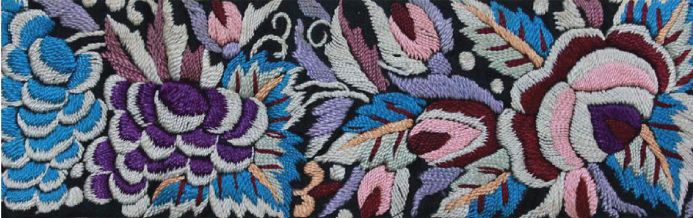
Indian Traditional Embroidery- How to Recognise-2


West India

Continued from Part-1


1. Gujarat Kutchh

Abla Bharat

Mochi Bharat

Soof Bharat

2. Parasi


Central India

1. Chikankari- Uttar Pradesh


2. Phoolpatti- Uttar Pradesh


3. Zardozi- Uttar Pradesh


South India

1. Kasuti- Karnataka


2. Lambani


East India

1. Kantha- West Bengal


2. Sujani- Bihar


3. Pipli Applique- Orissa


Buy my books at Amazon.com

Sunday, 27 March 2016

What are Dhalapathar Sarees


Dhalapathar sarees are woven in the Dhalapathar in Khurda district of Orissa. These are woven by Rangani community in the village.

Dhalapathar Saree
Source:http://www.parisera.com/


These are also known as Kusumi Kapta, Kankana Pedi, Muktapunji, Nahati and Akata.

The yarn is cotton and they are woven in 20s to 2/120s count. Sizing is done only when 20s or 26s yarn in used. With mercerised yarn, no sizing is required. It is woven in fly shuttle pit looms. Ground weave is plain. Cotton healds are used for each warp.

Figuring is done with extra warp. For that flat rectangular wooden pieces called "Chiaris" are used. However now frame looms and Jalas are also used. The designing is done using weft rib of either 4 up 1 down or 6 up one down.

The dyeing is done using synthetic dyes.

For more details please refer to this source. and this one.


Buy my books at Amazon.com

Saturday, 12 March 2016

Indian Traditional Embroidery - How to Recognise-1


A Structure of Traditional Embroidery in India:

The CBSE book on Indian traditional Textile has enumerated a structure to study Indian Traditional Embroidery. I am reproducing briefly the structure

North India

1. Kashida- Kashmir
2. Phulkari- Punjab
3. Chamba Rumal- Himachal Pradesh

West India
1. Gujarat Kutchh
2. Parasi

Central India

1. Chikankari- Uttar Pradesh
2. Phoolpatti- Uttar Pradesh
3. Zardozi- Uttar Pradesh

South India

1. Kasuti- Karnataka
2. Lambani

East India

1. Kantha- West Bengal
2. Sujani- Bihar
3. Pipli Applique- Orissa

The basic Takeaways from this book are as follows:

1. Kashidakari

- Practiced by Mensfolk
- Main stitches are darning stitch, stem stitch, satin stitch and chain stitch

There are three styles of Kashidakari

a. Sozni- Use fly stitch, stem stitch and darning stitch


b. Aari Style- This is also called Zalakdozi


c. Kashmiri Couching


Phulkari

The base material is khadi dyed in darker colors. Soft untwisted "Pat" silk is used for embroidery.

Basic stitch is darning stitch, done from the reverse side of the fabric. Outlining stem, chain and herringbone stitches are used.

One motif is left unembroidered or done in off color to ward of evil. This is called Nazarbuti.

There are two styles of embroidery:
a. Bagh- fully embroidered wrap- used on special occasion.
b. Phulkari- lightly embroidered- Daily use.''

Chamba Rumal

The base is either light mull or heavy Khaddar.
Embroidery is done using dyed, untwisted silk threads called "Pat"
Uses double satin stitch. Produces reversible fabric.


Will continue...

Buy my books at Amazon.com
Source

Saturday, 20 February 2016

Word Origins of Some Textile Terms


Cotton

Cotton originated in Arbic qutn, the name for cotton plant.

Silk

Word silk originated in Chinese si. Greek called Silk traders Seres, "silk people". This is the origin of the words like Sericulture and Serge. 

However, the 'l' rather than an 'r' came through Russian Shelk.

Linen

The word comes from old Germanic "lin" meaning "Flax"which is an origin of the words such as linseed.

It has contributed to other words such as Lingerie, crinoline, linoleum and lint. 

Wool

It came from Indo-European "wlna". the word flannel is related to it.

Source: Bloomsbury Dictionary of Word Origins by John Ayto.

Spinning

Spin comes from Indo-European Base "spen" which means to stretch. The logic seems to make sense as spinning essentially involves stretching or drafting of a strand of fibers.

The words span, spinster, spider, spill and spindle are related to it.

Weaving

The origin is from Germanic "Weben"- to weave. This is the source of the words wafter, wasp, web and weft. 

Dyeing

The source of this word remain unknown.

Printing

The origin comes from Latin "premere" meant press. The words impression are related to it.

Bleaching

The origin comes from Germanic base "blaik-"means to whiten. The words blight and blink are related to it.

Textile

Latin texere means to "weave" which came from Indo European base "tek-" to make. It is the origin of the words text, context, pretext, subtle, texture, tissue and toilet, technical and architect.

Cloth

The history of the word cloth is Germanic "kleid"- means garment.

Fabric 

The word fabric is related to carpenter. The origin is the word "Faber" which means a carpenter. Other related words are fabricate and forge.

Apparel

It has the same source as apparatus, which came from apparare "make ready". The other related words are parent and prepare.

Yarn

The root came from prehistoric German "garn" which is originated from Greek "Khorde"- sting. The other related words are chord and cord. 

Fashion

The word came from Latin factio "make" or "do". The words related to it are difficult, fact, faction and factory. 

Buy my books at Amazon.com

Total Pageviews