Wednesday, 28 September 2011

Effluent Treatment in Textile Industry-1


The idea for this topic is triggered by the news of discovery of treatment of textile effluent by a combination of biological and physico-chemical methods.

Speaking simply, the effluent control is effected by two approachs, physcial and chemical. However these methods are expensive and non effective. Using both biological and chemical methods, one can achieve effective effluent control. 

Read the full story here .

Industrial Textile processing comprises several processes which include pretreatment, dyeing, printing and finishing processes. Besides consuming large amount of energy and water, these processes generate lot of waste products.  

Generally the effluents generated in textile processes have the following shorcomings:

- Heavily Colored
- Contain High concentration of Salts
- Exhibit High BOD ( Biochemical Oxygen Demand) and COD ( Chemical Oxygen Demand)

Understanding COD and BOD

COD is the total measurement of all chemicals in the water that can be oxidised.  BOD is supposed to measure the amount of food ( or organic matter ) that bacteria can oxidise. Permissible limit of COD is 250 to 500 ppm and BOD is 30mg/l.

To explain it further, the microbes present in polluted water consume the dissolved oxygen for respiration and nitrification. These bacteria consume pollutants and then use dissolved oxygen to convert the pollutants into energy. Other bacteria consume ammonia to nitrate a process called nitrification. Please see the pictures here for illustration.

This is important to control COD and BOD as a water high in BOD can deplete oxygen in the receiving waters, causing fish kills and ecosystem damages. Low BOD also helps in further treatment.

A typical textile mills effluent has a pH of 9.8 to 11.8, Total alkalinity as CaCO3 17-22 mg per liter, BOD 760-900 mg/l, COD 1400-1700 mg/l, total solids 6000-7000 mg/liter and total chromium 10-13 mg/l.

Three methods are suggested to reduce pollution

1. Use of new, less polluting technologies
2. Effective Treatment of effluent
3. Recyling waste several times over before discharge. 

The following are the most common causes of generation of effluent wasts in textile industry:

Desizing

In general 50% of the water pollution is due to waste water from desizing. 

Problem with Effluent from Desizing

It has high BOD which renders it unsuitable. 

Solutions to Control

- Using enzymes that degrade starch into ethanol. This can be recovered by distillation
- Using oxidative system like H2O2 that degrade startch to CO2 and Water. 
- Using Electro-oxidation
- Treatment with Mixed activated Sludge system. 

In mixed activated sludge system, microorganisms are introduced which convert carbon in the effluent into suspended solids and carbon dioxide and water. The solids are then separated from the wastewater in the settling tank and then recovered.

As most of the dyes are not biodegradable, this method of using activated sludge is not always successful. 

Mercerisation

Problems:

The effluent has high concentration of NaOH

Solutions:

- Recovering NaOH from waste water using membrane techniques. 
- Use of Zinc Chloride during mercerisation

Source: 1

Now that you've finished reading this post, what are you going to do? You should join the Forum.

Sunday, 25 September 2011

Buti and Buta Motifs in Jodhpur Textile Printing


1. Sada:  This motif is used by Bishnoi community of Jodhpur.


2. Oul : This motif is worn by Chaudhari Community.


3. Ankuri : This motif is worn by Kalbelia and Jat Community

4. Makhi : This Motif is used by Choudhary community.

5. Gulbuta : This motif is used by Jain and Choudhary community


6. Kapa: This motif is worn by widows of Rabari Community


7. Bhalka: This motif is ued by Gadiya Luhar community.

8. Jali : This motif is used by Gadiya Luhar community


Now that you've finished reading this post, what are you going to do? You should join the Forum.

Saturday, 24 September 2011

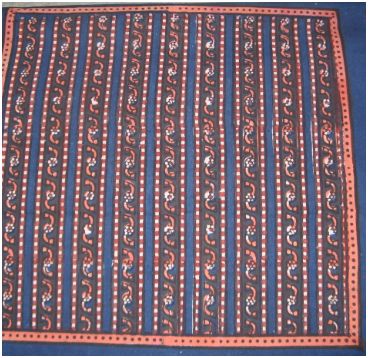
Traditional Striped Motifs in Jodhpur Textile Printing


Boriya

Boriya Motif- Used by Mali Kaum in Rajasthan
Ilaicha
Ilaicha Motif- Worn by Sirvi in Rajasthan
Jodhpuri Katar
Jodhpuri Katar- Worn by Rabari Kaum
Makoda
Makoda- Worn by Rabaris
Mehndi
Mehndi Motif- Worn by Sindhi Muslim- Ghagras
Methi
Methi Worn by Choudhari Community in Rajasthan
Nimboli
Nimoli Motif- Used by Choudhary Women in Jodhpur
Phooli
Phooli Worn by Rebari ( Raika) in Rajasthan
Rakhri
Rakhri - Worn by Rebaris in Rajasthan
Rata Katar
Rata Katar- Worn by Sirvis
Sada Chint
Sada Chhint- Worn by Vaishnav
Samundar
Samundar- Worn by Merat Kaum in Rajasthan

All these pictures are courtesy Mr. Chhipa Yasin- who has developed a bed sheet using thirty of these now-forgotten motifs.

Now that you've finished reading this post, what are you going to do? You should join the Forum.

Thursday, 22 September 2011

Motifs of Jodhpur Printing- Phetiya ( Fetia, Phetia)


Phetiya is one of the most popular motifs used in block printing in Jodhpur. There are various variations of Phetiya are available. Some of them are as given below:

1. Panihari Phetiya


In this motif, Indigo and Alizarin are prominent Colors. It is a traditional costume of Sirvi ( Chaudhary) Community in Rajasthan. The word Sirvi means share cropper (A sharecropper is a farmer who doesn't own the lands he farms). Sirvi people speak Marwari. The men wear cotton thread around their waist, called bell or dhaga, having eleven knots. They believe that this dhaga symbolizes their community deity Jagadhamba of Rajasthan.

2. Nanna Phetiya


It comprises of natural colors like Indigo, Alum, Haldi and Alizerin. Availability of good water enhances this kind of block printing. It is a favourite among the women in the Choudhari community who carry these prints in their traditional Ghaghras.

3. Genda Phetiya


The genda print is seen mostly in the traditional dresses of Rabari community. Some natural colors like alum or indigo are used in Dabu technique of printing.

4. Gunda Phetiya


The Gunda Phetiya kind of block prints are vividly seen in the traditional attires of the Mali Jat in Rajasthan. Simple yet unique prints with Shades of alizerin and indigo enhance the simplicity of the fabric.

5. Bavliya or Guddi Phetiya


The Bavliya kind of print is mostly seen in the traditional outfits of the women in the Choudhari ( Godwal)  community of Rajasthan. The prints are made with finely carved blocks using natural Colors.

Now that you've finished reading this post, what are you going to do? You should join the Forum.

Sunday, 18 September 2011

How Neel or Ultramarine Blue Whitens Fabrics


What is Neel? The Science of Ultramarine Blue in Washing White Clothes


Neel is a familiar household material used in the washing of white clothes. In many Indian homes, a small quantity of Neel is added during the final rinse so that white garments appear fresher and cleaner. Though it looks like a simple traditional practice, the science behind Neel is quite interesting.

The main blue substance used in traditional laundry blueing is generally Ultramarine Blue. It is not a dye, but a blue inorganic pigment. Chemically, ultramarine blue is based on a complex sodium aluminosilicate structure containing sulphur species. Its general composition may be represented approximately as:

\( \text{Na}_{8-10}\text{Al}_{6}\text{Si}_{6}\text{O}_{24}\text{S}_{2-4} \)

This formula is only approximate because ultramarine is not a simple single compound. It is better understood as a complex mineral-type pigment in which the colour-producing sulphur species are held inside a framework structure.

Why is it Called Ultramarine?

The word ultramarine comes from the idea of “beyond the sea.” Historically, the natural blue pigment was obtained from lapis lazuli, a semi-precious stone mined in Asia, especially Afghanistan, and transported to Europe through long-distance trade routes.

Because natural ultramarine was rare and expensive, it became one of the most valued pigments in art history. Later, synthetic ultramarine was developed, making this beautiful blue pigment much more affordable and widely available for industrial and domestic use.

Ultramarine Blue is a Cage Pigment

One of the most important research insights about ultramarine blue is that it has a sodalite-type cage structure. The framework is made of aluminium, silicon, oxygen, and sodium. Inside this framework, sulphur-based colour centres are trapped.

In simple words, ultramarine blue is like a tiny mineral cage:

\( \text{Aluminosilicate cage} + \text{Sulphur chromophores} = \text{Blue colour} \)

The aluminosilicate framework by itself is not responsible for the strong blue colour. The colour mainly comes from sulphur radical species such as:

\( S_3^- \quad \text{and} \quad S_2^- \)

These sulphur species are trapped inside the cage-like structure and act as chromophores, meaning they are responsible for the colour of the pigment. This is why ultramarine blue is considered one of the most fascinating inorganic pigments.

Simple explanation:
Ultramarine blue gets its colour not from an ordinary dye molecule, but from sulphur species trapped inside a mineral-like cage. This makes it different from most organic colouring materials used in textiles.

Why Do White Clothes Become Yellow or Grey?

White fabrics often lose their fresh appearance after repeated washing and use. They may become slightly yellow, grey, or dull. This can happen because of body oils, detergent residues, ageing of fibres, water hardness, dust, pollution, or repeated exposure to sunlight and washing conditions.

A white fabric appears white when it reflects most of the visible light falling on it. But when the fabric develops a yellowish tone, the reflected light is no longer visually balanced. The cloth may be clean, but it does not look fresh.

How Neel Makes Clothes Look Whiter

Neel works on the principle of colour correction. Blue and yellow are complementary in visual perception. When a very small amount of blue is added to a slightly yellowish white fabric, the yellow tone is visually neutralised. As a result, the fabric appears whiter to the eye.

\( \text{Yellowish white fabric} + \text{trace blue tone} = \text{visually whiter fabric} \)

This does not mean that Neel has chemically cleaned the fabric. It has not removed dirt or stains like a detergent or bleach. Instead, it has improved the perceived whiteness of the fabric by adjusting its colour balance.

Why Ultramarine Blue is Suitable for Laundry Blueing

Ultramarine blue is especially useful because it has a balanced blue tone suitable for correcting yellowish whites. Many blue pigments may have a greenish undertone, but ultramarine has a characteristic tone that helps neutralise yellow without making the fabric look harsh or unnatural when used in very small quantities.

The important point is that Neel must be used in trace quantity. Its purpose is not to colour the cloth blue. Its purpose is to correct the yellowish appearance of white fabric.

Neel is a Pigment, Not a Dye

A very important distinction is that ultramarine blue is a pigment, not a dye. A dye dissolves in water and has affinity for the fibre. A pigment does not dissolve in water. It remains suspended as fine particles.

Therefore, when Neel is added to water, it must be properly diluted and stirred. If the pigment particles are not evenly dispersed, they may settle or deposit unevenly, causing blue patches on the fabric.

During rinsing, some fine ultramarine particles get temporarily trapped on or near the surface of the fabric. These particles give the fabric a slight bluish correction. In the next wash, many of these particles are removed and new particles may deposit again if Neel is used. This makes the process partly self-correcting when used correctly.

The Role of Particle Size

Particle size is very important in the performance of ultramarine blue. In pigment science, finer particles generally give stronger tinting power and better dispersion. However, in laundry use, particles that are too fine may remain trapped in the fabric and create a gradual blue build-up.

If the particle size is extremely small, especially below about \(1 \, \mu m\), the particles may not wash out easily in the next washing cycle. This may slowly increase the bluish tone of the fabric. A particle size around \(2-3 \, \mu m\) is often considered more suitable for temporary deposition and removal during washing.

Practical point:
In Neel, chemistry gives the colour, but particle size decides how the pigment behaves on the fabric.

What Happens if Too Much Neel is Used?

If too much Neel is added, the fabric will no longer appear brilliantly white. Instead, it may develop a pale blue shade. This is a common problem when Neel is added directly to clothes or when it is not diluted properly.

To avoid this, Neel should always be diluted in water before the clothes are dipped. The water should be stirred well so that the pigment particles remain uniformly suspended. White clothes should then be dipped evenly and briefly.

If excess blueing occurs, repeated rinsing in clean water can reduce the blue tone. Traditionally, mild rinses using vinegar or lime water have also been used to help remove excess blue colour.

Whiteness and Brightness are Not the Same

Neel improves the whiteness appearance of fabric, but it does not truly increase brightness. This distinction is important.

Ultramarine blue works by reducing the yellowish appearance of fabric. In optical terms, it absorbs or masks part of the unwanted yellow component. Because of this subtractive action, the fabric may look whiter, but the total reflected light may not increase.

Brightness is improved by a different class of materials called optical brightening agents or fluorescent whitening agents. These materials absorb ultraviolet light and re-emit it as visible blue light. This makes the fabric appear brighter and more luminous.

Material How it Works Main Effect on Fabric
Neel / Ultramarine Blue Adds a slight blue tone and neutralises yellowish appearance Improves perceived whiteness
Optical Brightening Agent Absorbs ultraviolet light and emits visible blue light Improves brightness and luminous whiteness
Bleach Chemically destroys coloured impurities and stains Removes colour bodies and cleans stains

Stability of Ultramarine Blue

Ultramarine blue is generally suitable for alkaline washing conditions, which is useful because many soaps and detergents are alkaline. However, ordinary ultramarine blue is less stable in acidic conditions. Acids can damage the sulphur-containing colour centres and reduce the blue colour.

This is one reason why modern pigment research also studies acid-resistant forms of ultramarine blue. Improvements in synthesis, coating, and surface treatment can make the pigment more durable for different industrial applications.

Modern Research on Ultramarine Blue

Although Neel appears to be a simple household material, ultramarine blue continues to be studied in materials science. Researchers are interested in its structure, colour mechanism, particle morphology, acid resistance, and more sustainable methods of production.

Recent research has explored the preparation of ultramarine pigments from alternative mineral sources such as palygorskite. Such studies examine how raw material composition, sodium carbonate, sulphur ratio, firing conditions, and post-treatment influence the final colour and stability of the pigment.

This shows that ultramarine blue is not only a traditional laundry pigment, but also an important industrial inorganic pigment used in plastics, paints, rubber, paper, detergents, cosmetics, and conservation science.

Practical Guidelines for Using Neel

  • Use only a very small quantity of Neel.
  • Always dilute it in water before adding clothes.
  • Stir the water well to keep the pigment evenly suspended.
  • Do not pour concentrated Neel directly on fabric.
  • Dip the white clothes evenly and briefly.
  • Use Neel for white fabrics only, not coloured garments.
  • If blue patches appear, rinse repeatedly in clean water.

Conclusion

Neel is a beautiful example of practical household science. Its main pigment, Ultramarine Blue, is a complex inorganic pigment with a sodalite-type aluminosilicate cage structure. The blue colour comes mainly from sulphur radical species such as \(S_3^-\) and \(S_2^-\), which are trapped inside this mineral framework.

In laundry use, Neel does not clean the fabric chemically. It improves the appearance of white clothes by neutralising their yellowish tone through colour correction. The effect depends on correct dilution, good dispersion, proper particle size, and careful use.

Therefore, Neel should not be seen merely as an old-fashioned washing additive. It is a scientifically interesting pigment whose structure, colour mechanism, and fabric behaviour connect household practice with textile science, pigment chemistry, and materials research.

Source note:
This article is based on general textile chemistry concepts and research literature on ultramarine blue pigments, including studies on sodalite cage structure, sulphur chromophores such as \(S_3^-\) and \(S_2^-\), pigment particle size, laundry blueing, and the historical development of natural and synthetic ultramarine.

References and Further Reading

  1. Kowalak, S. et al. “Sulfur radicals embedded in various cages of ultramarine.” Journal of Solid State Chemistry, 2007.
    https://www.sciencedirect.com/science/article/abs/pii/S0022459607000217
  2. Gobeltz, N. et al. “Occupancy of the Sodalite Cages in the Blue Ultramarine Pigments.” Inorganic Chemistry, American Chemical Society.
    https://pubs.acs.org/doi/10.1021/ic010822c
  3. Å kvarlová, A. et al. “Preparation and characterization of ultramarine blue pigments.” Microporous and Mesoporous Materials, 2019.
    https://www.sciencedirect.com/science/article/abs/pii/S1387181119302665
  4. Farsang, S. et al. “\(S_2^-\) and \(S_3^-\) radicals and the \(S_4^{2-}\) polysulfide ion in lazurite, haüyne and synthetic ultramarine blue revealed by resonance Raman spectroscopy.” American Mineralogist, 2023.
    https://pubs.geoscienceworld.org/msa/ammin/article/108/12/2234/629853/S2-and-S3-radicals-and-the-S42-polysulfide-ion-in

Friday, 9 September 2011

Textile Analysis for Forensic Testing


Textile as used in Forensic Evidence

Fibers represent one of the forensic evidences known as trace evidence.

The forensic examiners must handle a victim with care, to minimize fiber loss. Retrieving the victim's clothing as soon as possible is very necessary to prevent as much fiber loss as possible. Fibers are typically collected using adhesive tape.

The following details are particularly noted when analysing fibers. This helps to determine the source of the fibers.

1. Fiber Type: The presence of less common fibers at a  crime scene or on the clothing of victim or suspect increases its significance.

2. Fiber Colors: It greatly influences the significance of fiber comparison. Fading and discoloration further adds significance to a fiber association.

3. Number of Fibers: The greater the number of fibers on the body of a suspect or victim,  the more is the likely hood of a direct contact between individuals, however converse may not be true.

4. Fabric type: Loosley knit or woven fabric or new fabric shed more fibers.

Source 12


Now that you've finished reading this post, what are you going to do? You should join the Forum.

A Note on Medical Textiles


Textiles act as an interface between man and treament. Depending upon the area of application, the medical textiles are categorises as Non-implantable, implantable and healthcare and hygiene products.

Non implantable material are external to the body, with or without skin contact. It includes absorbant pad, bandages and plasters among others. These material should have good padding characteristics and should be non sticking to the wound. Air and vapor permeability is requrired so that the material is comfortable to the patient. They should have high absorbancy and should be soft and pliable.

Implantable materials are used in place of defective body parts. It includes sutures and soft tissue implants. These materials should have compatibility with the natural body systems. They should be durable and resistant to alkali and acidic media. Of course, they should have functionality for the purpose for which they are applied.

Healthcare and hygine products are not directly used in medical treatment, rather they are used for good hygiene application and healthcare. It includes surgical clothing and surgical covers. They should have high bacterial and viral resistance. They should be hygienic and should have softness and breathablitity. They should have required strength.

Source of image: 1

Now that you've finished reading this post, what are you going to do? You should join the Forum.

Friday, 26 August 2011

Some Facts about Linen


1. Flax yarns and fabrics increase about 20% in strength on wetting. Linen is therefore stronger than cotton when it comes to washing.

2. Linen can absorb upto 20% of its own weight of moisture while still feeling dry to the touch. That explains why Linen cloth are always fresh and cool.

3. The tensile strength of Linen is twice as high as that of cotton and 3 times as that of wool.

4. Linen reduces gamma radiation almost by half and protects humans against solar radiation.

5. Linen Cloth does not accumulate static electricity- even 10% of linen in a blend is enough to eliminate the static electricity effect.

6. Heat conductivity of Linen is 5 times as high as that of wool and 19 times as that of silk. In hot weather, those dressed in Linen clothes are found to show the skin temperature 3-4 deg below those wearing silk and cotton.

 Among all the linens, Irish Linen is always known to be the best. Linen is an important fiber for Ireland, so much so that stamps and coins are minted showing linen leaves. Source


You can view the production process of Linen from here

Now that you've finished reading this post, what are you going to do? You should join the Forum.

Sunday, 31 July 2011

Varanasi Saris- Process Notes


Notes on Varanasi Silk Saris

A Scenic View of the Ganges

Warp and Weft

Loom- Note the two Jacquards
A Close-up view of the Cloth Roll
Rangkaat Sari - Different Colored weft - Interlock technique
Card for Jacquard- Not Interchangeable for other machines

Temple- 6 nails- Unlike Chanderi come from Below
Dyeing of Body and Palla
A View of the Karkhaana- No Jaalas anymore

The warp used is 20/22 denier filament silk. 20/22 is called so because normally a silk fiber is of 2 denier. When 11 such filaments are taken then it becomes 22 denier. However, while reeling one filament may get broaken which means the denier is 20. Hence it is called 20/22 denier. Apart from this 14/18, spun, tussar , 16/18 and Pashmina are also used in the warp. Weft normally used is Katan. Normally for plain weave base 4 heald shafts are used in groups of 2. For Tanchui with Satin base more heald shafts are used. Jacquards are used for extra weft figuring. There can be upto three jacquards, one for weaving body motif, one for palla and one to set Konia etc. Min. warp size can be two saris. Jacquard can be 120 hooks or 160 hooks depending upon the design. Cards cut for one jacquard cannot be interchanged for the other.

Zari

Zari comes in 220 grams bundle and the fineness is denoted by Gajas. If 220 grams has 1200 yards, it is called 1200 gaja if this bundle has 1750 yards, it is called 1750 Gaja. and if it has 3700 yards, it is called 3700 gaja. 1750 and 3700 yard zaris are most commonly used. Zari comes in four quality plastic, Powder, Tested and Real Zari. Plastic zari is also called Kalabattu. Poweder zari has a thinner coating then tested zari and plastic has a synthetic base. In all the zaris except Real, the copper wire is wrapped over a cotton, viscose or synthetic and it is coated with gold or silver. Generally tested zari is also called half fine zari. Also in powder zari the inner core is twisted rayon over which artificial gold color powder is super imposed to obtain the lustrous appearance.However this lace get blacken after some use.3700 Gaja tested Zari has polyester as a base ( 30 denier) with copper covering and siliver or gold electroplating. The thicker zaris has cotton as the core. The Silver coated zari is called Rupa and Gold coated sari is called Sona. The best zari suppliers are AVJ from Surat or Locat supppliers like Uma. Zari comes in three shades; dark, light and medium. To subdue the effect of zari, it can be twised with Resham and used.  An amazing presentation on Zardozi work can be seen here.

Dyes

Dyes used are acid and metal complex for silk and Vat/reactive for cotton.  The colors of Varanasi Saris are fast and no staining is observed.

Preserving Varanasi Saris

The best way to preserve a Varanasi Sari is to keep it in the Mull cloth ( no starch, washed). Plastic is not recommened. It should be dry cleaned.

Finishing of Varanasi Saris

Generally after sari is finished it is then passed through cold calendar to give it a sheen and delivered.  

Other Notes

Maximum weight variation in two Varanasi saris willl be 20-50 grams per sari. Organza sari is called Kora. 

Other Readings:
123

An interesting reading is about the use of Condoms in making Varanasi Saris


Now that you've finished reading this post, what are you going to do? You should join the Forum.

Monday, 25 July 2011

Technological Institute of Textile and Sciences, Bhiwani


It would be an injustice if I do not dedicate this blog to Technological Institute of Textiles(TIT), Bhiwani - the institute where I did my graduation from.

Image: http://www.titianslive.com

I joined the institute in 1990, barely knowing anything about textiles. At that time ( and I guess still now) the institute reverberated with anything related to textiles. I still remember the first lecture we attended of Revered Mr. Dhamija about Textile Raw Material. He seemed to be knowing everything about textiles ( which we found out later he actually did). I remember attending the lectures of Introduction to Textile Processes by Mr. Bhatnagar and Mechanism of Weaving by Mr.Arya. While we struggled our way to know about textiles, we got 'helped' a lot by our seniors who taught us short cuts to pass a particular course- which sometimes worked also. Textile Testing was taken care of by Mr. Punj and yes, it was Mr. Manuja who tried to run us throuh Engineering of Textile Structure. We were particularly influenced by Mr.R.K. Singh ( aka 'Raka') whose penchant for making graphs while teaching Synthetic fibers was particularly noted ( I remembered whenever he uttered "Rheology" and "Miscelles" while lecturing, I got so frustrated that I could not take any further notes ). Then came Mr.Tyagi and Mr.Sharma who tried to take us through to the subjects of Spinning and weaving respectively. Mr.KN Chatterjee made the subject of Fabric Structure very easy for us to learn. The best part about this institute is the mill attached to it which makes the whole process of learning very fast. 

TIT has a very good alumni following, with its ex students spread all across the globe. It has this organisation called TITOBA ( TIT Old Boys Association) which after girls started coming to the institute has become TITOSA (TIT old Students Association). TITOBA is a rather loose organisation with chapters all across the cities and regions of the world. Some attempts have been made to make to online. One of them is TITOBA on the NET by Mr. Dudeja, which has been a great effort. 

Now that you've finished reading this post, what are you going to do? You should join the Forum.

Total Pageviews