Sunday, 3 June 2012

Manufacturing of Powerloom 40s x 40s 72 x 68 Fabric


This fabric is woven on the border areas of Andhra Pradesh and Tamil Nadu states of India and has a widepopularity as a dress material for ladies ( Kurtis and Salwars). It has the potential to be printed or embroidered.

The count for this fabric is 40s  both warp and weft and constructions is 72 and 68. It is available in both 44 inches and 56 inches.

The following are the broad steps in making the fabric

1. Yarn is taken in hank form and is kept in water tanks for two days for them to wet properly. Then the yarn is scoured in hank form itself.

Label on a Hank Yarn


2. Yarn dyeing is done using either reactive or vat dyes. Yarn dyeing is done manually.
Color Kitchen

Dyeing Bath for Hank Yarn - Reactive Dyes
  

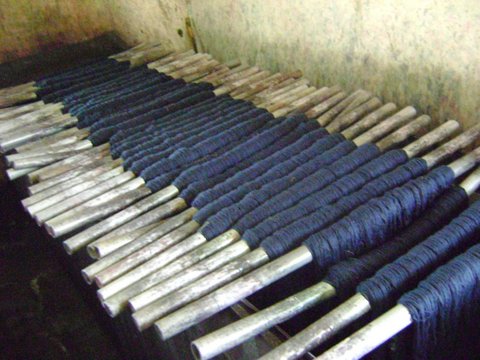
3. Yarn is then subjected to sizing using Maida and Gum as components. The yarn is subjected to alternate dyeing and sizing three times.
Yarn Being Dried after Sizing

4. Yarn is then prepared for warping using an ingenious creel and then wound onto a weavers beam using a conventional sectional warping machines. 


5. Pirns are prepared using an indigenous contraption.


6. Yarn is then worked on powerloom having warp stop and weft stop motion.


6. Primitive dobbies are used for woven and zari borders.
 
7. The yarn is then subjected to finishing using water, sometimes in a padding mangle using softner and desizing agent.


Thanks for your attention. Did you find the information you were looking for ? Please leave a comment. Do you need to know more ? Please suggest a topic in the comments. You can also join the Forum for your specific queries.

Sunday, 8 April 2012

Trip to Bhagalpur- Pureni and Miranchak Clusters


 Visit to Pureni 


Pureni, a place about 12 km from Bhagalpur, is known for its thicker deniers of Silks. At one time, it was feeding to a lot of exporters, but now only a few have remained.

A lot of government initiative has gone into the development of those clusters. One of those is the opening of several of these centers where handloom general facilities and dyeing facilities are provided.


In Pureni, a lot of weavers are working for master weavers based in Nathnagar and Bhagalpur. The picture below shows a Dupatta in Viscose and Dupion being woven for an exporter. 


A very heavy sheeny fabric is in demand for home furnishing. The picture below depicts one such fabric made in dupion. With a price of Rs. 500 plus per meter in production, it is turly for the discerning.


In handloom, different methods are used at different places to hold on the fabric. The picture below shows a typical cross style of gripping the fabric.


A look at the chamber dyeing machines at weavers service center. The machines are so new that it is evident that these are hardly used. 


A look at the sari woven at the service center. The motif is in Jamdani style, where the extra weft is inserted using big sewing needles.


Type of Yarns

This yarn is a single Matka yarn. Matka yarn is made from waste of Mulberry Silk


The yarn below is ghicha yarn from Pureni. Ghicha from Pureni is finer than that from Baghaiya.

The yarn below is a twist of Matka yarn and Dupion yarn.

Yarn below is called Matka Throwester Also called ( 27/1). It is made up from Waste of Katan Silk. It is also called Matka 85, as it was first used in 1985. Second picture is a close of the yarn. The yarn is very slubby and very soft.


The yarn below is the twisted Throwster ( 27/2).


The yarn below is Dupion yarn. Characterized by soft twist and feel, it adds sheen to any thing it is woven with. 


The fabric below is made up of Valkal, the yarn obtained from the link by which cocoon is held on the tree. Very costly.


Visit to Miranchak 


Picture below is that of a cho cho yarn. Generally it is made from waste silk. However the yarn below is that of viscose.


The picture below depicts the mat made out of cho-cho yarn.


A look at the weaver community there. 


A sari being woven there using polyester in weft.


A look at the school at Miranchak


A fabric using Matka 85+Dupion and matka.


Thanks for your attention. Did you find the information you were looking for ? Please leave a comment. Do you need to know more ? Please suggest a topic in the comments. You can also join the Forum for your specific queries.

Thursday, 15 March 2012

...they learned to spin and spool...Textile Songs


I happen to come across some of the songs written on the theme of textile mills. Sadly, almost all of them show the toil and hard work in a textile mills.

This songs depicts the plight of child workers used to work in the Textile Mills of America. A few lines (Source):

....Those babies all grew up unlearned, they never went to school.
They never learned to read or. write. They learned to spin and spool.
Every time I close my eyes, I see that picture still
When textile work was carried on by babies in the mill.... 


See the complete video here...


The other one, written on the Carolina Mills of Denim, depicts the similar theme of hard work at mills:


I am sure there are more. Looking forward to your suggestions.

Thanks for your attention. Did you find the information you were looking for ? Please leave a comment. Do you need to know more ? Please suggest a topic in the comments. You can also join the Forum for your specific queries.

Sunday, 11 March 2012

GK Questions on Apparels


The following Questions are taken from my son's GK book, who is in 8th Standard. Out of twelve questions, I could answer only two. Lets see how many can you answer:


1. A Welsh country town gave its name to a warm long sleeved woollen garment. Name it.

2. Smocking is a popular form of decoration on clothes. What is the name of the stitch in which smocking is worked ?

3. Which item of clothing did James Belcher give his name to in the nineteenth century.

4. What name is given to the thin veil worn by Muslin women in public ?

5. What was the name of the very narrow skirt introduced in 1910 which made it difficult for the wearer to walk?

6. An anorak is a long hooded jacket of skin or cloth. From what language does the word "anorak" come ?

7. Who would wear an Orphrey, Morse and Cope and carry a cozier ?

8. What is the name of the kind of pouch which Scotsmen wear in front of their kilts.

9. What is the name of a loose tunic worn in Arabia, Persia and Malaysia.

10. What were known as Oxford Bags ?

11. On which part of the body is a wimple worn and who would normally be seen wearing it ?

12. One of the British Channel islands gave its name to to a knitted woollen garment. Name it.

Answers


1. Cardigan
2. Honeycomb Stitch
3. Scarf
4. Yashmak
5. Hobble Skirt
6. Eskimo
7. Bishop
8.Sporran
9. Kabaya
10. Extremely wide bottomed trousers.
11. On the head, a nun
12. Jersey

Find more Quiz Questions here.  ( Please type "Dress" in the filter)

Thanks for your attention. Did you find the information you were looking for ? Please leave a comment. Do you need to know more ? Please suggest a topic in the comments. You can also join the Forum for your specific queries.

Total Pageviews