Tuesday, 18 October 2011

Common Printing Defects in Screen or Roller Printing


The following printing defects are frequently observed in screen or roller printing:

1. Scrimp

 During the printing process the fabric sometimes creases under one of the screen during the printing process. Thus the pattern is printed on the top of the screen. When the crease is removed, it leaves a large area of the fabric unprinted.

2. Misfit or Out of Registration

 A misfit is a defect caused when screens are not properly aligned. The misaligned screens can leave an area unprinted or cause the pattern overlap on one another.

3. Stick-in

A stick-in occurs when a small fiber or yarn get stuck in one of the screen openings. It can result is a small unprinted circle in the design of the size of the tip of a pen. A stick-in is very  difficult to see and often go unnoticed.

4. Wicking or Flushing

It occurs when the printed area bleeds out into the unprinted area. This results in a "haloing" or shadowing effect around the outline of the pattern design. Wicking is often caused by residual salts left in the fabric during  resign finishing or during fabric preparation.

5. Doctor Streak

It refers to a wavy white or colored streak in the fabric in the warp direction. It is called so because it is caused by damaged or improperly set doctor blade in the printing machine. A doctor blade is a metal knife that cleans or scrapes the excess dye from engraved printing rollers, leaving dye paste only in the valleys of engraved areas.

6. Mottled

It results from the color applied unevenly during printing

7. Printing Machine Stop

As a result of printing machine stop the dye sometimes is smudged along the width of the fabric.

An excellent description of defects in digital printing can be found here.

Thanks for your attention. Did you find the information you were looking for ? Please leave a comment. Do you need to know more ? Please suggest a topic in the comments. You can also join the Forum for your specific queries.

Monday, 17 October 2011

What are Plisse and Burnout Prints


Plissé Prints

The plisse prints are created by application of strong alkali to 100% cotton fabric. The alkali is applied in a pattern. After some time ( usually several minutes) the fabric is washed so that the alkali is removed. This results in the shrinkage of fabric from those areas where alkali is applied. This shrinkage causes puckering in the areas where alkali is not applied. A seersucker type appearance can be given to the fabric by applying the print pattern in parallel stripes. The alkali can be applied using direct or resist methods. 

http://ny-image0.etsy.com


Burn Out Prints

A beautiful "burn out" effect can be created by applying strong mineral acids or acid salts in the selected areas of a cotton polyester blended fabric. The acids will cause cotton to be destroyed and the polyeste rremains. Thus very beautiful lacey designs can be imparted to the fabric. Also in the burn out paste, a disperse dye can be incorporated which will also dye the polyester which burnout is taking place. However, due to the corrosive nature of the process special protections need to be taken.


Thanks for your attention. Did you find the information you were looking for ? Please leave a comment. Do you need to know more ? Please suggest a topic in the comments. You can also join the Forum for your specific queries.

Saturday, 15 October 2011

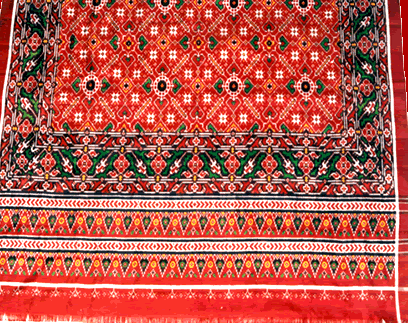
Motifs in Patola Saris


Ratanchowk


Kesar Chandan Design


Chhabdi Bhaat


Chanda Bhaat


Naari Kunjar Design


Five Phool Bhat


Three Phool Bhat


Sarvariya Bhat


Vora Gaji


Thanks for your attention. Did you find the information you were looking for ? Please leave a comment. Do you need to know more ? Please suggest a topic in the comments. You can also join the Forum for your specific queries.

My Notes about Textile Books: Fabric Analysis


An excellent book on fabric analysis can be found here. 

This book is unique is the sense, that it takes care to analyse the fiber contents in common fabrics.

It gives detailed explanation on the following (among others):

1. Distinguishing between cotton and silk, silk and linen
2. Distinguishing between Weighted and Normal Silk.

I haven't tested the chemical procedure described in the book. Users are advised their discretion. And yes, this book is quite old, so don't expect to find treatment on Synthetic fibers.

Thanks for your attention. Did you find the information you were looking for ? Please leave a comment. Do you need to know more ? Please suggest a topic in the comments. You can also join the Forum for your specific queries.

Total Pageviews