Textile Notes related to fiber, yarn, fabric knowledge, spinning, weaving, processing, projects, knitting, Indian Traditional Textiles and denim manufacturing
Saturday, 29 July 2017
Saturday, 18 February 2017
Photoblog- Visit to Textile Clusters of Indore, Dhar and Maheshwar
Route to Bagh is breathtaking. In the background are seen the windmills. The road is newly laid and extremely well built.
These are a common site in Bagh. The printing is done with natural colors and ingredients like myrobalan. The red is developed with Alum by boiling in Alizarin ( an ingredient of Alum). It is also known as alizarin printing. It is said that the minerals dissolved in the Bagh river provide that extremely rich red color to the fabric. The printing is done on cotton, chanderi, Maheshwari, Modal Tussar and Mulberry.
Printing is done with hand. All the three blocks gad, reikh and datta ( daat ) are used.
There are lots of words of wisdom you will find on the local shops, the above notice says "loan is a magic, we give you and you will get vanished....." so true sometimes !!!!
Visit to Maheshwar is inspiring. The township is reverberating with the sweet sounds of handlooms. A neat and clean place with an all pervasive presence of Ahilyabai Holkar dynasty, which is reflected in their philanthropic institutions.
Maheshwari is a fabric in silk and cotton. The difference from Chanderi, as we are told is in the count of weft and twist constructions of warp. In chanderi twisted yarn is used in the warp. Also in chanderi 100s count is used whereas in Maheshwari 80s count is used. But the real difference is in the woven border of chanderi, the inspiration from which is taken from the carvings of the Ahilyabai fort.
The picture above indicates the dobby used to create the famous Maheshwari Border.
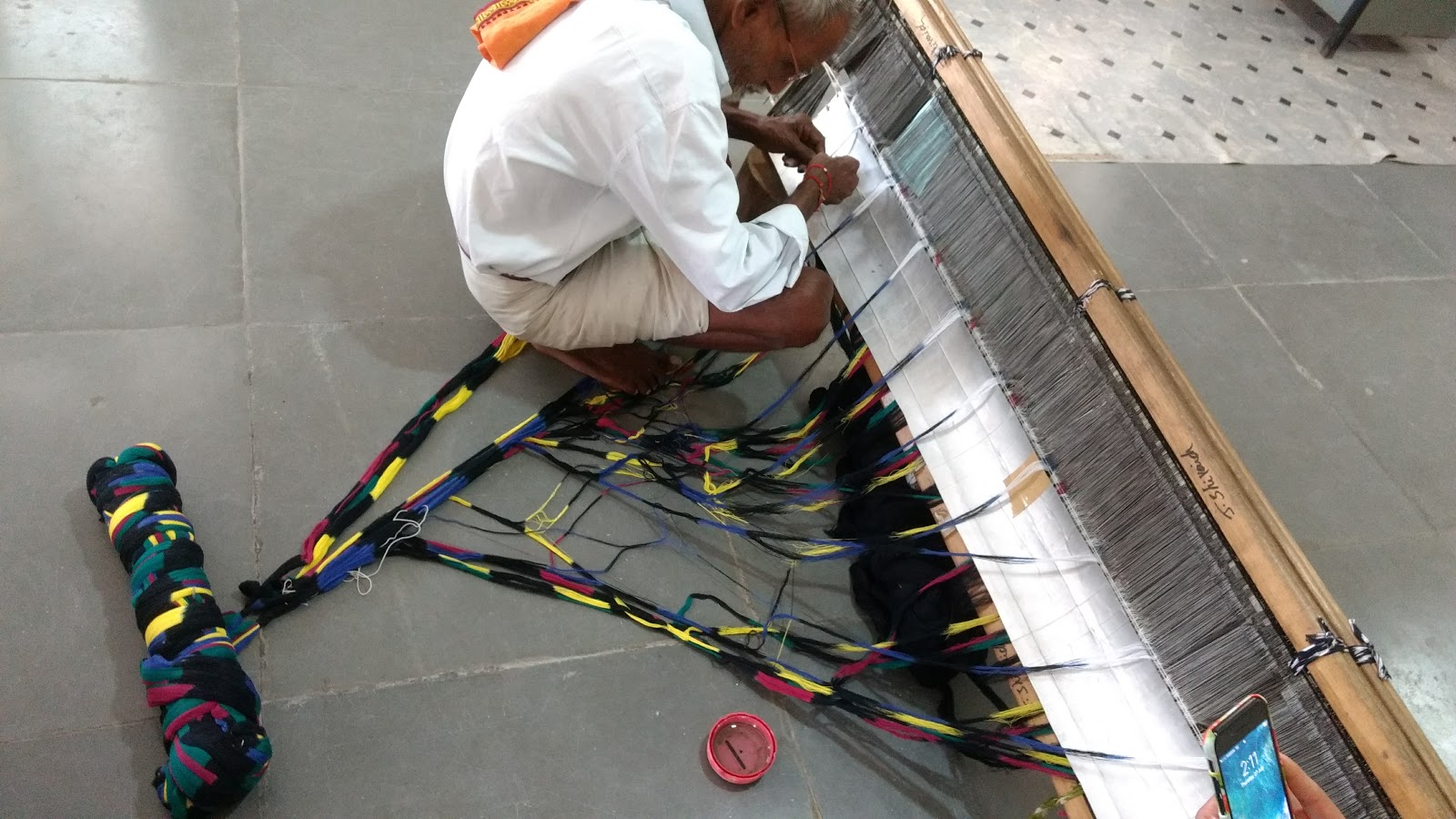
So the iron frames are used to hold the handloom together. Look at the way the warp are arranged.
Look at the way the indigenous drop box motion is provided on the loom to change the shuttle.
Here we can see that gears are finding their way in to handlooms to make the process of weaving faster and painless.
It was enlightening to address a group of weavers. A great job is done there by the Handloom School. It was amazing to see how this next generation of weavers is evolved to take on this e-commerce revolution.
Watching Narmada at the sunset was a treat
It was great to see ambar Charkha spinning Khadi at Womens Weaves
Back in Indore, chance to see the Indigo Alizarin Process of Tarapur Cluster
Chance to Meet Sattar Bhai, doing Dabu with hand block printing
This is not all, in the next blog will write about my learning on the various borders in Maheshwar.
Buy my books at Amazon.com
Wednesday, 28 December 2016
Two Million Page Views...and counting !! Thank you Readers !!!
I thank all my viewers for helping the blog reach this magical figure. Your constant encouragement, feedback and suggestions help me keep on writing !! Thanks a lot !!!
Buy my books at Amazon.com
Why Handlooms are Dying in India- An Economic Argument
This is an adaptation to the answer to the post submitted on facebook by a reader:
Buy my books at Amazon.com
Some people say that handlooms in India are dying and the reason is the emergence of powerloom and MNREGA. I agree with them that there is an imminent
death of the handloom sector, but the reasons are different than what they site. Powerlooms and MNREGA are just alternatives they have for the handloom. The reasons are purely economic. One, switching of weavers from
handloom to powerloom is just analogous to our switching to smart phone from
your old phone for the simple reason that it is more efficient and productive. So
a weaver, when he finds that the product of a powerloom is not so much
different or even better from the point of view of the returns for his family,
he will switch to alternatives like any rational human being. Running a powerloom is not as as simple that one relegate the task to some less
skilled person. A break in powerloom whether warp or weft can ruin a whole
product for the simple reasons that by the time it is noticed and the machine
is stopped, a lot of picks have already gone by resulting in a patta or chira
as the case may be- of course I am talking about the primitive powerlooms
prevalent in our country without the warp or weft stop motions.
They also say that to protect the handlooms they are offering weavers twice the usual wages. However, their offering of double or even triple wages
help a little, as their baseline wages are so small in relation to the effort
involved that doubling or tripling may not help much.
Khadi sector is already diluted as the “amber
charka” is like a mini ring frame taking its inputs from the mill product-
roving. Only difference is that it has more defects and it is S-twisted.
Genuine Charkhas produce so little that it is only used on the national days.
I
feel it is our greed- the high profile elite consumers- that we let the weavers
stick to the handloom when they have much better alternatives including
powerloom. Let us not bind them into their age old professions for our greed by
throwing them with yarn subsidies and increments in wages which are abysmally
low as compared to their efforts. And they are realising that which is the
effect you are witnessing across all the clusters. We need to remember that
while business is talking numbers, they are also understanding numbers and
taking actions which are good for their survival. Lets not make them the slaves
of the handloom in th name of protecting the handlooms.
Buy my books at Amazon.com
Saturday, 24 December 2016
What is the Most Eco-friendly Fiber
How do we measure Eco-friendliness
A worldwide known measure is the estimation of Carbon Footprint for a particular activity. Carbon Footprint is the amount of carbon dioxide released into the atmosphere as a result of the activities of a particular individual, organization, or community.
Measuring carbon footprint of textiles fibres involves the energy needed to make that fiber and then energy needed to weave that fiber into the yarn.
The following table gives an idea:
Energy used in MJ per kg of fiber
1. flax fiber: 10
2. Cotton: 55
3. Wool: 63
4. Viscose: 100
5. Polypropylene: 115
6. Polyester: 125
7. Acrylic: 175
8. Nylon: 250
Interestingly Cotton emits 5.90 ton of CO2 per ton of spun fiber. The same values for organic cotton ( India) are 3.80 and 2.35 respectively.
Thermal energy required per meter of weaving of cloth is 4,500-5,500 Kcal and electrical energy required per meter of cloth is 0.45-0.55 kwh and is independent of the nature of fiber.
Processing of fibers, however, use a lot of chemicals and copious amount of water.
Source
http://timeforchange.org/what-is-a-carbon-footprint-definition
https://oecotextiles.wordpress.com/2011/01/19/estimating-the-carbon-footprint-of-a-fabric/
Buy my books at Amazon.com
A worldwide known measure is the estimation of Carbon Footprint for a particular activity. Carbon Footprint is the amount of carbon dioxide released into the atmosphere as a result of the activities of a particular individual, organization, or community.
Measuring carbon footprint of textiles fibres involves the energy needed to make that fiber and then energy needed to weave that fiber into the yarn.
The following table gives an idea:
Energy used in MJ per kg of fiber
1. flax fiber: 10
2. Cotton: 55
3. Wool: 63
4. Viscose: 100
5. Polypropylene: 115
6. Polyester: 125
7. Acrylic: 175
8. Nylon: 250
Interestingly Cotton emits 5.90 ton of CO2 per ton of spun fiber. The same values for organic cotton ( India) are 3.80 and 2.35 respectively.
Thermal energy required per meter of weaving of cloth is 4,500-5,500 Kcal and electrical energy required per meter of cloth is 0.45-0.55 kwh and is independent of the nature of fiber.
Processing of fibers, however, use a lot of chemicals and copious amount of water.
Source
http://timeforchange.org/what-is-a-carbon-footprint-definition
https://oecotextiles.wordpress.com/2011/01/19/estimating-the-carbon-footprint-of-a-fabric/
Buy my books at Amazon.com
Thursday, 8 December 2016
Technology of Charkha Spinning
This document is for textile technologist. You can download it from here or from here.
Buy my books at Amazon.com
Wednesday, 7 December 2016
What is the difference between Khadi and Handloom
Khadi means a cloth woven on Handloom using Hand –Spun Yarn. Handloom means cloth woven on Handloom using Mill-spun yarn.
Khadi cloth is generally much more porous. This gives Khadi a soft and well ventilated feel. The twist of the hand woven yarn is generally less than that of mill yarn. This less twist helps improve its absorption properties.
Yarn spun on Charakhaa has a twist in the direction of letter 'S'. If we twist the yarn in the direction of normal tightening of the right handed screw, the yarn gets more twist. ( The mill yarn has an opposite twist in the direction of letter 'Z').
Interestingly the count of Khadi is measured in km/kg or N/m. The general relationship between Nm and English count is 0.59 x Nm. Thus khadi that is sold in the khadi store as 250s count khadi is actually 250 x 0.59= 147s count, which is also very good.
Generally 1 meter of roving is converted to 20 m of yarn for Amber charkha.
It would be curious to know that one tree yields 1-2 kg of raw cotton. 40% of it can be used for spinning. As a thumb rule, from 1 kg of yarn of 40s count we can weave 7 to 8 sq meter of cloth ( of course, it also depends upon the reed and pick).
As a trivia, it takes 5-6 hours on Amber charkha to make a yarn required from 1 sq meter of cloth. One weaver family can weave about 200-250 meters of cloth per month.
Source
Watch this movie on Khadi
and this movie
This movie narrates self employment through Khadi:
http://www.kvic.org.in/kvicres/images/KHADI_Englilsh_Compress.mp4
Buy my books at Amazon.com
Khadi cloth is generally much more porous. This gives Khadi a soft and well ventilated feel. The twist of the hand woven yarn is generally less than that of mill yarn. This less twist helps improve its absorption properties.
Yarn spun on Charakhaa has a twist in the direction of letter 'S'. If we twist the yarn in the direction of normal tightening of the right handed screw, the yarn gets more twist. ( The mill yarn has an opposite twist in the direction of letter 'Z').
Interestingly the count of Khadi is measured in km/kg or N/m. The general relationship between Nm and English count is 0.59 x Nm. Thus khadi that is sold in the khadi store as 250s count khadi is actually 250 x 0.59= 147s count, which is also very good.
Generally 1 meter of roving is converted to 20 m of yarn for Amber charkha.
It would be curious to know that one tree yields 1-2 kg of raw cotton. 40% of it can be used for spinning. As a thumb rule, from 1 kg of yarn of 40s count we can weave 7 to 8 sq meter of cloth ( of course, it also depends upon the reed and pick).
As a trivia, it takes 5-6 hours on Amber charkha to make a yarn required from 1 sq meter of cloth. One weaver family can weave about 200-250 meters of cloth per month.
Source
Watch this movie on Khadi
and this movie
This movie narrates self employment through Khadi:
http://www.kvic.org.in/kvicres/images/KHADI_Englilsh_Compress.mp4
Buy my books at Amazon.com
Sunday, 2 October 2016
What is Khana or Khunn Saree Blouse Fabric
Guledgudd Khana is the name of the fabric which has obtained the Geographical Indication ( GI) Registration.
The small design motifs are a speciality of these fabrics. These designs are produced using extra threads and make the motifs appear bolder and enhance the attractiveness of the fabrics.
The basic raw material is silk, viscose and cotton yarn. However, increasingly polyester is also used. Dyeing of cotton and silk yarn is done in open using firewood. Indigo dyeing using buried earthern pots is also practised.
Street sizing is practiced. Weaving of the Khana requires a dobby attachment in both handlooms and powerlooms. The handlooms are either pit looms or plain looms. These are narrow width looms of 32 to 36 inches width.

Guledgudd is a cluster of villages in the Badami area of Bagalkot district of Karnataka. This is a great compliment to Ilkal sarees and other sarees also woven in Karnataka. Most of the designs are replicas of Suranarayana Mukta ( Sun God), Siddeswar Mukta ( Siddeswara God), Theru ( Chariot), Ane Hejje ( Footsteps of elephants), Tulsi Pan or Sooji Mallige ( Frangrance Giving Flower).These are woven by Devanga and Veerashaiva community.
The structure of a khunn Fabric is like this:
1. Extra Warp: It is usually in viscose with yarn count of about 75/2. Sometimes silk of 16/18 denier is also used.
2. Ground Warp: It is usually of silk of 16/18 denier or polyester 80s or 30s count.
3. Border Warp: It is usually of silk of 16/18 denier or polyester 80s or 30s count. Sometimes mercerised cotton of 120s count is also used.
4. Weft: Most of the time it is of cotton of 40s or 60s count.
A few of the designs:
Reference
Buy my books at Amazon.com
The small design motifs are a speciality of these fabrics. These designs are produced using extra threads and make the motifs appear bolder and enhance the attractiveness of the fabrics.
The basic raw material is silk, viscose and cotton yarn. However, increasingly polyester is also used. Dyeing of cotton and silk yarn is done in open using firewood. Indigo dyeing using buried earthern pots is also practised.
Street sizing is practiced. Weaving of the Khana requires a dobby attachment in both handlooms and powerlooms. The handlooms are either pit looms or plain looms. These are narrow width looms of 32 to 36 inches width.
Guledgudd is a cluster of villages in the Badami area of Bagalkot district of Karnataka. This is a great compliment to Ilkal sarees and other sarees also woven in Karnataka. Most of the designs are replicas of Suranarayana Mukta ( Sun God), Siddeswar Mukta ( Siddeswara God), Theru ( Chariot), Ane Hejje ( Footsteps of elephants), Tulsi Pan or Sooji Mallige ( Frangrance Giving Flower).These are woven by Devanga and Veerashaiva community.
The structure of a khunn Fabric is like this:
1. Extra Warp: It is usually in viscose with yarn count of about 75/2. Sometimes silk of 16/18 denier is also used.
2. Ground Warp: It is usually of silk of 16/18 denier or polyester 80s or 30s count.
3. Border Warp: It is usually of silk of 16/18 denier or polyester 80s or 30s count. Sometimes mercerised cotton of 120s count is also used.
4. Weft: Most of the time it is of cotton of 40s or 60s count.
A few of the designs:
| Deepa |
| Kalawar Balli |
| Karamantikki |
| Kavalihuva Putani |
| Navalpari |
| Suryanarayana Sudarshna |
| Kolu Teru |
| Bairihuwu |
Reference
Buy my books at Amazon.com
Sunday, 12 June 2016
Jamnagri Bandhani
Jamnagri Bandhani Technique is an ancient tie-and-dye technique practised in the regions of Saurashtra and Kutchh in Gujarat of India.
In this process, the fabric is tied in various patterns using nails, beads or grain which prevent the color from coming in these tied areas during dyeing.
You can go through the complete process here. However, briefly the process is as follows:
a. The bleached cloth is printed with design using wooden blocks.
b. The cloth is then rolled and tied using thick threads, wound usually an interval of one inch. The process is done by women. The dots to be resist dyed are pushed up from the reverse side of the cloth by the nails of artisan's left small finger, then the heads of the pushed up parts are tightly tied in knots. Cotton threads are used for knots.
c. Then dyeing commences. The first shade before tying is yellow shade. Then it is dyed in other colors.
A few of the products using Jamnagri Bandhani Technique are mentioned here
1. Panetar
Panetar is a white saree with red tie-dye border. Traditionally in Gujarat region, the wife wears panetar saree gifted from her mother's brother. Later she wears the Gharchola sari gifted by her in-laws.
2. Gharchola
Gharchola is white and yellow tie-dyed on a red background with checked pattern of gold plated thread. It has auspicious patterns like elephant, flowers and mango.
3. Virbhol
4. Barbaug
Sources: 1 2 3 4 5
Buy my books at Amazon.comIn this process, the fabric is tied in various patterns using nails, beads or grain which prevent the color from coming in these tied areas during dyeing.
You can go through the complete process here. However, briefly the process is as follows:
a. The bleached cloth is printed with design using wooden blocks.
b. The cloth is then rolled and tied using thick threads, wound usually an interval of one inch. The process is done by women. The dots to be resist dyed are pushed up from the reverse side of the cloth by the nails of artisan's left small finger, then the heads of the pushed up parts are tightly tied in knots. Cotton threads are used for knots.
c. Then dyeing commences. The first shade before tying is yellow shade. Then it is dyed in other colors.
A few of the products using Jamnagri Bandhani Technique are mentioned here
1. Panetar
Panetar is a white saree with red tie-dye border. Traditionally in Gujarat region, the wife wears panetar saree gifted from her mother's brother. Later she wears the Gharchola sari gifted by her in-laws.
2. Gharchola
Gharchola is white and yellow tie-dyed on a red background with checked pattern of gold plated thread. It has auspicious patterns like elephant, flowers and mango.
3. Virbhol
4. Barbaug
Sources: 1 2 3 4 5
Monday, 23 May 2016
My New Book on Indian Saris
My new book on Indian Saris is out. This is the second volume. Please let me know your feedback.
Buy my books at Amazon.com
Saturday, 21 May 2016
Basic Quality Parameters of Handloom Products including Sarees
India Handloom is an initiative by the Ministry of Textile to bring the best of the handloom products to the users. They have produced a table of the basic quality parameters of the handloom fabrics, specifically sarees.
It is useful for buyers of traditional sarees who would like to know the quality parameters such as count, constructions, length, width and fabric for Indian traditional sarees.
7 August is celebrated as the National Handloom Day.
To download, you can go to this link or this link.
They have also published a list of registered users which can be a treasure for any sourcing professional.
Buy my books at Amazon.com
Sunday, 15 May 2016
Charkha or Hand Spinning Wheel
Charkha is not only synonymous with Khadi, it is also the soul of Indian Subcontinent. It reminds one of the good old villages and the simple life there. One cannot just love but feel from one's core this heart rendering song from Ustad Nusrat Fatah Ali Khan in Punjabi. I have give the translation in English.
This is an ode to Charkha from Rahet Fatah Ali Khan
A Beautiful song from Harjit Harman
And of course - there is a spinning wheel at every corner ( Chappa Chappa Charkha Chale)
There are many, the fact remains that spinning wheel has penetrated deep from culture to our hearts.
Buy my books at Amazon.com
Listen to this song from great mastero here...
Translation ( Source)
Listen oh sound of the spinning wheel I remember my love, my heart laments for my beloved...
When will the new moon of my love rise When will you come home beloved Sorrows are intolerable and life hopeless...
when beloved arrives I will rejoice I will unfurl my glances in his direction This separation is life threatening ...
relatives have started hurting with their words do write letter with the date of your arrival dark night bites hurting with its sting...
my tears keep flowing constantly as I gather the thread spundo not like laughter these days how can I forget his behavior...
Charkha is embedded in the Sufism of our subcontinent, from Kabir to now...it is a source of inspiration of many songs. Listen to this song from Lakhwinder Wasdali and Puran Sing
This is an ode to Charkha from Rahet Fatah Ali Khan
A Beautiful song from Harjit Harman
And of course - there is a spinning wheel at every corner ( Chappa Chappa Charkha Chale)
There are many, the fact remains that spinning wheel has penetrated deep from culture to our hearts.
Buy my books at Amazon.com
Monday, 25 April 2016
Patteda Anchu and Gamcha Sarees
I had the privilege to attend the launch of Patteda Anchu and Gamcha Sarees in Bangalore. It is amazing to find that there are so many kinds of art and craft of this country that are still getting discovered.
Patteda Anchu
I met Hemlatha Jain, who has done this commendable work of reviving the Patteda Anchu Sarees which are in records since the 10th century. As a part of her PhD project, and with a support from Dastkari Haat Samiti, she was able to get these sarees produced for the first time. She recalled how she learnt Kannada to communicate with weavers.
Briefly speaking, the saree is named after the borders and check patterns. It is also known as dundina, devaru or laxmi sare.
Speaking on the technical aspects of it, she told us it is woven in the count combinations of 20s x 40s cotton yarn. The typical length of one warp is six sarees and is woven on the traditional pit looms. She used cold reactive dyes to dye the yarns, which are then woven with three shuttle technique.
Gamcha Sarees
These have their own story of the revival. On a trip to Phulia, Jaya Jetly of Dastkari Haat Samiti found that there were beautiful Gamchas woven in the areas of Nabadweep. The weavers used to get a pittance while weaving these. She thought it would be great if these Gamchas are woven into sarees so as to ensure its wider reach as well as ensuring a better livelihood for weavers. At the same time she did not want to put these sarees out of reach of common masses. So she started discussion with Ankit, a NIFT graduate, who in his remarkable way, had to convince the weavers to set the sarees. He not only gave them designs but also technical inputs on how to weave the sarees. Finally the first set of sarees came and are sure to create waves among the consumer communities.
The typical length of warp is 100 Sarees which are then distributed over four looms with 25 sarees on ach loom.
Subscribe to:
Posts (Atom)


