Showing posts with label Linen. Show all posts

Sunday, 22 November 2009

Identification of Natural Fibers by Burning Test


Identification of Natural Fibers by Burning Test


Cotton

When cotton is brought near the flame it scorches and ignites readily. In the flame it burns quickly with yellow flame. Upon removing from flame it continues to burn rapidly and shows afterglow. It emits a smell of burning paper. The Ash is light, feathery and grayish. If the ash is black it denotes mercerized cotton.

Linen

Linen like cotton when brought near the flame scorches and ignites easily. In the flame it burns slower than cotton with yellow flame. Upon removing from flame it continues to burn with a smell of burning paper. The ash residue is feathery and gray.

Wool

Wool when brought near the flame smolders. In flame it burns with small and slow flickering flame. Also in flame it sizzles and curls. When removed from flame it ceases to burn. The Odor is like that of burning feather or hair. It gives crisp, dark and irregular shaped ash that can be crushed easily.

Pure Silk

Pure silk smolders when brought near the flame. In the flame it burns slowly with sputtering. When removed away from flame it continues to burn but with difficulty and ultimately extinguishes. The smell that is emitted is like that of burning feathers or hair but it is less pronounced than wool. It gives out a round, crisp, shiny black beads that can be crushed easily.


Weighted Silk

Weighted Silk smolders when brought near the flame. In the flame it burns with a glow. When removed from flame the burned part becomes briefly incandescent then it slowly chars. The smell is like that of pure silk i.e. burning feather or hair. The ash brings a screen like skeleton of original sample.

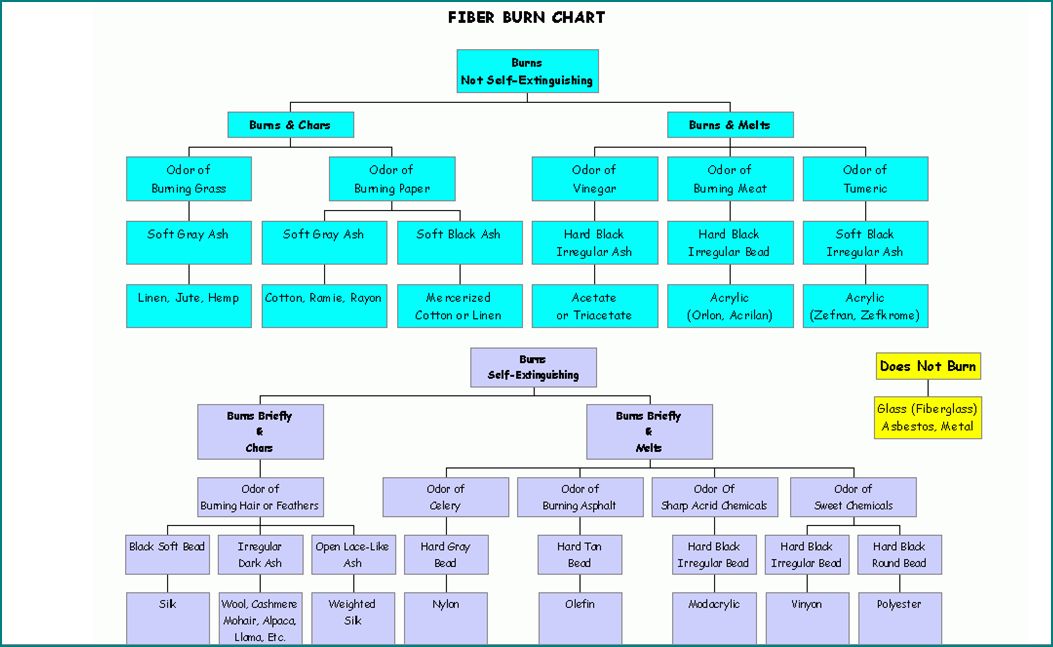
The following guide is very handy in identifying the fibers by burning test:


Now that you've finished reading this post, what are you going do? You should go join the Forum.
Reblog this post [with Zemanta]

Wednesday, 29 August 2007

Selling Points of Different fibres-1


Selling Points of Different Fibres


Every textile fibre has its own personality. Some fibres are valued for comfort, some for luxury, some for warmth, some for strength, and some for technical performance. For textile students, merchandisers, designers, buyers, and retailers, it is useful to understand fibres not only by their technical classification, but also by the benefits they offer to the final user.

A fibre’s selling point is the reason why a customer, designer, or manufacturer may prefer it over another fibre. Cotton is sold for comfort, silk for luxury, wool for warmth, nylon for strength, polyester for easy care, and spandex for stretch. In this way, fibre knowledge becomes a practical tool for fabric selection, product development, merchandising, and retail selling.

Cotton: The Comfortable and Economical Fibre

Cotton is one of the most widely used textile fibres because it is economical, versatile, comfortable, absorbent, durable, and easy to care for. It is suitable for shirts, dresses, sarees, bedsheets, towels, denim, children’s wear, innerwear, and summer garments. Cotton feels pleasant against the skin and is especially useful in hot and humid climates because of its moisture absorbency. CottonWorks notes that cotton is well suited for apparel and home textiles because of its combination of strength, durability, comfort, and temperature resistance.

The main selling point of cotton is everyday comfort. It may wrinkle more than some synthetic fibres, but consumers still accept cotton because it feels natural, breathable, familiar, and skin-friendly.

Linen: The Cool and Hygienic Fibre

Linen is made from flax and is valued for its cool touch, crisp handle, natural freshness, and hygienic character. It is a vegetable fibre and is especially suitable for summer clothing, shirts, dresses, trousers, sarees, table linen, napkins, and premium lifestyle products. Linen fibres are longer and stronger than cotton, and linen becomes stronger when wet, which makes it suitable for repeated laundering.

Linen wrinkles easily, but its wrinkles are often accepted as part of its natural charm. In fashion, linen is not expected to look perfectly pressed all the time; instead, it communicates relaxed elegance. Its selling point is cool, crisp, clean comfort.

Silk: The Luxurious Fibre

Silk is valued for its beauty, lustre, softness, drape, and graceful appearance. It can be made into sheer, dainty, rich, heavy, or elaborate textures depending on yarn, weave, and finishing. Silk drapes beautifully in graceful folds and gives garments a refined appearance. It is also warm in proportion to its weight, which means that a relatively light silk fabric can still feel comfortable and protective.

Silk is one of the strongest natural fibres in commercial use and has a special place in luxury textiles. In Indian textiles, silk is associated with Kanjivaram, Banarasi, Paithani, Patola, Muga, Tussar, Baluchari, Mysore silk and many other traditional fabrics. Its selling point is not merely softness; it is richness, elegance, and cultural value.

Wool: The Warm and Comfortable Fibre

Wool is best known for warmth, softness, comfort, elasticity, and attractive appearance. Wool fibres have natural crimp and bulk, which help trap air within the fabric structure. Since still air is an excellent insulator, wool fabrics are able to provide warmth without needing to be extremely heavy. Wool can also absorb and release moisture vapour, which contributes to its comfort in changing climates.

Woollen fabrics made from shorter, more elastic fibres and slack-twisted carded yarns often have a fuzzy, hairy, and cushion-like surface. They are warm, soft, and comfortable. Wool also takes deep and rich colours well, and its draping quality makes it useful for shawls, coats, suits, blankets, sweaters, carpets, and winter accessories. Its selling point is intelligent warmth with comfort.

Worsted: The Firm and Tailored Wool Fabric

Worsted fabrics are made from longer wool fibres that are combed, aligned, and spun into tighter, smoother yarns. Compared with woollen fabrics, worsteds have a firmer handle, harder surface, clearer appearance, and better crease retention. They are commonly used for suits, trousers, formal wear, uniforms, and tailored garments.

The selling point of worsted is smartness and durability. Because of the longer fibres, higher yarn twist, closer weave, and cleaner surface, worsted fabrics keep their shape well and are easier to keep pressed. They are ideal when a garment must look neat, formal, and structured.

Rayon and Acetate: The Beautiful Man-Made Cellulosic Fibres

Rayon and acetate are man-made fibres derived from cellulose. They are valued because they can imitate the look and feel of natural fibres such as silk, cotton, or linen, depending on how they are manufactured and finished. They take dyes well, can produce attractive colours, and are often used in dresses, linings, blouses, scarves, saree-like fabrics, fashion fabrics, and decorative textiles.

Acetate is especially valued for its beauty, lustre, and graceful drape. It should be ironed carefully with a warm iron rather than a very hot one. Rayon and acetate may lack the elasticity of some fibres, so garments can sometimes bulge or break at points of strain. Their selling point is attractive appearance, smooth handle, and the ability to create natural-fibre-like effects at accessible price points.

Nylon: The Strong Fibre

Nylon is known for strength, elasticity, toughness, abrasion resistance, quick drying, and durability. It is useful in hosiery, activewear, swimwear, sportswear, luggage, ropes, carpets, technical textiles, and performance apparel. Nylon filaments can be very strong while still being light in weight, which is why nylon hosiery can be sheer yet durable.

Nylon does not mildew easily, can be dyed, dries quickly, and can be heat set. This makes it useful for products that need flexibility, strength, shape retention, and resistance to wear and tear. Its selling point is lightweight strength with excellent wear performance.

Acrylic: The Warm, Lightweight Wool-Like Fibre

Acrylic is often used as a wool-like synthetic fibre. It is soft when made from spun yarn, warm when made into high-bulk yarn, bulky without being very heavy, and comfortable in many winter products. It is used in sweaters, shawls, blankets, socks, fleece-like fabrics, knitwear, and winter accessories.

Acrylic can create varied textures and attractive colours. It has good resistance to sunlight and is generally easy to care for. It may not have the same moisture management or luxury feel as wool, but it is useful where a warm, lightweight, wool-like effect is required at a more accessible price. Its selling point is warmth without heaviness.

Modacrylic: The Soft, Fleecy and Fur-Like Fibre

Modacrylic fibres are warm, soft to touch, resilient, and useful where a fur-like or pile surface is required. They are used in faux fur, wigs, coat collars, mittens, toys, furnishings, protective textiles, and stuffing applications. Since they are non-absorbent, they do not weaken or flatten easily in some end uses.

Modacrylics are also valued for resistance to sunlight, flame, inorganic acids, bacteria, and abrasion. Their selling point is a soft, fleecy, fur-like appearance combined with functional resistance properties.

Polyester: The Easy-Care and Wrinkle-Resistant Fibre

Polyester is one of the most commercially important fibres because it is wrinkle resistant, strong, light in weight, durable, easy to care for, and resistant to dirt, stains, moisture, sun, abrasion, and moths. It can remain smooth and crisp-looking even in humid weather, which makes it suitable for garments that need easy maintenance.

Polyester is used in shirts, sarees, dress materials, sportswear, uniforms, curtains, upholstery, home textiles, technical textiles, and blends with cotton, viscose, wool, and other fibres. It dries quickly and often needs little or no ironing. Its selling point is durability, easy care, and shape retention.

Vinyl Plastic Fibres: The Tough Utility Fibres

Vinyl-based fibres and plastics are valued in applications where toughness, strength, quick drying, and easy cleaning are required. They are resistant to moths, dirt, soil, grease, and many chemicals. These materials are more common in utility and industrial applications than in ordinary apparel.

Their selling point is not luxury or softness, but practical performance. They are useful where the textile or flexible material must face rough handling, outdoor use, or repeated cleaning.

Spandex: The Stretch and Form-Fitting Fibre

Spandex, also called elastane, is the fibre of stretch, recovery, fit, and movement. It is rarely used alone; instead, it is blended in small percentages with cotton, polyester, nylon, viscose, wool, or other fibres to give elasticity to fabrics. It is used in leggings, jeans, sportswear, innerwear, swimwear, shapewear, stretch blouses, socks, medical textiles, and body-fit garments.

Spandex allows garments to stretch and return to shape. Its selling point is comfort through movement. In modern apparel, spandex has changed consumer expectations because people now expect garments to move with the body rather than restrict it.

Metallic Fibres: The Luxury-Look Fibres

Metallic fibres and metallic yarns are used when fabric needs shine, sparkle, glamour, or decorative richness. They may be used in embroidery, laces, ribbons, labels, brocades, partywear, upholstery, curtains, and festive garments. In Indian textiles, metallic effects are closely associated with zari, Banarasi brocades, festive sarees, lehengas, dupattas, and wedding textiles.

Metallic fibres are valued for luxurious appearance, durability, and resistance to sunlight, abrasion, and some chemicals. Their selling point is visual richness rather than comfort. They make a fabric look festive, ceremonial, decorative, and premium.

Glass Fibre: The Fire-Resistant Technical Fibre

Glass fibre is an inorganic technical fibre valued for fire resistance, non-absorbency, strength, dimensional stability, limited stretch, and resistance to microorganisms, insects, sunlight, and water. It is used in fireproof curtains, theatre interiors, insulation, filtration, industrial textiles, protective textiles, and composite reinforcement.

Glass fibre is not normally chosen for skin comfort, but it is extremely useful where ordinary fibres cannot survive heat, flame, industrial stress, or technical performance demands. Its selling point is protection where ordinary fibres fail.

Rubber: The Elastic Fibre

Rubber is valued for elasticity, stretch, recovery, and form-fitting performance. Traditionally, rubber threads were used where high stretch was needed, such as in elastic bands, waistbands, foundation garments, and certain medical or support textiles.

Today, spandex has replaced rubber in many apparel uses because it gives better performance, comfort, and durability in stretch fabrics. Still, rubber remains important as a historical and functional elastic material. Its selling point is simple: stretch and recovery.

Quick Reference Table: Selling Points of Fibres

Fibre Main Selling Point Useful Consumer Language
Cotton Comfort, absorbency, durability Everyday breathable comfort
Linen Coolness, crispness, hygiene Fresh, cool and elegant
Silk Luxury, lustre, drape Rich, graceful and premium
Wool Warmth, comfort, resilience Warm without feeling flat
Worsted Firmness, tailoring, crease retention Smart, formal and structured
Rayon / Acetate Drape, colour, beauty Soft, smooth and graceful
Nylon Strength, elasticity, abrasion resistance Strong, light and hard-wearing
Acrylic Wool-like warmth and lightness Warmth without heaviness
Modacrylic Fur-like softness and resistance Soft pile with safety performance
Polyester Easy care and wrinkle resistance Durable and low maintenance
Vinyl Plastic Toughness and chemical resistance Built for utility
Spandex Stretch and recovery Moves with the body
Metallic Shine and luxury appearance Festive and decorative richness
Glass Fire resistance and technical performance Protection where ordinary fibres fail
Rubber Elasticity Stretch and form-fitting performance

Practical Note for Merchandisers

A fibre should not be sold only by its technical name. It should be sold by the benefit it gives to the wearer or user. Customers understand words such as comfortable, warm, luxurious, washable, wrinkle-free, stretchable, lightweight, festive, durable, and quick-drying. Therefore, the best fibre communication converts science into benefit.

Instead of saying “polyester has dimensional stability,” one may say “the garment holds its shape.” Instead of saying “spandex has elastic recovery,” one may say “the garment stretches and comes back.” Instead of saying “wool has crimp,” one may say “it traps warmth.” This is the bridge between textile knowledge and retail selling.

Conclusion

Every fibre has a role to play. No fibre is universally good or bad. Cotton wins in comfort, silk in luxury, wool in warmth, linen in freshness, nylon in strength, polyester in easy care, acrylic in affordable warmth, modacrylic in soft pile effects, glass in fire-resistant technical applications, metallic fibres in decorative richness, and spandex in stretch. The art of textile understanding lies in knowing which fibre to use for which purpose.

Fibres are not just materials; they are promises. Cotton promises comfort, silk promises luxury, wool promises warmth, polyester promises easy care, and spandex promises movement.

References

  1. CottonWorks. Textile Fibers. https://www.cottonworks.com/wp-content/uploads/2017/11/Fibers_Booklet_edited-1.pdf
  2. Woolwise. The Wool Fibre and its Applications. https://www.woolwise.com/wp-content/uploads/2017/05/02.1-The-Wool-Fibre-and-its-Applications-Presentation.pdf
  3. University of Georgia Extension. Understand Your Fibers. https://site.extension.uga.edu/textiles/textile-basics/understand-your-fibers/
  4. International Wool Textile Organisation. Wool Notes 2024. https://iwto.org/wp-content/uploads/2024/06/IWTO-Wool-Notes-2024.pdf
Selling Points of Different fibres


Selling Points of Different Fibres: A Practical Guide for Textile Students, Designers and Merchandisers

Every textile fibre has a personality. Some fibres sell through beauty, some through comfort, some through warmth, some through strength, and some through technical performance. For a textile student, designer, merchandiser, retailer, or buyer, understanding these selling points is very important because fibres are not merely raw materials. They are the foundation of how a fabric feels, behaves, performs, and finally appeals to the customer.

A good fibre story converts technical properties into consumer language. Cotton is not only a cellulose fibre; it is a comfort fibre. Wool is not only a protein fibre; it is a warmth and insulation fibre. Silk is not only a natural filament fibre; it is a luxury and lustre fibre. Polyester is not only a synthetic fibre; it is an easy-care and resilient fibre. In this way, each fibre can be understood through its strongest consumer-facing advantage.

1. Silk: The Luxurious Fibre

Silk is one of the most admired textile fibres because it combines beauty, softness, lustre, drape, and comfort in a way very few fibres can match. Its natural sheen gives it a rich and elegant appearance, making it suitable for sarees, bridalwear, scarves, stoles, ties, luxury garments, and premium home textiles. Silk is also valued because it takes dyes beautifully, producing deep and glowing colours. In Indian textiles, silk has special cultural importance in Kanjivaram, Banarasi, Paithani, Patola, Muga, Tussar, Baluchari, Mysore silk and many other traditional fabrics. Technically, silk is valued for its tensile strength, lustre, dye affinity, and mechanical properties. Its strongest selling point is simple: silk makes fabric look precious. [1]

2. Wool: The Warm Fibre

Wool is best sold as the fibre of warmth, insulation, comfort, and natural protection. Wool fibres have natural crimp and bulk, which help trap air inside the textile structure. This trapped air gives woollen fabrics their famous warmth, making wool suitable for winterwear, shawls, coats, suits, blankets, carpets, and knitwear. Wool can also absorb and release moisture vapour according to surrounding conditions, which helps it feel comfortable in changing climates. Its selling point is not merely “warmth”; it is intelligent warmth — warmth with moisture management, resilience, body, and comfort. [2]

3. Cotton: The Comfortable and Economical Fibre

Cotton is perhaps the most familiar fibre to the consumer, and its selling points are comfort, absorbency, durability, washability, and everyday usability. Cotton is widely used in shirts, dresses, sarees, bedsheets, towels, denim, children’s wear, innerwear, and summer garments because it feels pleasant against the skin and performs well in regular use. CottonWorks describes cotton as suitable for many apparel and home textile uses because of its combination of strength, durability, comfort, and temperature resistance. For hot climates like India, cotton has a strong emotional and practical value: it is associated with coolness, simplicity, hygiene, and ease of wear. Cotton’s strongest selling point is: the fibre of daily comfort. [3]

4. Flax / Linen: The Hygienic and Cool Fibre

Flax, from which linen is made, is a strong bast fibre known for its crisp handle, cool touch, absorbency, and freshness. Linen fabrics are valued for shirts, dresses, trousers, sarees, table linen, napkins, and premium lifestyle textiles. A useful technical point is that flax is stronger than cotton and becomes stronger when wet, which supports its reputation for laundering and durability. Linen also has a natural freshness because it does not cling closely to the skin and allows air movement around the body. Its wrinkles are often not treated as a defect; in fashion language, they are part of linen’s relaxed elegance. Linen’s selling point is: cool, crisp, clean elegance. [4]

5. Acetate: The Beautiful Fibre

Acetate is a manufactured regenerated cellulose-based fibre valued mainly for beauty, drape, softness, silk-like appearance, and lustre. It is often used in linings, dresses, blouses, eveningwear, scarves, ribbons, decorative textiles, and fashion fabrics where surface appearance is very important. Compared with rugged performance fibres, acetate should be presented more as an aesthetic fibre. It gives a graceful look and smooth hand, but it is not normally chosen where high abrasion resistance or heavy-duty durability is required. Its selling point is: silk-like beauty with graceful drape. [5]

6. Azlon: The Soft Blender

Azlon is a lesser-known manufactured fibre made from regenerated protein sources. It is historically interesting because it represents an attempt to make soft textile fibres from natural protein raw materials. According to Britannica, azlon has been used in apparel fabrics and is soft and warm to the wearer. It absorbs moisture, does not accumulate static electricity, and does not become matted. However, it has had limited commercial success, partly because of weakness when wet and recovery limitations. Its selling point is: a soft, protein-based blending fibre with a natural-origin story. [6]

7. Glass Fibre: The Non-Flammable Technical Fibre

Glass fibre is very different from apparel fibres like cotton, silk, or wool. It is an inorganic technical fibre known for heat resistance, non-combustibility, dimensional stability, and industrial performance. Glass fibres are used in heat-resistant fabrics, insulation, fire barriers, filtration, industrial curtains, protective textiles, and composite reinforcement. In apparel, it is not valued for comfort, because glass fibre is not soft or skin-friendly in the way cotton or wool is. But in technical textiles, it has a powerful role. When the requirement is protection from heat, flame, chemicals, or industrial stress, glass fibre becomes highly valuable. Its selling point is: protection where ordinary fibres fail. [5]

8. Metallic Fibre: The Luxury-Look Fibre

Metallic fibres and metallic yarns are used when a fabric needs shine, sparkle, glamour, or decorative richness. They may be made from metal, metal-coated plastic, plastic-coated metal, or metallic films, and they are used in fashion textiles, smart textiles, decorative fabrics, embroidery, laces, ribbons, labels, upholstery, and ceremonial garments. In Indian textiles, the metallic effect is deeply connected with zari, brocade, Banarasi fabrics, festive sarees, lehengas, dupattas, and wedding textiles. The selling point of metallic fibre is not absorbency or comfort; it is visual richness, festive appeal, and luxury surface effect. [7]

9. Nylon: The Strong Fibre

Nylon is a synthetic polyamide fibre known for strength, toughness, abrasion resistance, elasticity, and durability. It is widely used in hosiery, activewear, swimwear, luggage, ropes, carpets, industrial fabrics, and performance apparel. Nylon’s commercial value lies in its ability to withstand wear and mechanical stress. It is lightweight yet strong, making it useful where fabric must be flexible but durable. In fashion, nylon is used where smoothness, strength, and lightness are required. In technical textiles, it is valued for rugged performance. Its selling point is: lightweight strength with excellent wear resistance. [5]

10. Acrylic: The Warm, Lightweight Wool-Like Fibre

Acrylic is often described as a wool-like synthetic fibre. Its selling points are warmth, light weight, bulk, softness, colour brightness, and resistance to moths. Acrylic is widely used in sweaters, shawls, blankets, knitwear, fleece-like fabrics, socks, and winter accessories. It can imitate the bulky and warm feel of wool while usually being lighter and easier to care for. Acrylic may not have the same moisture management or luxury feel as wool, and it may pill in use, but it remains important because it offers a warm, soft, wool-like handle at accessible price points. Its selling point is: wool-like warmth without heaviness. [5]

11. Modacrylic: The Fleecy and Fur-Like Fibre

Modacrylic is closely related to acrylic but has additional performance advantages, especially flame resistance. It is soft, warm, resilient, lightweight, and often used in faux fur, wigs, fleece-type fabrics, pile fabrics, protective clothing, furnishings, and toys. Modacrylic’s ability to imitate fur makes it important in fashion and home furnishing, while its flame-resistant character gives it value in protective and technical textiles. It is useful where appearance, softness, and safety are required together. Its selling point is: soft fur-like appearance with flame-resistant performance. [8]

12. Polyester: The Resilient and Easy-Care Fibre

Polyester is one of the most widely used textile fibres in the world because of its strength, wrinkle resistance, dimensional stability, abrasion resistance, quick drying, easy care, and blending ability. It is used in shirts, sarees, dress materials, sportswear, home textiles, upholstery, curtains, uniforms, technical textiles, and blends with cotton, viscose, wool, and other fibres. Polyester has low moisture absorbency, which can be a comfort limitation in hot climates, but the same property helps it dry quickly. Its greatest commercial strength is that it performs consistently and is easy to maintain. Its selling point is: durability, wrinkle resistance, and easy maintenance. [9]

13. Saran: The Hard-Wearing Fibre

Saran is associated with polyvinylidene chloride and has historically been used where hard wear and durability were required. One historical advertisement describes Saran fabric made from Saran textile monofilaments and promotes it for automobile seat covers and luggage. This gives us a useful clue about the way the fibre was positioned: not as a soft apparel fibre, but as a utility fibre for surfaces that face abrasion, handling, and regular wear. Saran is not a mainstream clothing fibre today, but it remains useful to understand as an application-specific fibre. Its selling point is: hard wear for upholstery and utility applications. [10]

14. Vinyon: The Industrial Fibre

Vinyon is a synthetic fibre made mainly from vinyl chloride polymers. It has been used in industrial applications such as bonding fibres, nonwovens, filtration, and other functional textile areas. One important feature of vinyon is that it softens at relatively low temperatures, which allows it to be used as a bonding fibre in nonwoven fabrics. It also has resistance to chemicals, bacteria, and insects. However, because of its heat sensitivity and limited apparel comfort, it did not become a major clothing fibre. Its selling point is: industrial usefulness, especially where bonding or chemical resistance is required. [5]

15. Olefin: The Lightweight Fibre

Olefin, especially polypropylene, is a lightweight synthetic fibre known for low density, quick drying, low moisture absorption, chemical resistance, stain resistance, and practical utility. It is used in carpets, ropes, upholstery, automotive textiles, geotextiles, nonwovens, thermal underwear, and outdoor textiles. One of its attractive consumer-facing ideas is “warmth without weight,” because the fibre has low specific gravity and good bulk. Since it absorbs very little water, it dries quickly and resists mildew. However, olefin is not easy to dye after fibre formation, so colour is often added during fibre production. Its selling point is: lightweight, quick-drying, stain-resistant utility. [5]

16. Spandex / Elastane: The Stretch Fibre

Spandex, also called elastane, is the fibre of stretch, recovery, fit, and movement. It is rarely used alone; instead, it is blended in small percentages with cotton, polyester, nylon, viscose, wool, or other fibres to give fabrics elasticity. It is essential in sportswear, leggings, jeans, innerwear, swimwear, shapewear, stretch saree blouses, socks, medical textiles, and body-fit garments. Spandex introduces stretch behaviour into fabrics, improving comfort, flexibility, and fit. In modern apparel, spandex has changed consumer expectations because people now expect garments to move with the body. Its selling point is: comfort through stretch and recovery. [5]

Comparative Selling Point Table

Fibre Main Selling Point Best Consumer Language
Silk Lustre, luxury, drape Elegant, rich and graceful
Wool Warmth, insulation, resilience Warm without feeling flat
Cotton Comfort, absorbency, washability Everyday breathable comfort
Flax / Linen Coolness, crispness, wet strength Fresh, cool and naturally elegant
Acetate Beauty, drape, silk-like appearance Luxury look at accessible cost
Azlon Soft protein-based blending fibre Soft natural-origin novelty fibre
Glass Heat and flame resistance Protection in extreme conditions
Metallic Shine and decorative richness Festive sparkle and luxury surface
Nylon Strength and abrasion resistance Strong, light and hard-wearing
Acrylic Wool-like warmth and lightness Warmth without heaviness
Modacrylic Flame resistance and fur-like softness Soft pile with safety performance
Polyester Easy care, resilience, wrinkle resistance Durable and low maintenance
Saran Hard wear and utility use Built for tough utility
Vinyon Industrial bonding and chemical resistance Functional industrial fibre
Olefin Lightweight, quick drying, stain resistance Light, practical and fast-drying
Spandex Stretch and recovery Freedom of movement and fit

Practical Note for Merchandisers

A fibre should not be sold only by its technical name. It should be sold by the benefit it gives to the wearer or user. A customer may not immediately care whether a fibre is cellulose, protein, polyamide, polyester, polyolefin, or regenerated protein. But customers understand words like comfortable, warm, luxurious, washable, wrinkle-free, stretchable, lightweight, festive, durable, and quick-drying. Therefore, the best fibre communication converts science into benefit.

For example, instead of saying “polyester has dimensional stability,” one may say “the garment holds its shape.” Instead of saying “spandex has elastic recovery,” one may say “the garment stretches and comes back.” Instead of saying “wool has crimp,” one may say “it traps warmth.” This is the bridge between textile knowledge and retail selling.

Conclusion

Every fibre has a role to play. No fibre is universally good or bad. Cotton wins in comfort, silk in luxury, wool in warmth, linen in freshness, nylon in strength, polyester in easy care, acrylic in affordable warmth, modacrylic in soft flame-resistant pile, glass in heat protection, metallic fibres in decorative richness, olefin in lightweight utility, and spandex in stretch. The art of textile understanding lies in knowing which fibre to use for which purpose.

Fibres are not just materials; they are promises. Cotton promises comfort, silk promises luxury, wool promises warmth, polyester promises easy care, and spandex promises movement. Understanding these promises is the first step in understanding textiles.

References

  1. ScienceDirect Topics. Silk Fibre. https://www.sciencedirect.com/topics/engineering/silk-fibre
  2. Woolwise. The Wool Fibre and its Applications. https://www.woolwise.com/wp-content/uploads/2017/05/02.1-The-Wool-Fibre-and-its-Applications-Presentation.pdf
  3. CottonWorks. Textile Fibers. https://www.cottonworks.com/wp-content/uploads/2017/11/Fibers_Booklet_edited-1.pdf
  4. Home Science College. Flax (Linen). https://homescience10.ac.in/writable/uploads/media/1723109452_82ca254e0076117a80e3.pdf
  5. University of Georgia Cooperative Extension. Understand Your Fibers. https://site.extension.uga.edu/textiles/textile-basics/understand-your-fibers/
  6. Encyclopaedia Britannica. Azlon. https://www.britannica.com/technology/azlon
  7. Kumar, G. M. Metallic Yarns and Fibres in Textile. Fibre2Fashion. https://static.fibre2fashion.com/articleresources/PdfFiles/55/5437.pdf
  8. Goonvean Fibres. Modacrylic. https://goonveanfibres.com/products-services/modacrylic/
  9. ScienceDirect Topics. Polyester Fiber. https://www.sciencedirect.com/topics/engineering/polyester-fiber
  10. Science History Institute Digital Collections. Saran Seat Covers... Smart, Modern Patterns Last the Life of Your Car. https://digital.sciencehistory.org/works/mhaye2w

Total Pageviews