Saturday, 3 November 2018

Jaipur Printing- Jajam Print


Textile with Jajam prints used to play a great role in the social life of Rajasthan. These textiles used to get spread out on special occasion. It used to be printed in the region of Chittor, where it is spread for playing chaupad, an Indian version of Chess.

An amazing account of this craft is found here.  Anokhi Museum Blog talks a lot about it.


This video is posted by Mr. Brij Ballabh Udaiwal on Facebook:


Reference

Buy my books at Amazon.com

Sunday, 28 October 2018

What are Rapid Fast Dyes


The Rapid dyes are stabilized azoic dyestuffs. These are also called as Napthol dyes

 They are applied to the fibers in one operation.

 Bright full colors are obtained with very good fastness properties.

Printing and dyeing with Rapid fast dyes is getting very popular specially in the traditional garments such as sarees. 

Rapid fast dyes is a class of Azoic dyes. These dyes contain an insoluble azo group. These dyes are not found in the readymade form. The dye is produced by a reaction between two components. These components are: 

1. Coupling compound ( Napthol)
2. Di-azo compound or di-azo salt. 

They have excellent wash fastness and light fastness properties, provided these are produced properly.

How the reaction Takes place

1. Naptholisation: Napthols are insoluble in water and they are converted into water soluble compound by treating with alkali. The material is treated with this solution. 

It is important to remove excess napthol from material for improving rubbing fastness. This is done with the help of centrifuging, squeezing or vacuus extraction. 

2. Diazotisation:  A base containing amino group (-NH2) ( which is the dye stuff), reacts with Sodium nitrite to form a solution of diazonium salt by reacting with HCL of H2SO4 in presence of 0 to 50 deg C temperature. Ice is used sometimes for the low temperature, hence they are also called Ice-colors.

3. Coupling: The treated material from the first step is then put in a bath containing diazonium solution to carry out the coupling. Thus the color is produced inside the fabric. The pH is very important here.

The material then is agitated with first water and then boiling water to remove un-reacted color and to enlarge the size of color molecules inside the fiber. 

These are used for producing bright shades of color such as orange, red, scarlet, navy and black.  

These are also used for printing backgrounds so that the foreground becomes prominent. Hence these are suitable where large areas of ground need to be colored. Rapid dyes are mixed with water and boiled with caustic soda and a gum paste. A receipe for rapid dyes is given here.

Certain azo dyes are known to release some aromatic amines which are considered to be carcinogenic. A lot of countries have put ban on these dyes, as discharge of the untreated dyes lead to the toxic pollution of the atmosphere and water. 

Watch this video on how to dye with Azoic dyes in Laboratory


Source: 1 2 3

Thursday, 25 October 2018

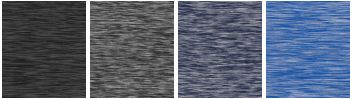
What is Space Dyeing and What are Space Dyed Fabrics


Space dyeing is a yarn dyeing technique in which a multicolor or blurred dye look is created. It creates a textured pattern and provides more color in the fabric.


Space dyeing can be done in any type of fiber- natural or synthetic. It is normally done on polyester, cotton, rayon, nylon and wool. 

In this method, the yarn is dyed at intervals along its length. There are two methods to produce. In the knit-de-knit method, the yarn is knitted first. Then the knitted cloth is dyed and then it is de-knitted. As dye cannot penetrate the areas where yarn cross, it creates alternate dyed and undyed spaces.

 In the other method, which is also a high speed method, the yarn must be wound on some dye package. It can be Dye Spring, plastic tube or steel tube. The chemicals are color mixtures are mixed and put in the individual color tanks of a space dyeing machine. Dyes are then injected using needles which are inserted into the package. 

https://www.cottonworks.com/wp-content/uploads/2018/01/Dyeing_Booklet.pdf

After dyeing the packages are placed in yarn conditioning machine for fixation and subsequently washed.

The below image gives the process steps

http://www.jogson.com/company_brochure.pdf

Multiple pattens can be produced as given below

http://www.jogson.com/company_brochure.pdf

Sources

1 2 3 4 5


Buy my books at Amazon.com

Tuesday, 1 May 2018

What is the difference of Modal from Viscose


Modal is type of Rayon, however it is different from Viscose in many aspects.

Viscose fiber, is one of the most widely used man-made fiber as it is versatile , affordable and its properties resemble to cotton .However, ordinary viscose staple fibers have low initial modulus i.e. they can be easily stretched under low load specially in wet condition . It has poor elastic recovery and is very sensitive to the effect of moisture.

Modal fiber, introduced in the year 1930 seems to be the right answer to these disadvantages. Modal as defined by the International Bureau for Standardization of Manmade Fibers (BISFA) is a distinct viscose rayon fibre genre, which has a higher wet modulus and satisfies a minimum value of tenacity in the wet stage at 5% elongation.

Modal has number of advantages over viscose fiber and mercerised Cotton.

1. Modal posses lower elongation and higher wet modulus as it has higher rate of polymerization than viscose.

2. Its exceptional similarity to cotton and silk in terms of texture (luster, sheen and gloss) results in a surface smoother than mercerized cotton .

3. It can be blended with almost all textile fibres, viz. cotton, wool, silk and other synthetic fibers.

4. Modal displays high dimensional stability, both for low shrinkage and low unrecoverable extension.

5. It is more hygroscopic in nature than cotton i.e. absorbs 50% more water than cotton, has more tensile strength with excellent wear resistance and is less likely to form pills as a result of friction.

6. Modal is also resistant to wear and strong while maintaining a soft, silky feel. Modal fibres have found a wide variety of uses in clothing, outwear and household furnishings.

7. Textiles made from modal fibres do not fibrillate, or pill, like cotton does and are resistant to shrinkage and fading .

8. It causes reduced growth of bacteria when compared to cotton, if both stored for the same period of time and it age like cotton.

Today, Modal is widely used in clothing as a replacement for cotton or mercerized cotton and viscose. (Source)

In addition to this, here is a guide to the various brand names of fibers to their generic names.

Want to go in more depth, here is an article.

Buy my books at Amazon.com

Total Pageviews