Friday, 4 December 2009

Fiber Length and Spinning Performance


Fiber length in spinning is important because it influences spinning limit, yarn strength, evenness and hairiness. It also contributes to the handle and luster of the product by influencing the number of turns of twist required. It influences productivity via the end breakage rate and end breakage rate.

In general, fibers less than 4 to 5 mm are lost at the spinning stage. Fibers from 12 to 15 mm do not contribute to strength but only to the fullness of the yarn. It is only fibers greater than 15mm in length that produce other positive characteristics in the yarn.

Fiber length after carding is most important. Conditions at card and fiber characteristics should be such that the fibers survive carding without noticeable shortening in length.

The fiber lengths can be assessed with the help of a staple diagram.

Remember that the fibers in the boll do not show extremely great length differences. Noticeable differences arise even before the spinning starts. This happens due to mechanical working on the fibers at the ginning and
cleaning stage.

Rectangular Staple

Such diagram is achievable with synthetic fibers.
However such lengths can cause problems in drafting as in drafting stage fibers do not move individually but in bunches, thereby producing a high degree of unevenness.

Triangular Staple

It lends itself to better processing than rectangular staple diagram. However, it produces too many short fibers which cannot be maintained under control. Thus it produces hairy yarn.

Trapezoidal Staple
The fibers depicting such diagram are ideal for processing.


Stepped Staple


It indicates that fiber materials of different lengths are mixed in wrong proportions. It has the disadvantage that fibres move only in bunches which produce a high degree of unevenness.

Now that you've finished reading this post, what are you going do? You should go join the Forum.

Sunday, 29 November 2009

Influence of Fiber Fineness and Maturity in spinning Process


Influence of Fiber Fineness and Maturity on spinning Process


Fiber Fineness

Fiber fineness determine how many fibers are present in the cross section of a yarn of given thickness. Additional fibers in the cross section not only provide additional strength but also a better distribution in the yarn. Minimum 30 fibers are needed, usually over 100 fibers are required. Fiber fineness influences spinning limit, drape of the fabric, yarn strength, luster, yarn evenness, handle, yarn fullness and productivity. Productivity is influenced by reduced end breakage rate.

In a conventional spinning process, fine fibers accumulate to the core and coarse fibers in the periphery.

Fiber fineness is measured in dtex which is equal to ratio of mass in dgrams and length in km. Decitex is equal to the product of Micronaire value of the cotton and 0.394.

Cotton fibers are generally classified as very fine if they have a micronaire value upto 3.1; fine if they have value between 3.1 to 3.9; medium if they have it between 4.0 to 4.9; slightly coarse between values of 5 to 5.9 and coarse if they have a micronaire value above 6.


Fiber Maturity

Cotton fiber consists of cell wall and lumen. The maturity index depends upon the thickness of the cell wall. The fibers are considered ripe if they have maturity index between 50-80 percent, unripe if they have MI between 30 to 45% and dead when they have it less than 25%.

Unripe fibers have neither adequate strength nor adequate longitudinal thickness. They lead to loss of yarn strength, neppiness, high proportion of short fibers, varying dyeability, processing difficulties mainly at the card.


Now that you've finished reading this post, what are you going do? You should go join the Forum.
Reblog this post [with Zemanta]

Wednesday, 25 November 2009

Fiber Identification - Burning Test- Man-made Fibers


All viscose including High Wet Modulus scorch and ignite quickly when brought near the flame. Like cotton they burn quickly with yellow flame when in the flame. When removed from the flame they continue to burn. There is no afterglow unlike cotton. The smell is that of burning paper. They leave a light gray and feathery ash.

Acetate Rayon  ( And Triacetate Rayon)

When brought near the flame, it fuses away from flame turning black. When in the flame, it flames quickly. The fabric puckers, sputters and melts. It drips like burning tar. When removed from the flame, it continues to burn and melt. It smells like vinegar. It leaves a brittle hard, irregular black ash which is difficult to crush.


3D diagram showing the variants nylon 6 and ny...Image via Wikipedia


Nylon fuses and shrinks away from the flame when brought near the flame. In flame, it burns slowly without melting. When removed from flame the flame diminishes and tends to die out. It has somewhat pungent odor. It leaves a hard, round, tough and gray bead.


When brought near the flame, it shrinks away from the flame. When in the flames it puckers and chars. When removed from flame, it extinguishes by itself. It has no smell and it leaves a hard black bead.


Scanning electron microscope image of a bend i...Image via Wikipedia

Polyester fuses and shrinks away from flame. When in flame, it burns slowly with melting. When removed from the flame, it burns with difficulty. It has slightly sweetish smell. It leaves a hard round brittle, black bead.


Orlon, Acrilan and Creslan and Zefran fuse and melt away from Flame when brought near the flame. When in flame Orlon flames rapidly. The fiber puckers, sputters and melts. Acrilan flames rapidly and melts. Creslan flames and melts and Zefran sputters slightly and flames. When removed flame all of acrylics continue to burn and melt. Orlon has a slightly burning meat-like smell. Acrilan has a buring steak smell. Creslan has sharp sweet smell and Zefran has a turmeric like smell. Orlon, Acrilan and Cresla have hard, brittle and irregular black bead. Zefran has irregular black ash that can be crushed easily.

Modacrylics

Verel and SEF fuse and shrink away from the flame when approached near a flame. When in flame, Verel burns very slowly with melting. SEF shrinks, melts and smolders. When removed from flames, all modacrylics are self extinguishing. Verel has a gunpower smell whereas SEF has a sharp sweet smell. Verel leaves a hard and irregular black bead whereas SEF leaves a hard and irregular black bead.


Fuses but doesn’t shrinks away from the flame when approached near the flame. When in flame, it burns with melting. It has an acrid smell. It leaves a soft, fluffy black bead.

Now that you've finished reading this post, what are you going do? You should go join the Forum.


Reblog this post [with Zemanta]

Sunday, 22 November 2009

Identification of Natural Fibers by Burning Test


Identification of Natural Fibers by Burning Test


Cotton

When cotton is brought near the flame it scorches and ignites readily. In the flame it burns quickly with yellow flame. Upon removing from flame it continues to burn rapidly and shows afterglow. It emits a smell of burning paper. The Ash is light, feathery and grayish. If the ash is black it denotes mercerized cotton.

Linen

Linen like cotton when brought near the flame scorches and ignites easily. In the flame it burns slower than cotton with yellow flame. Upon removing from flame it continues to burn with a smell of burning paper. The ash residue is feathery and gray.

Wool

Wool when brought near the flame smolders. In flame it burns with small and slow flickering flame. Also in flame it sizzles and curls. When removed from flame it ceases to burn. The Odor is like that of burning feather or hair. It gives crisp, dark and irregular shaped ash that can be crushed easily.

Pure Silk

Pure silk smolders when brought near the flame. In the flame it burns slowly with sputtering. When removed away from flame it continues to burn but with difficulty and ultimately extinguishes. The smell that is emitted is like that of burning feathers or hair but it is less pronounced than wool. It gives out a round, crisp, shiny black beads that can be crushed easily.


Weighted Silk

Weighted Silk smolders when brought near the flame. In the flame it burns with a glow. When removed from flame the burned part becomes briefly incandescent then it slowly chars. The smell is like that of pure silk i.e. burning feather or hair. The ash brings a screen like skeleton of original sample.

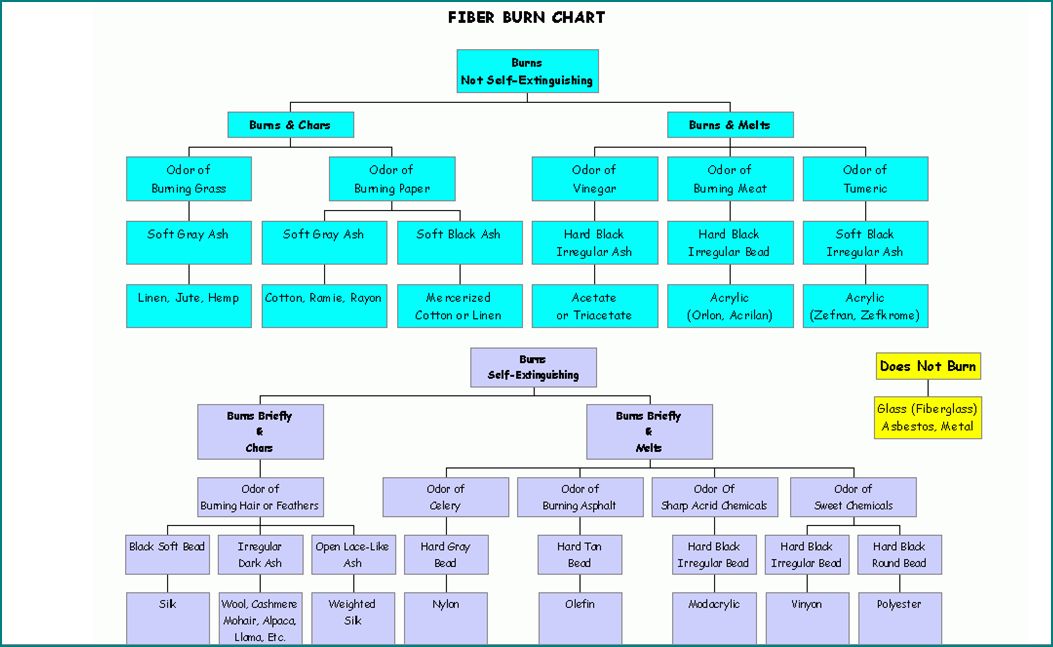
The following guide is very handy in identifying the fibers by burning test:


Now that you've finished reading this post, what are you going do? You should go join the Forum.
Reblog this post [with Zemanta]

Total Pageviews