Wednesday, 28 December 2011

Twist in Silk


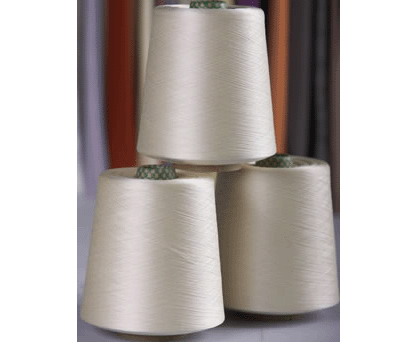
Silk yarn is classified in several ways based on the twist. A some of them are as follows:

Raw Silk
In this the silk is produced by reeling together baves of several cocoons. It has no twist.

Poil Yarn
A silk yarn produced by twisting raw silk. The twist may be slight or exceed 3000 per meter.

Tram Silk
To make a tram yarn, two or more raw silk threads are doubled and twisted slightly. Generally the twist is about 80 to 180 TPM ( Turns per meter)


Crepe
This yarn is made by doubling several raw silk threads and twisting them to very high levels in the range of 2000 to 4000 TPM.

Organzine
This silk yarn is formed by doubling two or more poil yarn and throwing them in a direction opposite to that of the individual yarn. The twist in the poil yarn will be about 700 TPM ‘Z’ and the doubled yarn will have about 950 TPM ‘S’.

http://www.habutextiles.com


Steaming of Twisted Yarn

The twisted yarn has to be subjected to steaming in an autoclave. This process fixes the twist in the thread. Duration of steaming depends upon the depth of layers of threads in the bobbin and twist levels of the thread. Ten minutes is usually sufficient for organza while more highly twisted crepe require considerably more time of about 2 hours. 


Thanks for your attention. Did you find the information you were looking for ? Please leave a comment. Do you need to know more ? Please suggest a topic in the comments. You can also join the Forum for your specific queries.

Monday, 26 December 2011

Waste Products of Mulberrry and Tussar Silk


Mulberry Silk

-          Spun Yarn: Matka, Handspun- Spun by Takli, Milspun- By Mill process

-          Waste yarn: Dupion

-          Short fiber in spun: Noil

Tussar Silk

-          Spun Yarn: Muga: Milspun

-          Waste Yarn: Ghicha

-          Inside yarn: Katiya

Spun Silk Production


Spun Silk takes the following process route:


1. Degumming the silk waste: It is done in degumming vats.
2. Dryers for drying the degumming material.
3. Openers for opening the fibres.
4. Fillers for opening and cleaning the material.
5. Dressing machine is used for combing the materials neps and remove the foreign materials, neps and short fibre and make a lap with average steple length.
6. Spreader : To further make the fibers parallel. Set frames for obtaining sliver.
7. Draw frame is used for making the Sliver with fibres more perfectly paralised, blending also can be done by this machine.
8. Roving machine for making roving (standard of thread with little twist from silver).
9. Ring frame is used for making the spun yarn from roving and insert sufficient twist for strength and wind in a bobbin.
10. Winding & doubling machine are used for two or three fold commercial yarn.
11. Gassing is done for removing the protruding fibres by passing the yarn through the flame at a speed 500-600 mts/min.
12. Reeling to make standard sized hank.
13. Bundling & Balling : First make a bundle and bale for disposal of the material.


The size of spun silk thread is defined in a similar manner to standards used for cotton yarn. For cotton, the term "2/60s"signifies a two-ply yarn consisting of two single strands twisted together, each having a yearn count of 60.
In the case of spun silk the notation has a different meaning. For example, for 60/2 two yearns with a separate yarn count of 120 have been doubled, producing a ply yarn with a new count of 60. (Source)

Spinning of Tussar

 Tassar silk waste is degummed by boiling in a pressurised tank with soap and soda for 30 min and treated with sodium sulphite for partial bleaching. However, to remove gummy matter completely, the material is subsequently kept in a soap and soda solution in a large wooden tank for 3-4 days. After degumming the material is fresh water, hydro extracted and subsequently dried in hot air chambers. The degummed tassar waste is then processed through a series of operations which includes opening, filling, dressing or combing, spreading, drawing, gill roving, spinning and gassing. Mill spun tassar yarn in the range of 60-210s (metric count) can be produced. The yarn is then doubled and twisted according to the required specifications.(Source)

Thanks for your attention. Did you find the information you were looking for ? Please leave a comment. Do you need to know more ? Please suggest a topic in the comments. You can also join the Forum for your specific queries.

Silk Reeling


Silk Reeling

In general silk reeling is defined as unwinding of silk cocoon. However it is technically defined as the process of finding the right end of the cocoon filament and jointly taking several ends together to reel raw silk. These processes are carried using reeling machines.


 Depending on the size of the yarn required to be produced, filament from the cocoons are drawn out simultaneously, compacted and wound on to a reel.  For example, if 20 / 22 denier yarn is required, filaments from 8 to 9 cocoons are drawn out simultaneously, compacted and wound.

Silk Reeling broadly has these operations:

a. Catching the correct number of threads to maintain the denier

This is done using a mechanism called Jettebout.

b. Intertwining of threads

This is done using a special mechanism called croissure. Croissure also squeezes most of the water contained in the filament. If the sericin is wet, the threads wound on the reel will stick to each other and defects like hand gum spots result.

c. Distribution of the yarn

 This is done using an arrangement called distributor or traverse.

d. Winding of the Yarn

This is done on reels

Quality of Water used in reeling

The water used for silk reeling should be free from impurities as many animal fibres like silk have a decided tendency to fix any substance found in water. Such water alters the appearance of the fibre as its luster becomes dull and matte, thus reducing the quality of the silk.


Reeling of Tusssar

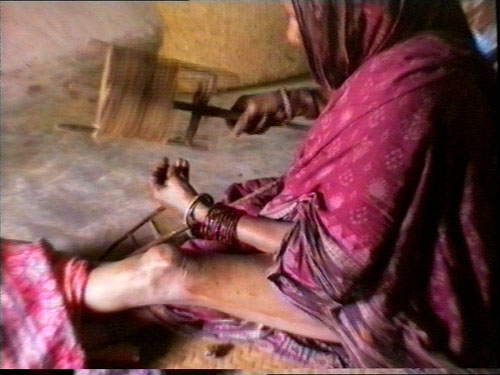
Tassar reeling is not carried out in filature like mulberry cocoons. Mostly it is done in small quantities by the womenfolk of weaver’s family.


Lacing and Skeining

Lacing 
In this process the two ends of the silk hank are tied with coloured thread. Lacing is a process in which a thread passing across the hank in such a way so as to devide it into five equal parts. So that the threads are kept in place to ensure that the thread can be unwound easily. For differenciating different denier of silk different coloured threads are used.

Skeining
It is done by twisting the hank several times and folding it upon itself in a number of spirals.

Book Making and Bailing

The skeins are made into neat books of approximately equal weight and dimensions in a bookmaking  machine. In each book there are eight skeins in the horizontal row and five in the vertical row.

Thanks for your attention. Did you find the information you were looking for ? Please leave a comment. Do you need to know more ? Please suggest a topic in the comments. You can also join the Forum for your specific queries.

Total Pageviews