Showing posts with label silk. Show all posts

Tuesday, 9 April 2024

Is Tussar Silk Inferior to Mulberry Silk ?


In a paper entitled  "Study of property and structural variants of mulberry and Tussar silk filaments" by professor Mohan Gulrajani, one can get several hints which may lead to the answer to the question.


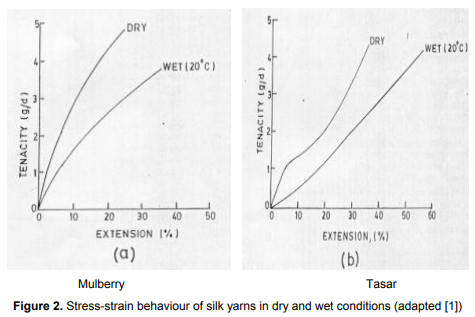
"A glance at the typical tensile behaviour reveals that the stress-strain curve of these two varieties is distinctly different, in that tasar shows a clear yield point and very high elongation compared to the mulberry filament."


Conclusion 1:  Tussar silk can undergo significant stretching before permanently deforming.

The tusar silk stress-strain curve exhibits a clear yield point. A yield point is a point on the stress-strain curve where the material transitions from elastic deformation (where it returns to its original shape after the force is removed) to plastic deformation (where it retains some deformation even after the force is removed). This suggests that Tussar silk can undergo significant stretching before permanently deforming. 

Conclusion 2:  Tussar can stretch a lot before reaching its breaking point compared to mulberry silk.

The stress-strain curve of tussar silk also shows very high elongation compared to mulberry silk. Elongation refers to how much a material stretches before breaking. The fact that tussar silk exhibits high elongation means it can stretch a lot before reaching its breaking point compared to mulberry silk.

In contrast, mulberry silk does not show as pronounced a yield point and has lower elongation compared to tussar silk. This implies that mulberry silk is less flexible and may have a more limited ability to stretch before breaking compared to tasar silk.

Why there is a difference in their properties

One answer can  be density.  The density of mulberry is higher ( 1.35 g/cc) as compared to tussar ( 1.30 g/cc). This suggests a relatively poor degree of orientation and less order in Tussar, which gives to lower modulus and elongation behavior of tussar.

These values have their commercial and functional implications. 

Can Silk be Machine Washed


At least a study suggests so. 

A paper titled "Study of property and structural variants of mulberry and Tussar silk filaments" by professor Mohan Gulrajani has suggested this idea. 

Earlier research suggested that the wet strength of silk specially Mulberry reduces considerably when subjected to water during laundering. This happens because in an aqueous environment, the hydrogen bonds between the molecules break. These bonds are crucial for maintaining the structure and strength of the fibers.

However the paper suggests that " silks can be machine washed at 40-60ÂșC provided one uses appropriate washing procedures, such as the use of neutral detergents".

The results for both Tussar and Mulberry found that " the tenacity and elongation at break are not
significantly different in dry or wet state ". However there is slight decrease in modulus. The figure given below talks about the result. 


A reduction in modulus would make the fiber less stiff.

Modulus, specifically in the context of materials science, refers to the measure of a material's stiffness or rigidity. It indicates the ability of a material to resist deformation under an applied force. Modulus is typically expressed in terms of stress divided by strain, where stress is the force applied per unit area, and strain is the resulting deformation.

When the modulus of a material decreases, it means that the material becomes less resistant to deformation for a given stress. In other words, it becomes more flexible or less stiff. Conversely, an increase in modulus would indicate that the material becomes stiffer or more resistant to deformation.

Then why it is not advised not to launder Pure silk sarees ?

The answer lies in the properties of commercially available silk fabrics or sarees. The above study was done after fully degumming the yarn. However, in commercially available silk fabric, the yarn is not fully degummed, there is always a residual gum or sericin. In the study about 20% sericin was found in mulberry and 5% in tussar.  On wetting, the sericin weakens, and allows inter filament slippage, which in turn leads to a drastic reduction in mechanical properties. Hence the strength of the wet silk gets reduced. 

What is sericin, what is silk fiber composed of ?

Silk fiber is primarily composed of two main proteins: fibroin and sericin. These proteins are produced by specialized glands in the silk-producing organisms, such as silkworms (Bombyx mori). The composition of silk fiber can vary depending on factors such as the species of the silk-producing organism and the conditions under which the silk is produced.

Fibroin: Fibroin is the structural protein that forms the core of silk fibers. It constitutes the majority of the silk fiber's mass and is responsible for its strength and resilience. Fibroin is a fibrous protein composed mainly of amino acids such as glycine, alanine, and serine. The exact composition and arrangement of amino acids within fibroin contribute to its unique mechanical properties, including its tensile strength and elasticity.

Sericin: Sericin is a glue-like protein that surrounds and binds the fibroin filaments together within the silk cocoon. It serves to protect the fibroin and provide cohesion to the silk fiber structure. Sericin is composed of various proteins and amino acids, with its composition varying depending on factors such as the silk-producing species. Sericin is typically removed from silk fibers during processing to improve their texture and appearance, leaving behind only the fibroin core.

In addition to proteins, silk fiber may also contain small amounts of other substances such as lipids, sugars, and minerals. These minor components can influence the properties of silk fibers but are present in much smaller quantities compared to fibroin and sericin.

Sunday, 21 December 2014

Difference Among Pure Silk, Blended Silk and Part Silk Fabrics


As per BIS (Bureau of Indian Standard) the following definitions will apply. Please note that composition of only ground fabric or base fabric will be considered.

1. Pure Silk

If the content of silk in the fabric is more than or equal to 95% then it is termed as pure silk.

2. Blended Silk

If the content of silk in the fabric is more than or equal to 50% then it is termed as blended silk. A tolerance of +-3% is allowed on the declared content.


3. Part Silk

If the content of silk in the fabric is more than or equal to 20% then it is termed as part silk. A tolerance of +- 3% is permitted.

As per BIS, a silk fabric to be marked with the following information among others:

a. Name of the fabric eg. chiffon, crepe etc.
b. Blend composition e.g. pure silk, blended silk or part silk
c. variety of silk eg. mulberry, eri, muga or tussar

Buy my books at Amazon.com

Monday, 8 December 2014

What is Scroop Finish


Scroop is a term used commonly as a finish with synthetic fibers and silk. 

In case of silk scroop is the crunchy feel as well as rustly sound that is produced in the fiber on use. Scroop is like the feeling of squeezing a big bag of corn starch or stepping down into a very powdery snow. 

Scroop is not an inherent property of silk. 

Scroop can be induced in silk in two ways:

One way is to leave the gum of the silk (sericin) behind and not remove it. Sericin has a high coefficient of friction and hence resists the easy sliding of fibers one over the other. Vibrations created by friction produce the sound. 

The other way is by treating silk with organic acid such as formic, lactic, citric or acetic acid in a concentration of 2-4 ml/l and drying without washing. 

In case of synthetic fibers, cohesive agents are used to increase the fiber-to-fiber friction. However, it will increase a property called scroop. The attribute is so named, because of the sound that the staple bundle makes when it is squeezed. It is caused by resistance to the fiber movement that results from the increase in friction between the fibers. If a fabric is made from a yarn having high scroop level- a harsh handle is produced. 

Reference: This is an amazing reading on silk by MIT

* By the way - Unrelated to the post- Cashmilon is made of acrylic and not nylon. 


Buy my books at Amazon.com

Saturday, 22 November 2014

Champa Silk


http://www.exportersindia.com/kosasilkkhadi/tassar-gheecha-saree-varanasi-india-270805.htm
Origin

Champa, Chhatisgarh, India

Fiber

There are seven varieties of Kosa silk i.e.
(1) Shukinda
(2) Dabha
(3) Jadav Dabha
(4) Ranad
(5) Railly
(6) Lariya
(7) Bhrafvala

Railly, Lariya and Barf cocoons are found naturally in the forest collected by the forest dwellers mainly the tribals.

The threads which come from Rally cocoons are generally black in colour while others are yellowish or creamish.

Yarn

Ghicha: Ghicha yarn is produced out of those cocoons, out of which live worm has come out. In the process, the cocoon is damaged and one cannot get a continuous filament. In such cases the cocoons are boiled with soap solutions and several filaments are joined and reeled. This process creates a yarn called as Ghicha and is characterized by its very typical coarseness.  


Katiya: After making the yarn from Gheecha process, some quantity of waste material remains in the cocoons. This waste material then cut together into finer pieces and then reeled into yarn. This yarn is called Katiya.

Nassi: Before making cocoon, the larva joins it with the help of a stem like structure. This structure also contains filaments. However, this is quite stiff. It has to be soaked and boiled in a soft solution and beaten with wooden hammer till it becomes soft. Then it is reeled on thigh in the form of yarn and out of which the fabric is made which is characterized by its typical softness. However, this yarn is costly as a large number of stems are needed to make the fabric.  

Technique

The looms being used now are mostly fly shuttle pit looms though there are some throw shuttle looms in Raigarh

The three shuttle technique is to be found in most Kosa silk areas

Sizing is done by hand with the help of brushes, specially meant for this purpose.

The loss of Sericin during reeling can be off set by what is known as ‘weighting’ or loading, which adds to the volume and weight of raw silk, as also adds to the luster and rustle of silk. In Chhattisgarh, weighting is a compulsory process which is done during the process of sizing, especially for fabrics like ‘Korahs’, undegummed and unbleached fabrics. The weighting is done with starch normally cooked rice water. This is applied to wet the warp and weft yarn during weaving

In the cottages of the weavers a usual warp is of one piece length i.e. one sari, or one piece of malmal of 6 yards or safa of 9 yards.

Surface Ornamentation

The Phera indicates the meaning of ‘round’. Phera method of weaving the body of saree and its border weft threads has rounded each other. The body weft threads are not interlacing with border warp threads and vice versa. They are interlaced by rounding each other at the point of body and border following the phera method. The designs are made using the jhala, jacaurd and dobby.


Uniqueness

The designs are prepared with the dexterous process of Dobby system& there is also no use of jacquard.

References

Wednesday, 26 December 2012

Dyeing of Silk with Acid Dyes


This is as per a brochure from CSTRI ( Central Silk Board)

Receipe

M:L- 1:30
Dye- X% on the weight of the material
Glauber Salt- 10% on the weight of the material.
Acetic Acid- 4-6% ( 40% strength)
Temperature: 85-90 deg C, pH-4-6, Time- 15 minutes

Procedure

- Preparation of dye solution: Dissolve required dye powder in boiling water in a separate beaker/vessel.
- Set the dye bath with required quantity of water.
- Add Glauber Salt
- Add dye solution.
- Enter the presoaked material at 40 deg C. Work for 10 minutes.
- Take out the material.
- Add acetic acid and stir well.
- Enter the material.
- Gradually raise the temperature to 85-90 deg C.
- Work for 35-40 minutes
- Take out the material followed by cold wash.
- Removal of excess water by using hydro extractor.
- Dyeing under shade.

Thanks for your attention. Did you find the information you were looking for ? Please leave a comment. Do you need to know more ? Please suggest a topic in the comments.

Wednesday, 19 December 2012

Bleaching and Optical Brightening of Silk


This is as per a brochure from CSTRI ( Central Silk Board)

Bleaching Receipe

M:L- 1:30
Soda Ash- 0.5 GPL or 1% on the weight of the material.
Sodium Silicate- 1.5 GPL
Hydrogen Peroxide- 20 MI/Lit
Temperature- 80 deg C, Time- 60 to 90 Min, pH-9

Procedure
-Take required quantity of water.
-Dissolve soda ash and sodium silicate
- Enter the material at 40 deg C
- Work for 5 min.
- Take out the material and add Hydrogen Peroxide
- Raise the temperature to 80 deg C
-Work for 60-90 min followed by cold wash.
- Removal of excess water by using hydro extractor.

Optical Whitening Receipe

M:L- 1:30
Ranipal WHN-3% on the weight of the material
Hydrose- 2 GPL
Temperature- 60-70 Deg C, Time-15 min, pH-9

Procedure

- Take required quantity of water.
- Add Ranipal WHN and hydrose ( Dissolve Ranipal in hot water)
- Enter the material at 40 deg C.
- Raise the temperature to 60-70 deg C
- Work for 15 minutes followed by cold wash.
- Removal of excess water by using hydro extractor.
- Drying under shade.

Thanks for your attention. Did you find the information you were looking for ? Please leave a comment. Do you need to know more ? Please suggest a topic in the comments.

Wednesday, 12 December 2012

Degumming of Silk


This is as per a brochure from CSTRI ( Central Silk Board)

Receipe

M:L- 1:30
Soap- 5 GPL or 15% on the weight of the material.
Soda Ash- 1 GPL or 3% on the weight of the material
Temperature- 90-95 deg C., Time- 30 to 45 minutes, pH- 9.5 to 10.5

Methods/Procedure

- Dissolve soap and soda in the required amount of water.
- Enter the material at 40 deg C
- Raise the temperature to 90-95 deg C
- Work for 30-45 minutes
- Take out the material and hot wash for 10 minutes for 60 to 70 deg C.
- Followed by cold wash.
- Removal of water by using hydroextractor.
- Drying under Shade.

Single Bath Degumming and Bleaching

Receipe

M:L- 1:30
Soap- 5 GPL or 15% on the weight of the material.
Soda Ash- 0.5 GPL or 1% on the weight of the material.
Sodium Silicate- 1.5 GPL
Hydrogen Peroxide- 20 MI/Lit
Temperature - 85-90 deg C, Time- 60 to90 min., pH- 10

Procedure

- Take required quantity of water.
- Dissolve Soap, Soda Ash and Sodium Silicate
- Enter the material at 40 Deg C
- Work for 5 minutes
- Take out the material and add hydrogen peroxide.
- Raise the temperature to 85-90 deg C
- Work for 60 to 90 minutes followed by hot wash and cold wash.
- Removal of excess water by using hydro extractor.
- Drying in Shade

Thanks for your attention. Did you find the information you were looking for ? Please leave a comment. Do you need to know more ? Please suggest a topic in the comments.

Wednesday, 5 December 2012

Dyeing of Silk with Reactive Dyes


This is as per a brochure from CSTRI ( Central Silk Board Bangalore)

Receipe

M:L- 1:30
Dye: X% on the weight of material.
Glauber Salt- 20% of the weight of material ( 1st Stage)
Glauber Salt- 20% of the weight of material (2nd Stage)
Soda Ash- 5% of the weight of material ( 1st Stage)
Soda Ash- 5% on the weight of material (2nd Stage)
Temperature ( Cold Brand)- 50 deg C
Temperature ( Hot Brand) - 60 deg C
pH-9,  Time: 65-75 minutes

 Procedure

Preparation of dye solution:

Dissolve required dye powder in boiling water in a separate beaker/vessel.

Set the dye bath with required quantity of water.
Add dye solution and add 20% Glauber salt and 5% soda ash at 1st stage.
Enter the material and work for 10 minutes.
Add 20% glauber salt and 5% sold ash at 2nd stage and work for 20 minutes.
For Cold brand reactive dyes, work for 45 minutes at 50 deg.
For hot brand reactive dyes, work for 45 minutes at 60 deg.
Take out the material followed by cold wash.
Remove excess water by using hydro extractor.
Dry under shade.


Thanks for your attention. Did you find the information you were looking for ? Please leave a comment. Do you need to know more ? Please suggest a topic in the comments.

Sunday, 25 December 2011

FAQ about Silk Manufacturing


What is Raw Silk as termed commonly


When we talk about raw silk, we generally are talking about mulberry raw silk. It is the compact untwisted and undegummed silk thread that is formed by combining the required number of silk filaments drawn from as many separate cocoons by a special technique called Reeling.

What is Filature Silk

The building in which cocoons are reeled for the production of raw silk is called a filature.It is carried with
sophisticated automatic machines,to ensure production of raw silk of desired qualities. The filature concept is
seen in developed countries where the raw material (cocoons) are of superior quality.

What is the type of Silk used in Indian Villages

However, more than 50 per cent of silk is reeled by a villager using country charka which forms the cottage industry. In the group of natural fibres.

What is the percentage of Silk production of all Textile fibers in the world

Which comprises cotton, wool and silk, production of silk amounts for 0.3 per cent only.

What are the other uses of silk apart from garments and home furnishings

Silk yarn is used as A package material in pencil industry and for making talcum powder puffs. Silk is used as raw material for preparing sound-free gears for making precision machinery. In France 22-24 denier silk is used in tyre manufacturing to have a longer life span than rubber tyres. Parachutes are made from 13-15 denier silk fiber. The silk gut used in surgery for internal suturing is made from silk glands. The silk glands are dissected out and put in warm water and pulled at two ends to yield a fibre of uniform thickness. This protein is auto absorbable and need not be removed after wound healing. Silk grafts have been used successfully to replace cut arteries.

What type of production is more in India- Raw silk or Cotton waste

India is very poor producer of raw silk to meet international standards. In India raw silk production is overtaken by silk waste. India produces annually about 180 tonnes of spun silk yarn and 130 tonnes of noil yarn besides hand spun yarn.

Why Silk Reeling using Charkha is inferior

Silk reeling, using country charka is of low quality but it contributes more to the raw silk produce. The reasons
for low quality silk in country charka are as follows;

1. No sorting of cocoons. Defective cocoons are also reeled.
2. No cocoon mixing
3. Improper deflossing.
4. As there is no jettebout the dirt, gum spots etc., can be eliminated. However, the charka has Tharpatti but
cannot function like button or jettebout.

What are cocoons, what are they made up of

Cocoons

Cocoon is nothing but a protective shell made up of a continuos long protein silk filament spun by mature silkworm

Content Percentage

Fibroin 72.0-81.0
Sericin 19.0-28.0
Fat & Wax 0.5-1.0
Colouring matter & ash 1.0-1.4

What are important physical and commercial characteristics on which the production and quality of silk depends

Color

Indian races produce either white or yellow cocoons and white cocoons have a slight edge over the yellow cocoons in market price.

Shape

For easy relling spherical, oval and moderately constricted or printed cocoons are selected.

Size

The size is generally indicated by the number of cocoons per litre.Generally the number of cocoons per litre varies between 110 to 400. Uniform sized cocoons are required for reeling.

Hardness or Compactness

When a cocoon is lightly pressed between the fingers, it should not yield but should feel firm, compact and
elastic.

Grain or Wrinkle

After deflossing the cocoon surface should be granual or wrinkled with convolution.For better reeling fine granular cocoons are selected.

Weight of Cocoon

Weight of Cocoon Shell 

Larger the weight of the shell, greater the silk yield.In Indian multivoltine hybrids the shell weights is 200 to
300 mg. , while it is 180 to 250 mg in multivoltine pure races. Indian univoltine cocoons have 200 and 300 mg of silk shell.

Commercial Chracteristics

1. Shell Ratio: It indicates the quality of raw silk that can be reeled from fresh cocoons. Shell ratio is the
weight of cocoon shell and weight of whole cocoon. . It varies from 12 to 19 per cent.

2. Length of filament

It denotes the length of silk in the cocoon. It varies from 300m to 1200 m.However non breakable filament length (NBFL) which is the average length of filament that can be unwound without breaks is very important.

3. Weight of reelable filament

The complete silk filament of the cocoon cannot be reeled. The outermost floss layer and innermost pelade layer cannot be reeled and therefore removed.

4. Denier

It determines the size of silk. The denier is high in outer floss layer than the middle or inner layer.The tolerance limits for the commercial raw silk are 13/15, 20/22 denier. Denier = ( Total weight of reeled silk in grams/Total length of reeled silk in meter) x 1000.

5. Raw Silk Percentage

This is the percentage of the quantity of raw silk reeled in relation to the quantity of fresh cocoons used for
reeling. This can vary from 40 to 85 per cent. Raw silk Weight = ( Wt of Reeled silk/wt of cocoon)x 100

6. Floss

It is the value outermost loose, fragmented unevenly thick silk layer of the cocoon. It is a waste silk.

7. Renditta

It is the value derived from liter of cocoons required to produce one unit (1 kg) of raw silk. It varies from 6 to
14. The lower the value, the better is the quality of Silk.

What are the various steps of Silk Manufacturing after the cocoon is ready and collected

The various steps are as follows

1. Cocoon Stifling and Conditioning
 The process of killing the pupa and keeping the cocoon in good condition by storing in a proper conditions is
called stifling and conditioning of cocoons.

a. Stifling of Cocoons
It can be done by
- Sun Drying
- Steam Stifling
- Hot Air Drying

Sun Drying
It is a method of killing and drying the pupae by prolonged exposure of freshly harvested cocoons to hot sun. It is simple and cheap and drying is even/uniform. However, it is not suitable for modern reeling, can only be done on bright days, prolonged exposure can cause poor quality silk, increases wastages of silk reeling, involve space and labour and the cocoons can get dust and dirt in the process. Tussar in India uses sun drying method.

Steam Stifling
In this process, the fresh cocoons are exposed to hot wet steam, for a required period. Large quantity of cocoons can be stifled in a short time. However, it kills the pupa inside and doesnt dry it properly. There is also a problem of mould formation and leaking of body fluids of pupa onto silk. It also affect the sericin, increasing silk waste.

Hot Air Drying
In this the pupae are killed by exposure to hot air. It is the best method of stifling, giving good quality of silk
and dried pupae.

2. Cocoon Storage
After complete drying, the cocoons are to be stored in a store house which is protected from rats and is moisture proof.To protect the cocoons from fungal attack, the inside temperature and relative humidity of the store need to be maintained at 27 deg C to 30 deg C with 60-70 per cent relative humidity.

3. Cocoon Sorting
Sorting of Cocoon is done before reeling to give good quality cocoons.

4. Deflossing
Generally deflossing is done by fingers but now simple hand operated machines are also available.

5. Riddling

It is a process that separates the cocoons according to their sizes.

6. Cocoon Cooking and Brushing.

Silk thread spun by silkworms is technically called as ‘bave’. This is a composite structure which inturn has two filaments inside which are known as ‘brins’. Brins are the filaments which are produced by the two silk glands. Brins are made up of silk protein biborin synthesized in the silkglands. The brins are intrun bound by silk protein called sericin.

The cooking process is done for softening the sericin to facilitate easy unwinding of the silk filament at the same time.The sericin content of the silk filament ranges from 25 to 30 per cent, which varies in different races. In cooking process 7 to 8 per cent of sericin is dissolved.

 In order to cook the cocoons properly there are different types of systems of cooking.

1. Top reeling or floating system
2. Sunken system

In top reeling the cocoon shell becomes wet and impervious to water and float in water when the cooked cocoons are put in to the reeling basin. In sunken system the shell is cooked and the process fills the cocoon with water (97- 98 per cent) and makes the cocoon heavy and which sink in the reeling water. The top reeling is a old method while sunken reeling is a latest method.


Traditionally tassar cocoons are cooked in an earthen pot at or near boiling sodium carbonate (washer man’s soda) solution for 4-6 hours. Cocoons are then reeled in semi moist condition on Natwa/Thigh, where the productivity per day per reeler comes to about 60-80 g of 60 D silk yarn.


Brushing
The cocoons have to be brushed to remove the surface floss before reeling. Floss is a lossely knit, broken, uneven thickness, water silk. Without removing the floss layer one cannot reel the proper silk. This waste layer obstructs the reeling process unless it is clearly removed. The process of removing floss layer is called “brushing”.Brushing can be done with the help of a stick, a brush or through mechanical means.

---to be continued---

Thanks for your attention. Did you find the information you were looking for ? Please leave a comment. Do you need to know more ? Please suggest a topic in the comments. You can also join the Forum for your specific queries.

Tuesday, 20 December 2011

Comparing Silk Fabrics from China and India


The following are the major differences between Silk Fabrics made from China and India.

1.    The raw silk produced by Chinese producers is qualitatively better because they employ dried cocoon reeling method as compared to the Indian silk producers who employ fresh cocoon reeling method to obtain raw silk.

2.   Majority of Indian silkworms are multi-voltine variety, whereas Chinese silkworms are of the bi-voltine variety, which has high productivity of cocoon per acre, and the cocoon has higher silk output per kg, and the silk has higher tensile strength on the loom.

3.    The machinery used by the Indian producers are obsolete, simple and inefficient which is the primary cause for the higher per unit value of Indian silk as compared to Chinese silk.

4.    The twisting machines used  by Indian producers to produce silk yarn can reach 800 twists per minute at the most. However, the twisting machines used by Chinese producers are advanced and can reach a number of twists of more than 2600 twists per minute the resultant product being of high quality.


China and India together account  for more than 90% of the total production of the 20-100 grams of silk fabric variety in the world; China producing approximately 78% and India approximately 15% being the two major producers of silk in the world.


Thanks for your attention. Did you find the information you were looking for ? Please leave a comment. Do you need to know more ? Please suggest a topic in the comments. You can also join the Forum for your specific queries.

Tuesday, 22 November 2011

A Layman's Review of Silk


What is Silk

Silk is a continuous protein filament secreted by specific types of caterpillars commonly known as silkworms. It is the most loved fiber the world over. Natural sheen, inherent affinity for rich colors, high absorbency, lightweight (yet stronger than a comparable filament of steel), poor heat conduction ( warm in winter, cool in summer), low static current generation, resilience, and excellent drape are some of its irresistibly endearing qualities. 

Varieties of Silk

Mulberry

This is the most commonly known and understood form of natural silk. 

Mulberry silk is light weight, has a natural sheen and smooth feel. Majority of finished silk products available in the market are made from mulberry silk. 

The mulberry silk worm feeds on mulberry leaves and forms a smooth cocoon, from which yarn is taken out through a process called reeling. 

Mulberry silk is a rich absorbent of colors and is a printer's delight. 


India's Wild Silks or Vanya Silks reflect the exotic and untamed spirit of wild silk worm...in texture, feel, sheen and color. It has inspired designers to create distinct fashion statements in clothing and home textiles. 

Vanya Silks have baffling thermal properties, keeping warm in winter and cool in summer. 

Vanya Silk portray the rich crafts culture and folklore of the North Eastern and Tribal zones of Central and Eastern India. They are of three different types, each distinct in its characterisics, Tasar, Eri and Muga. 


The tropical or Indian Tasar Silks are highly textured and have a wide range of natural colors from off-white to beige and gold brown. It has a dull, uneven sheen and can also be dyed in a number or colors and easily blended with cotton, wool, linen or other silks. 

Well known Bafta fabric is a blend of India Tasar with cotton. Tasar is used in both spun and filament form. Tasar silkworms feed mainly on Asan and Arjun leaves. India is the second largest producer of Tasar silk in the world. 

Desi or Indian Tropical Tasar is produced by the species of worms known as Antharaea Mylitta. There is another variety of Tasar which is called Oak Tasar. It is produced by another species of worms called Antharaea Proyeli (produced in India ) and Antharaea pernyi (produced in China). It is a finer variety of Tasar.

Eri

Also known as Endi or Errandi Eri silk is produced by Eri silkworm, which mainly feeds on Castor and Kesseru leaves. 

Eri can be spun in coarse to very fine yarns and is home washable. It can also blend with cotton, wool, jute and mulberry silk. 

Eri silk gains better sheen with every wash. Its high warmth retention makes it very comfortable in cooler climes. It is popularly used for making Shawls, Stoles, Fashion accessories and Home Furnishings. 

Muga

The shimmering golden color, distinct look and smooth feel of muga is an instant inspiration to the interior, home and fashion designers all over the world. Muga commands highest premium amongst all silks. 

Reared in Assam, the Northeastern region and Cooch Behar in West Bengal, Muga silkworms feed on Som and Sualu Leaves. 

Muga yarn is generally used in the Assamese homes for home furnishings. The famous Sualkuchi sarees too are a product of Muga silk. 

Silk Care

Precautions during washing ( Source : Silkmark Brochure- Please try separately before following instructions)

1. Always wash silks in soft water. Add a pinch of Borax or ammonia, if the water is hard. 
2. Use a good neutral soap in the forms of either flakes or solutions. 
3. Light detergent may also be used in the case of hard water. 
4. Wash in lukewarm water by kneading and squeezing or suction. 
5. Rinse in warm water 2-3 times to remove traces of soap.
6. Add a few drops of citric acid or acetic acid to the final rinse in cold water. 
7. Silk with doubtful color fastness may be steeped in cold water with a small amount of citric or acetic acid for 1-2 minutes before washing. Squeeze lightly by hand to remove water. 
8. Always dry flat, in shade. 

Precautions during Ironing

1. Use Low to medium heat
2. Never spray water to dampen silk before ironing. This will cause water spots in the fabric. 
3. Silk should always be ironed on the reverse side if still damp.

Storage of Silk Products

1. Store in cool and dry place in brown craft paper covers. 
2. In case of sarees avoid stacking more than three, frequently reverse and change the folds. A small sandal wood piece instead of naphthalene balls would provide dry, cool and fresh air. Sweat should never be allowed to settle and should be removed by rinsing in cold water. 
3. Hang the silk products in good ventilated wardrobe or cupboard.
4. Use anti-mildew compound spray.
5. Warp in muslin cloth to avoid discoloring of zari. 
6. Use natural perfume like Sandalwood swatch for refreshning.
7. Plastic bags given as package material after laundering or purchase should not be used for storage. 

Thanks for your attention. Did you find the information you were looking for ? Please leave a comment. You can also join the Forum for your specific queries.

Wednesday, 29 September 2010

Common Parameters measured in Silk Yarn


Common Parameters measured in a Silk Yarn: An Example

Direction of Twist: S
Average Twists Per Metre: 691.4 Turns
C.V.Twist: 3.09 %
Percentage of Twist Deviation: 1.23 %
C.V.Size: 4.18%
Cleanness: 98.2 Percentage
Neatness: 96.15Percentage
Tenacity: 3.89 Grans/Denier
Elongation: 19.2%
Average Moisture Regain: 10.99%
Grade:***
Circumference of the Swift:*** Inches
Skein Weight:  about 500 grams

To know more about these tests you can click here.

General Denier Qualities in Mulberry Silk

14/16,16/18,18/20,20/22

General Norms for Organzine Twist

z800- Z direction Twist, No. of twists per meter-800
s850- s direction twist, No of twists per meter- 850


Now that you've finished reading this post, what are you going do? You should go join the Forum.

Thursday, 2 September 2010

More about Silkworms and Silk fiber- Mulberry, Muga, Tasar and Eri


Silkworm belong to the order Lepidoptera. They belong to family of Bombycidae and Saturniidae. Under Bomycidae, we have Bombyx Mori or commonly known as Mulberry Silkworm. Under Saturniidae family the eri silk worm is called Philosamia Ricine, Muga is called Anthrerea Assamensis and Tasar is called A. Mylitta

Silk filament is made up of 75-80 percent fibroin and 20-25% sericin or gum. Fibroin is insoluble but sericin may be removed by boiling. 

The Muga and Tasar varieties of the worm also secrete a cement which causes a drab color to develop, making bleaching a very laborious process. 

Silk of the B. Mori variety is triangular in cross section. It has a capacity to reflect light and the layers of protein impart it with a pearly sheen. Tasar silk has a flatter structure which is a reason for its dull appearance. 

Muga is rounder and more lustrous. 

The B.Mori and Muga imagos cut their way through one end of the cocoon, thus making the filament discontinuous. The Tasar moth secrets an enzyme called cocoonase, which softens the cocoon shell facilitating  emergence. The eri moth spins an open ended cocoon through which the imago can fly to full term. 

In silk only male worm can fly. 

During the process of boiling of silk 75% of the sericin is removed. Care is taken to retain the 25% of the gum to prevent tangling. If the boiling is insufficient, filaments tend to snap during weaving, while excess boiling increases the amount of waste silk. 

The thread drawn from the cocoon is of uneven consistency, being finer at the beginning and the end. In order to provide uniformity in consistency, additionaly filaments are drawn in course of reeling, the process is called throwing. 

Because of the structure of cocoon, the process of reeling also generates a residue of waste fiber. In B. Mori, about 45% of the product is floss. This material is spun. This is called Matka. In the case of muga worm 25 to 50 percent may be spun. With regard to tasar only about 10 per cent of the filament can be reeled

Now that you've finished reading this post, what are you going do? You should go join the Forum.

Monday, 1 February 2010

Chemical Identification of Silk


Please see the following link for details on chemical identification of silk.

Now that you've finished reading this post, what are you going do? You should go join the Forum.

Sunday, 31 January 2010

Weighting of Silk


Weighting of Silk

Silk is sold by weight. By means of weighting the manufacturer can increase the weight of silk by 3 to 4 times. The weighting substances in the silk includes tannins such as salts or iron, tin (mostly used), chromium, sodium, magnesium and barium. Also sugar (mostly used), glucose, gelatin, glycerin and paraffins are used.

How weighting is done

Silk has great absorptive power. It can take upto 50% of tannin. Once that is applied the tannin itself can attract salts of iron and tin by another 50% without any visible indication of being changed in character. For dark colored silks, iron salts are used, for light-colored silks, tin salts are used. 

For applying weighting, the silk is first degummed. During degumming process, silk loses approximately one-fifth of the weight. This is done prior to weaving. Then it is immersed in a solution of catechu or some other substance rich in tannin. Then it is tranferred from tannin vat to iron or tin baths. After this cloth is taken out and washed in pure water. 

Effects of Weighting

Weighting causes the fabric to lose its strength as soon as the weighting is applied. Heavily weighted silk must be made into garments as soon as it is made. Spots develop in the dyes. Saltswater, perspiration and tears cause spots to be formed which seems as if the silk is eaten by acids. Sunlight also attacks weighted silk and can cause silk to fall to pieces.


How to Detected Weighting in Silk :

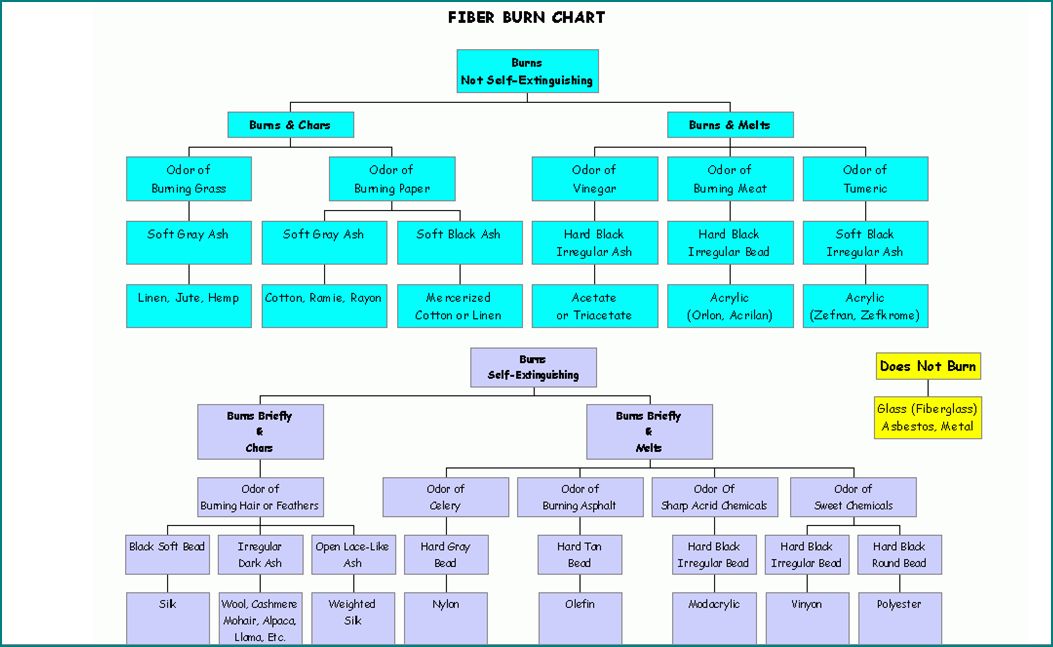
Weighting of silk can usually be detected by the burning test. Separate threads from the warp and the weft are set on fire with a burning match. Pure silk burns very badly and stops burning as soon as the burning match has been removed. Practically no ash is formed (less than one per cent), and the end of the fiber left unburned takes the shape of a little bulb.

Weighted fibers, when burned, leave a considerable amount of ash, and the entire thread may keep its shape after being burned. When only the filling or the warp is weighted, applying the flame to a sample of the cloth seems to consume only one set of threads, the unweighted ones, the others keeping their form because of the heavy ash content.

Now that you've finished reading this post, what are you going do? You should go join the Forum.

Sunday, 22 November 2009

Identification of Natural Fibers by Burning Test


Identification of Natural Fibers by Burning Test


Cotton

When cotton is brought near the flame it scorches and ignites readily. In the flame it burns quickly with yellow flame. Upon removing from flame it continues to burn rapidly and shows afterglow. It emits a smell of burning paper. The Ash is light, feathery and grayish. If the ash is black it denotes mercerized cotton.

Linen

Linen like cotton when brought near the flame scorches and ignites easily. In the flame it burns slower than cotton with yellow flame. Upon removing from flame it continues to burn with a smell of burning paper. The ash residue is feathery and gray.

Wool

Wool when brought near the flame smolders. In flame it burns with small and slow flickering flame. Also in flame it sizzles and curls. When removed from flame it ceases to burn. The Odor is like that of burning feather or hair. It gives crisp, dark and irregular shaped ash that can be crushed easily.

Pure Silk

Pure silk smolders when brought near the flame. In the flame it burns slowly with sputtering. When removed away from flame it continues to burn but with difficulty and ultimately extinguishes. The smell that is emitted is like that of burning feathers or hair but it is less pronounced than wool. It gives out a round, crisp, shiny black beads that can be crushed easily.


Weighted Silk

Weighted Silk smolders when brought near the flame. In the flame it burns with a glow. When removed from flame the burned part becomes briefly incandescent then it slowly chars. The smell is like that of pure silk i.e. burning feather or hair. The ash brings a screen like skeleton of original sample.

The following guide is very handy in identifying the fibers by burning test:


Now that you've finished reading this post, what are you going do? You should go join the Forum.
Reblog this post [with Zemanta]

Thursday, 9 July 2009

Care of Silk Fabric


Silk should be dry-cleaned, in most of the cases. Whenever in doubt, dryclean it.

It should not be machine washed at all.

Silk Shrinks when washed in water. It doesn’t itself shrink. It is the way the individual fibers are twisted together than causes the silk to shrink. Highly twisted yarns and loose weave cause shrinking when water releases twisting energy in the fibers.

Water also affects the texture and sheen of the fabric. Thus the firmness and color of the fabric is also affected by water.

When hand washing do it in this way:

Always wash silk in soft water. Add a pinch of Borax or ammonia, if the water is hard.

1. Put the silk in a tub full of lukewarm water and mild soap like Ezee.

2. Rub the silk fabric for a few minutes in the solution and drain.

3. Rinse in clear cool water until all the soap is gone.

4. Fill the tub again and put about a quarter cup of white vinegar.

Vinegar neutralizes any remaining soap and allows it to rinse out completely restoring the fabric’s natural sheen. It also helps preventing any damage from the alkali present in the soap.

5. Give the fabric a final rinse in clear, cool water to restore the vinegar smell.

6. Roll up in a towel to remove moisture then dry flat on a towel. Never wring it.

7. Avoid soaking silk as this may fade the dye.

Silk with doubtful color fastness may be steeped in cold water with a small amount of citric or acetic acid for 1-2 minutes before washing.

Please test this method on a small part of the garment before commencing the full-fledged washing.

Treating Stains

1. Use a capful of hydrogen peroxide and a few drops of ammonia added to the wash.

2. For recent perspiration stain dab a tablespoon of ammonia dissolved in half cup of water. Older perspiration can be removed with a vinegar solution. Unfortunately, perspiration stains on silk may not be completely removable.

Pressing

1. Silk should be pressed when damp never when completely dry.

2. Turn the item inside out and iron on the reverse side of the fabric.

3. Use a low setting and don’t use steam as it will leave watermarks.


Storage

1. Keep silk in a cotton pillowcase or other material that can breathe.

2. Avoid plastic which traps moisture and can cause yellowing and mildew

3. Use naphthalene balls to keep the bugs away from silk.

4. Avoid direct contact with wood

5. Wrap zari sarees in cotton cloth to avoid discoloring of zari.

General Care Instructions

1. Keep it away from heat or direct sunlight, it will yellow the fiber.

Sunday, 17 May 2009

Some Online Resources in Silk


These two websites - one of which is a commercial exporter's and the other is about hand painted silk, provide some valuable information about silk.


First of all, definitions. One can go through the definitions here. However, I was always looking for the definitions of the following types of Silk.

1. Mulberry Silk

I was not particularly looking for this definiton. Silk produced by silk worm (Bombyx Mori) fed on Mulberry Leaves.

2. Tussar Silk

I was particularly looking for this:
Larvae of several species of moth such as Antheraea mylitta, Antheraca proylei, Antherea pernyi and Antheraca yamamai produce this silk.The insects mostly live in the wild on bushes and trees on which they feed.

3. Katiya Silk
A big one for me.

The portion of Tussar cocoons leftover after about 60% reelable silk is spun into Katiya yarn.

4. Balkal Silk

The peduncles (silk that anchors the cocoon, it is very weak) are utilised for production of Balkal yarn.

5. Muga Silk:

It belongs to same family as Tussar. It is popular for its natural golden colour, glossy fine textures and durability. Muga silk is produced by Antheraea assama westwood which is an endemic species prevalent in the Brahmaputra valley and adjoining hills.

Muga silkworm is a polyhageous insect which feeds on leaves of Som, Soalu and other plants which grows abundantly in Brahmapautra valley.

Eri Silk :

The word Eri is a derivative from Sanskrit nomenclature for Castor Plant, eranada. Castor leaf is the main food for the Eri silkworms and so named as Eri. This is the only completely domesticated non-mulberry variety. Its silk is spun as it can not be reeled.

Spun Silk:

A Silk yarn made of short lengths of silk obtained from silk wastes, pierced cocoons or floss which gives yarn its characteristic brilliance. There are two grades of yarn Schappe and Bourette. It is spun on special machinery which in some ways is akin to cotton and worsted.

Noil Silk:

Noil Short fibres removed in combing operation of yarn making of Spun silk is spun into Noil yarn. Noil is mostly produced in Karnataka and Madras.

Dupion Silk:

An irregular, rough silk reeled from double cocoons or cocoons spun side-by-side which are interlocked, making it necessary to reel them together. The unevenness of the yarn confines its use.

Filature Silk


A raw silk which is reeled by machine as distinct from silk prepared by hand in cottage industry.

Matka silk

Another Big One.

Matka Silk is obtained from waste Mulberry silk by hand spinning without removing the gum (sericin). Cocoons required to produce Matka are mainly obtained from Karnataka and Kashmir but spinning is mostly done in the villages of Malda and Murshidabad districts in West Bengal by women by hand spinning.

Filaments of the cocoons of this silk from Bihar were originally unwound and  plied together on a mud pot, or Matka ( Today, they are alikely to be reeled on a woman's thigh)

MASHRU

Though not a silk fabric yet very important from the point of view of traditional textiles. It is a veg based fabric. A satin weave with rayon warp and cotton weft, creates a high glossy surface.

GAJJI

Gajji Silk is satin weave done on silk fabric. Used in Tie-Dye Sarees in Gujarat state of India

Care of Silk Fabric: This site gives it comprehensively among other resources.

such as Interesting Facts about silk Fabrics and Scarf Tying Techniques

I am still looking for the following definitions of Silk

Korean Silk
China Silk
Kora Silk
Desi Silk

Some other Snippets

* All tussar is wild silk which is produced from an unraptured cocoon.

* Ghicha and Matka are produced from Raptured cocoon.

* Korea Silk is also known as 33/37 fiber. Generally we have fabrics of   korea x korea , korea x china and korea x desi. Korea x Korea can be made on powerloom. The other two qualities are not possible to make on powerloom because of their marked evenness.

* When a supplier talks about 2x1 Korea x China, it means he has taken two threads of Korea together in warp (not twisted, but just taken together) .

* Generally reed in these fabrics is always 72

* China silk is also known as 50/70 fiber. It is paler and coarser in appearance than Korea.   

*
Desi is a raptured silk from India. Very uneven yet brilliant when worn.

Total Pageviews