Showing posts with label Textiles and Nonwovens. Show all posts

Sunday, 29 November 2009

Influence of Fiber Fineness and Maturity in spinning Process


Influence of Fiber Fineness and Maturity on spinning Process


Fiber Fineness

Fiber fineness determine how many fibers are present in the cross section of a yarn of given thickness. Additional fibers in the cross section not only provide additional strength but also a better distribution in the yarn. Minimum 30 fibers are needed, usually over 100 fibers are required. Fiber fineness influences spinning limit, drape of the fabric, yarn strength, luster, yarn evenness, handle, yarn fullness and productivity. Productivity is influenced by reduced end breakage rate.

In a conventional spinning process, fine fibers accumulate to the core and coarse fibers in the periphery.

Fiber fineness is measured in dtex which is equal to ratio of mass in dgrams and length in km. Decitex is equal to the product of Micronaire value of the cotton and 0.394.

Cotton fibers are generally classified as very fine if they have a micronaire value upto 3.1; fine if they have value between 3.1 to 3.9; medium if they have it between 4.0 to 4.9; slightly coarse between values of 5 to 5.9 and coarse if they have a micronaire value above 6.


Fiber Maturity

Cotton fiber consists of cell wall and lumen. The maturity index depends upon the thickness of the cell wall. The fibers are considered ripe if they have maturity index between 50-80 percent, unripe if they have MI between 30 to 45% and dead when they have it less than 25%.

Unripe fibers have neither adequate strength nor adequate longitudinal thickness. They lead to loss of yarn strength, neppiness, high proportion of short fibers, varying dyeability, processing difficulties mainly at the card.


Now that you've finished reading this post, what are you going do? You should go join the Forum.
Reblog this post [with Zemanta]

Sunday, 22 November 2009

Identification of Natural Fibers by Burning Test


Identification of Natural Fibers by Burning Test


Cotton

When cotton is brought near the flame it scorches and ignites readily. In the flame it burns quickly with yellow flame. Upon removing from flame it continues to burn rapidly and shows afterglow. It emits a smell of burning paper. The Ash is light, feathery and grayish. If the ash is black it denotes mercerized cotton.

Linen

Linen like cotton when brought near the flame scorches and ignites easily. In the flame it burns slower than cotton with yellow flame. Upon removing from flame it continues to burn with a smell of burning paper. The ash residue is feathery and gray.

Wool

Wool when brought near the flame smolders. In flame it burns with small and slow flickering flame. Also in flame it sizzles and curls. When removed from flame it ceases to burn. The Odor is like that of burning feather or hair. It gives crisp, dark and irregular shaped ash that can be crushed easily.

Pure Silk

Pure silk smolders when brought near the flame. In the flame it burns slowly with sputtering. When removed away from flame it continues to burn but with difficulty and ultimately extinguishes. The smell that is emitted is like that of burning feathers or hair but it is less pronounced than wool. It gives out a round, crisp, shiny black beads that can be crushed easily.


Weighted Silk

Weighted Silk smolders when brought near the flame. In the flame it burns with a glow. When removed from flame the burned part becomes briefly incandescent then it slowly chars. The smell is like that of pure silk i.e. burning feather or hair. The ash brings a screen like skeleton of original sample.

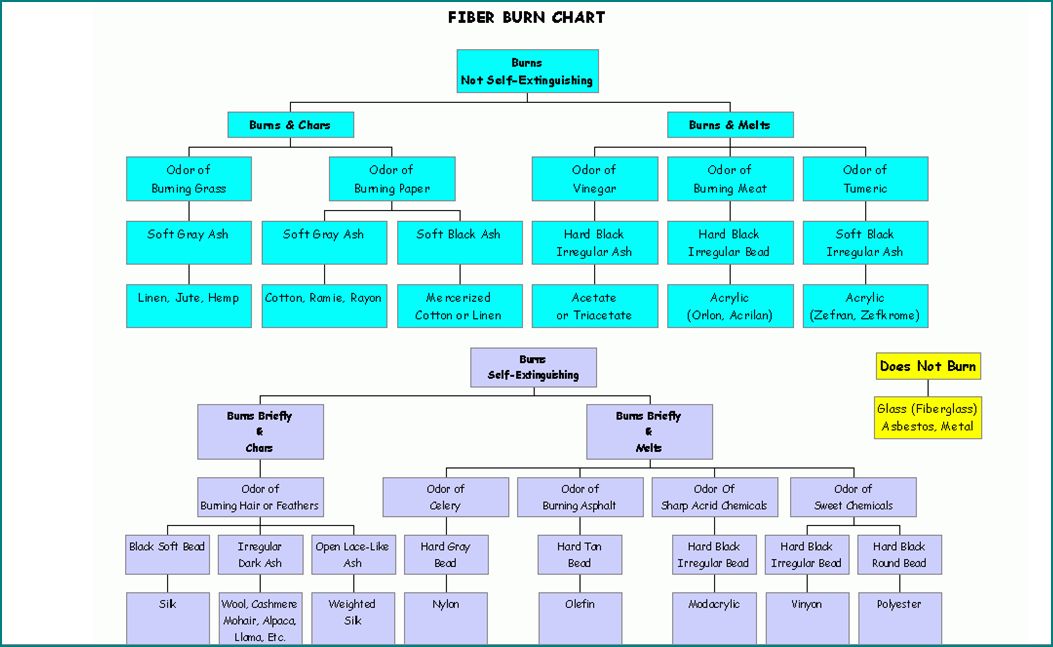
The following guide is very handy in identifying the fibers by burning test:


Now that you've finished reading this post, what are you going do? You should go join the Forum.
Reblog this post [with Zemanta]

Sunday, 18 October 2009

Cloth setting and Fabric Geometry Theories


1. Fractional Cover is defined as d/p where d is the diameter of the yarn and p is the thread spacing.

2. There are various theories for calculation of yarn diameter. According to Law yarn diameter d is equal to 1/ sqrt (Fn) where F is 500 for worsted yarn, 800 for cotton yarns, 530 for woolen n being worsted and cotton and Yorkshire count respectively. According to Ashenhurst yarn diameter d = 1/(F sqrt(N)), where F is .95, .9,.84 for cotton, worsted and woolen yarns respectively and n= yds/lb. According to Pierce, yarn diameter is 1/(28 sqrt(N) where N is the English count.

3. Ashenhurst Diameter  intersection theory says that when the count of warp and weft are the same, it is assumed that an intersection takes up as much space as a thread. Then Threads/inch (T) can be determined as equal to D x W/ (W+I) where D is the diameter per inch of yarn, W is the threads in one repeat of weave and I are the intersection in one repeat of weave. For plain weave W =2, I=2 for 2/1 twill weave, W=3 and I = 2.

4. Curvature theory says that T = D x W/ ( W +.732 I), the notations being the same as in point 3.

5. Armitage Maximum Setting Theory says that cloths which are similarly built are equally firm. For regular twill weaves Threads per inch (T) = Sqrt (6 x C(F+4)) where C are the counts of worsted yarn and F is the average float of weave. For other weaves, Armitage gave the following “setting ratio” instead of (F +4). For plain weave it is 4.75, for 2/2 hopsack it is 6.25, for 4 end satin it is 6.5 for 5 end, 6 end and 8 end satin it is 7.5, 7.75 and 9.0 respectively.

6. Laws Maximum Setting suggests that T = ((D x F)/ (F+1) )+ various percentages where F is the average float and D is the diameter per inch. For common weaves like plain weave T = ( D X 1)/(F+I), for twill weave T= ((DF)/(F+1))+ 5% for each float exceeding two, for satin weave T = ((DF)/(F+1))+5.5% for each float, for hopsack weaves T= ((DxF)/(F+1))+ 4.5% for 2 floats and 9.5% for floats exceeding two.

7. Brierjey’s Maximum Setting suggests that square settings vary according to the formula T= sqrt (KC x (F)^m) where C is the average count of yarn, F is the average float, K is a constant varying according to kind of yarn and numbering system: it is 134 for worsted yarn, 200 for cotton yarn and 60 for york shire yarn. m is a constant varying according to the type of weave: For twill weaves it is 0.39, for Satin weaves it is 0.42 and for plain and hopsack weaves it is 0.45.

An amazing treatment on fabric geometry is done in this presentation.


Now that you've finished reading this post, what are you going do? You should go join the Forum.
Reblog this post [with Zemanta]

Wednesday, 14 October 2009

Why Wool Feels Warm


Long and short hair wool at the South Central ...Image via Wikipedia
Why Wool is Warm to Wear- Heat of Sorption

When a fiber absorbs water, heat is evolved. It results from the attractive forces between the fiber and water molecules. The phenomenon occurs due to the fact that when moisture vapour is absorbed into fiber’s internal structure, it transforms from gas to liquid and the phase change produces the rise in temperature.

It is calculated by heat of wetting. It is the heat evolved when a specimen of the material at a given regain, whose dry mass is one gram is completed is completed wetted.

It is expressed in joules per gram ( of dry material)


The heat of wetting is greatest for the more highly absorbing fibers and is very small in the non-hygroscopic fibers. Thus it is 113 J/g for wool, 106 for viscose, 69 for silk, 55 for flax, 46 for cotton , 73 for mercerized cotton and only 34, 31,5 and 7 respectively for Acetate, Nylon, Polyester and Acrylic.

As we can see from the figures above, wool has the highest heat of sorption. And this heat raises the temperature of the wearer which makes the wool feel warmer. In fact “the heat of sorption from a kg of Merino can be equivalent to the output from an electric blanket over eight hours” (Source ).

You can also find some discussion on Heat of Sorption here.

Now that you've finished reading this post, what are you going do? You should go join the Forum.
Reblog this post [with Zemanta]

Tuesday, 13 October 2009

Why Fiber Fineness is so Important


Why Fiber Fineness is So Important

It has been known since long that fiber fineness plays an important role in determining the quality of resultant yarn and hence that of the resultant fabrics. In general fiber fineness is important due to the following factors:

1. It affects Stiffness of the Fabric

As the fiber fineness increases, resistance to bending decreases. It means the fabric made from yarn of finer fiber is less stiff in feel. It also drapes better.

2. It affects Torsional Rigidity of the Yarn

Torsional rigidity means ability to twist. As fiber fineness increases, torsional rigidity of the yarn reduces proportionally. Thus fibers can be twisted easily during spinning operation. Also there will be less snarling and kink formation in the yarn when the fine fibers are used.

3. Reflection of Light

Finer fibers also determine the luster of the fabric. It is so because they there are so many number of fibers per unit area that they produce a soft sheen. This is different from Hard glitter produced by the coarser fibers. Also the apparent depth of the shade will be lighter in case of fabrics made with finer fibers than in case of coarser fibers.

4. Absorption of Dyes

The amount of dye absorbed depends upon the amount of surface area accessible for dye out of a given volume of fibers. Thus finer fibers leads to quicker exhaustion of dyes than coarser fiberes.

5. Ease in Spinning Process

Finer fibers leads to more fiber cohesion because the number of surfaces are more so cohesion due to friction is higher. Also finer fibers lead to less amount of twist because of the same increased force of friction. Which means yarns can be spun finer with the same amount of twist as compared to coarser fibers. Which also means that the yarns will be softer.

6. Uniformity of Yarn and Hence Uniformity in the Fabric

Uniformity of yarn is directly proportional to the number of fibers in the cross fibers. Hence finer the fiber, the more uniform is the yarn. When the yarn in uniform lit leads to other desirable properties such as better tensile strength, extensibility and luster. It also leads to fewer breakages in spinning and weaving. In fact fiber fineness is one of the dominant factor in determining the limiting count to which a yarn can be spun.


Now that you've finished reading this post, what are you going do? You should go join the Forum.
Reblog this post [with Zemanta]

Total Pageviews