Wednesday, 30 March 2016

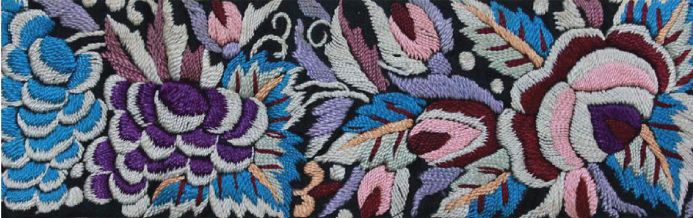
Indian Traditional Embroidery- How to Recognise-2


West India

Continued from Part-1


1. Gujarat Kutchh

Abla Bharat

Mochi Bharat

Soof Bharat

2. Parasi


Central India

1. Chikankari- Uttar Pradesh


2. Phoolpatti- Uttar Pradesh


3. Zardozi- Uttar Pradesh


South India

1. Kasuti- Karnataka


2. Lambani


East India

1. Kantha- West Bengal


2. Sujani- Bihar


3. Pipli Applique- Orissa


Buy my books at Amazon.com

Sunday, 27 March 2016

What are Dhalapathar Sarees


Dhalapathar sarees are woven in the Dhalapathar in Khurda district of Orissa. These are woven by Rangani community in the village.

Dhalapathar Saree
Source:http://www.parisera.com/


These are also known as Kusumi Kapta, Kankana Pedi, Muktapunji, Nahati and Akata.

The yarn is cotton and they are woven in 20s to 2/120s count. Sizing is done only when 20s or 26s yarn in used. With mercerised yarn, no sizing is required. It is woven in fly shuttle pit looms. Ground weave is plain. Cotton healds are used for each warp.

Figuring is done with extra warp. For that flat rectangular wooden pieces called "Chiaris" are used. However now frame looms and Jalas are also used. The designing is done using weft rib of either 4 up 1 down or 6 up one down.

The dyeing is done using synthetic dyes.

For more details please refer to this source. and this one.


Buy my books at Amazon.com

Saturday, 12 March 2016

Indian Traditional Embroidery - How to Recognise-1


A Structure of Traditional Embroidery in India:

The CBSE book on Indian traditional Textile has enumerated a structure to study Indian Traditional Embroidery. I am reproducing briefly the structure

North India

1. Kashida- Kashmir
2. Phulkari- Punjab
3. Chamba Rumal- Himachal Pradesh

West India
1. Gujarat Kutchh
2. Parasi

Central India

1. Chikankari- Uttar Pradesh
2. Phoolpatti- Uttar Pradesh
3. Zardozi- Uttar Pradesh

South India

1. Kasuti- Karnataka
2. Lambani

East India

1. Kantha- West Bengal
2. Sujani- Bihar
3. Pipli Applique- Orissa

The basic Takeaways from this book are as follows:

1. Kashidakari

- Practiced by Mensfolk
- Main stitches are darning stitch, stem stitch, satin stitch and chain stitch

There are three styles of Kashidakari

a. Sozni- Use fly stitch, stem stitch and darning stitch


b. Aari Style- This is also called Zalakdozi


c. Kashmiri Couching


Phulkari

The base material is khadi dyed in darker colors. Soft untwisted "Pat" silk is used for embroidery.

Basic stitch is darning stitch, done from the reverse side of the fabric. Outlining stem, chain and herringbone stitches are used.

One motif is left unembroidered or done in off color to ward of evil. This is called Nazarbuti.

There are two styles of embroidery:
a. Bagh- fully embroidered wrap- used on special occasion.
b. Phulkari- lightly embroidered- Daily use.''

Chamba Rumal

The base is either light mull or heavy Khaddar.
Embroidery is done using dyed, untwisted silk threads called "Pat"
Uses double satin stitch. Produces reversible fabric.


Will continue...

Buy my books at Amazon.com
Source

Saturday, 20 February 2016

Word Origins of Some Textile Terms


Cotton

Cotton originated in Arbic qutn, the name for cotton plant.

Silk

Word silk originated in Chinese si. Greek called Silk traders Seres, "silk people". This is the origin of the words like Sericulture and Serge. 

However, the 'l' rather than an 'r' came through Russian Shelk.

Linen

The word comes from old Germanic "lin" meaning "Flax"which is an origin of the words such as linseed.

It has contributed to other words such as Lingerie, crinoline, linoleum and lint. 

Wool

It came from Indo-European "wlna". the word flannel is related to it.

Source: Bloomsbury Dictionary of Word Origins by John Ayto.

Spinning

Spin comes from Indo-European Base "spen" which means to stretch. The logic seems to make sense as spinning essentially involves stretching or drafting of a strand of fibers.

The words span, spinster, spider, spill and spindle are related to it.

Weaving

The origin is from Germanic "Weben"- to weave. This is the source of the words wafter, wasp, web and weft. 

Dyeing

The source of this word remain unknown.

Printing

The origin comes from Latin "premere" meant press. The words impression are related to it.

Bleaching

The origin comes from Germanic base "blaik-"means to whiten. The words blight and blink are related to it.

Textile

Latin texere means to "weave" which came from Indo European base "tek-" to make. It is the origin of the words text, context, pretext, subtle, texture, tissue and toilet, technical and architect.

Cloth

The history of the word cloth is Germanic "kleid"- means garment.

Fabric 

The word fabric is related to carpenter. The origin is the word "Faber" which means a carpenter. Other related words are fabricate and forge.

Apparel

It has the same source as apparatus, which came from apparare "make ready". The other related words are parent and prepare.

Yarn

The root came from prehistoric German "garn" which is originated from Greek "Khorde"- sting. The other related words are chord and cord. 

Fashion

The word came from Latin factio "make" or "do". The words related to it are difficult, fact, faction and factory. 

Buy my books at Amazon.com

Tuesday, 16 February 2016

Warli Painting


Warli is one of the major tribes in Maharashtra in Thane District.

Traditionally only white is used on a red ochre background. Only married women used to draw these paintings.

They use basic vocabulary of a circle, a triangle and a square.

The Tarpa Dance motif is very famous.

Know more by watching this fantastic video:


and this:


Buy my books at Amazon.com

Saturday, 13 February 2016

Banarasi Sarees- Kadiyal, Katan, Kadhuan, Brocade, Tanchoi...


When someone searches for the Banarasi Sarees or goes to buy the sarees, various types of terms are used to describe the sarees. Let me try to explain a few of the terms. I have dealt these terms elsewhere also in this blog.

1. Katan

Katan is the name of the silk yarn used to produce sarees. Simply speaking katan is degummed- very slightly twisted pure silk yarn. It is softer in feel.

2. Kadhuan or Jamdani. 

This is one of the most used (and misused) terms in Banarasi sarees. Kadhuan involves producing designs using extra weft technique, without producing any surfeit yarn floats at the back of the fabric. It is epitome of weaving. It is manual, painstaking and mimics the tapestry weaving technique at much micro level. In India this is also called Jamdani in producing Kotas, Chanderis and Uppadas.


 3. Brocade

It is a fabric where design dominates. Thus it can be a Resham brocade ( where the extra warp figuring is done with viscose or silk yarn) or Zari Brocade ( where the figuring is done with gold or silver yarn). When 60% of the fabric is covered by zari it is called Kimkhab.


4. Jamavar

Basically this paisley design in found in shawls. However in Banaras, they combine it beautifully in the pallu and hence are called Jamavar Brocades.


5. Cutwork

Unlike Kadhua, in cutwork, there are yarn floats at the back of the fabric which are cut after the fabric is woven, thereby creating an embossed effect on the fabric. Cutwork fabrics are cheaper as they can be made on machine Jacquards.

6. Raw Silk

Raw silk is the filament silk obtained from mulberry cocoons, from which it is not possible to obtain. These are non degummed and hence have their characteristic slubby appearance.


7. Summer Silk

Summer silk sarees have non degummed in the warp and twisted yarn in the weft.

8. Kora Silk

Kora silk is both organza in the warp and weft. It is non degummed.


9. Dupion Silk

It is produced by fine threads in the warp and uneven weft reeled from two or more entangled cocoons in the weft. It produces very deep colors.


10. Tanchoi

Tanchoi is the self design produced on the surface of the fabric with the help of resham or silk thread. There is no float either at the back or at the front of the fabric.


11. Tissue

In tissue fabric one or more warp or weft is of zari yarn. Thus it can be a silver tissue or can be a gold tissue.


12. Kadiyal

Kadiyal or Korvai is an ancient three shuttle technique of weaving sarees. Three shuttles are used for creating two border and the body. The borders are joined with the body in an interlocking way. Hence it is called Kaiyal technique. Apart from Banaras it is used in many handloom clusters of India.


Source of Images

Buy my books at Amazon.com

Tuesday, 29 December 2015

What is Pita or Pitta Work


Pitta work is an ancient work of embroidery in which first the filling is done with the help of metal wires and then it it beaten so that the texture becomes uniform.

Watch this video to understand Pitta work.


Buy my books at Amazon.com

Saturday, 31 October 2015

What is TR Fabric


TR fabric refers to Terry Rayon, a fabric made with a polyester/viscose blend yarn. Generally it is used for suitings.

Buy my books at Amazon.com

Saturday, 15 August 2015

Notes on Procion Printing- Part 1: Meaning, Types and Printing Paste Preparation


Procion Reactive Dyes in Textile Printing

Part 1: Meaning, Types and Printing Paste Preparation

Reactive dyes occupy a very important place in textile printing, especially for cellulosic fibres such as cotton and viscose. Among them, Procion reactive dyes are well known because they can produce bright shades with good washing and light fastness.

For a textile student, Procion dyes are also interesting because they connect three things together:

dye chemistry, fabric behaviour, and printing technique.

What Are Procion Reactive Dyes?

Procion dyes are a class of reactive dyes. They are called reactive because they do not merely deposit colour on the fibre surface. Instead, they react with the cellulose fibre and form a chemical bond.

This is the key idea.

In many dyes, the colour may remain attached to the fibre through physical attraction or weak forces. But in reactive dyes, the dye molecule chemically combines with the fibre. Because of this, the print becomes more durable.

In simple words:
Procion dyes become chemically linked with cotton or viscose fibres.

This chemical bonding is the reason why Procion dyes generally show good fastness properties.


Why Are Procion Dyes Suitable for Cotton and Viscose?

Cotton and viscose are both cellulosic fibres. Their structure contains hydroxyl groups, which can react with reactive dyes under suitable alkaline conditions.

That is why Procion dyes are mainly used for printing fabrics such as:

  • Cotton
  • Viscose rayon
  • Other cellulosic fabrics

When the right amount of alkali, moisture, temperature and time are provided, the dye reacts with the fibre and becomes fixed.

Important Advantages of Procion Dyes

1. Good Washing Fastness

Since the dye forms a chemical bond with the fibre, the printed colour can withstand washing better than many non-reactive dye systems.

2. Good Light Fastness

Procion dyes also give reasonably good resistance to light, depending on the shade and dye selection.

3. Bright Shades

Reactive dyes are known for producing clear and bright shades. This makes them suitable for printed dress materials, sarees, furnishings and many other cotton-based products.

4. Wide Shade Range

Different Procion dyes can be combined to obtain a wide variety of colours and tones.

Classification of Procion Dyes

Procion dyes can be broadly divided into three classes:

  1. Procion-H
  2. Procion-Supra
  3. Procion-M

The main difference between them is their reactivity.

Reactivity means how quickly and easily the dye reacts with the fibre.

1. Procion-H Dyes

Procion-H dyes are the least reactive among the three groups.

Because they are less reactive, the printing paste prepared with them remains stable for a longer time. This is useful in textile printing because printing paste may have to remain usable during production.

However, because Procion-H dyes are less reactive, they need proper fixation conditions. They are mainly suitable where fixation is done by the steaming process.

Practical Understanding

Procion-H dyes are slow-reacting but stable.

So, they are useful when:

  • The printing paste needs good stability
  • Steaming facility is available
  • Longer fixation conditions can be provided

2. Procion-Supra Dyes

Procion-Supra dyes are more reactive than Procion-H dyes.

They give good washing fastness and are useful where somewhat higher reactivity is needed.

Procion-Supra dyes can also be used along with Procion-H dyes in many cases.

Practical Understanding

Procion-Supra dyes are a middle category.

They are more reactive than Procion-H, but they still offer reasonable process stability.

3. Procion-M Dyes

Procion-M dyes are highly reactive.

Because of their high reactivity, they are widely used in textile printing. They can be used not only in steaming processes but also in certain methods where steaming is not used.

They are also suitable for resist-style printing.

However, there is one important caution.

Because Procion-M dyes are highly reactive, their printing paste does not remain stable for a long time. Therefore, Procion-M paste should be prepared only in the quantity required for immediate use.

Practical Understanding

Procion-M dyes are fast-reacting dyes.

They are useful when:

  • Quick fixation is required
  • High reactivity is desired
  • The paste is going to be used soon after preparation

Difference Between Procion-H, Procion-Supra and Procion-M

Dye Type Reactivity Paste Stability Main Use
Procion-H Low High Mainly steaming process
Procion-Supra Medium Good Printing where better reactivity and fastness are required
Procion-M High Low Quick fixation, resist style, wider process use
A simple way to remember:

Procion-H is stable but slow.
Procion-Supra is intermediate.
Procion-M is highly reactive but less stable in paste.

Can Different Procion Dyes Be Mixed?

Most Procion dyes are compatible with one another and can be used to produce many shades.

However, one practical point is important:

Procion-H and Procion-M should not normally be used together.

This is because their reactivity levels are quite different. One reacts slowly, while the other reacts quickly. This difference may create problems in shade development and fixation.

On the other hand:

Procion-Supra and Procion-H can be used together.

Thickener Used for Procion Dye Printing

In textile printing, the dye cannot be applied like a simple liquid. It has to be converted into a paste so that it remains on the printed area and does not spread uncontrollably.

For this purpose, a thickener is used.

For Procion reactive dyes, the commonly used thickener is:

Sodium Alginate

Sodium alginate is preferred because it is suitable for reactive dye printing. It helps create a smooth printing paste and does not interfere seriously with the dye-fibre reaction.

A good thickener should:

  • Give proper viscosity
  • Allow sharp print outlines
  • Hold the dye on the fabric surface
  • Wash out after fixation
  • Not react negatively with the dye

This is why sodium alginate is generally used for Procion dyes.

Basic Printing Paste for Procion Dyes

A printing paste for Procion dyes generally contains:

  • Procion dye
  • Urea
  • Water
  • Sodium alginate thickener
  • Resist salt
  • Alkali

Each ingredient has a specific role.

Role of Each Ingredient

1. Procion Dye

This is the colouring matter. It reacts with the cellulosic fibre and gives the desired shade.

2. Urea

Urea helps in dissolving the dye and retaining moisture during fixation. Moisture is important because the dye-fibre reaction needs suitable conditions.

For cotton fabrics, urea is generally used in the range of:

50 to 100 parts

For viscose fabrics, it is generally used in the range of:

100 to 200 parts

The exact amount depends on the process and steaming conditions.

3. Water

Water dissolves the dye, urea and alkali and helps in preparing a workable paste.

4. Sodium Alginate

Sodium alginate acts as the thickener. It gives body to the printing paste and helps produce clean printed designs.

5. Resist Salt

Resist salt helps prevent unwanted effects during printing, especially in roller printing and discharge-related situations. It also helps control unwanted reduction or discharge effects.

6. Alkali

Alkali is essential for the reaction between Procion dye and cellulose fibre.

Without alkali, the dye may remain only deposited on the fabric and may not properly react with the fibre.

Common alkalis include:

  • Sodium bicarbonate
  • Sodium carbonate

The choice of alkali depends on the dye type and process.

General Recipe for Procion Dye Printing

A stock thickening paste is first prepared, generally using sodium alginate. The required dye is then added and mixed thoroughly. A high-speed stirrer is used so that the ingredients are properly dispersed.

Ingredient Stock Paste Reduction Paste
Procion dye 50 parts
Urea 50–200 parts 50–200 parts
Water 490–240 parts 540–290 parts
Sodium alginate thickener 350 parts 350 parts
Resist salt 10 parts 10 parts
Alkali: sodium bicarbonate or sodium carbonate 25 parts or 15 parts 15 parts
Total 1000 parts 1000 parts

Method of Preparing the Printing Paste

One common method is as follows:

  1. Dissolve urea in warm water.
  2. Pour this solution onto the dye powder.
  3. Mix properly so that the dye dissolves.
  4. Add this dye solution to the sodium alginate thickening paste.
  5. Mix thoroughly with a high-speed stirrer.
  6. Add the required alkali after dissolving it in water.
  7. Use the paste for printing.

The paste should be smooth, uniform and free from lumps.

Important Practical Point: Paste Stability

Paste stability is very important in printing.

The paste of Procion-H and Procion-Supra dyes can remain usable for a longer time, up to about 28 days.

But Procion-M paste is not stable for long because the dye is highly reactive.

Therefore:
Prepare Procion-M paste only as much as required for immediate printing.

This is a very practical point in production. If highly reactive dye paste is stored for too long, the dye may lose its effectiveness, and the print quality may suffer.

Practical Summary

Procion dyes are reactive dyes used mainly for printing cotton and viscose fabrics. They form a chemical bond with cellulose fibre and give good washing and light fastness.

The three main types are:

  • Procion-H: least reactive, more stable, suitable for steaming
  • Procion-Supra: moderately reactive, good fastness
  • Procion-M: highly reactive, less stable, useful for quick fixation

Sodium alginate is commonly used as the thickener. Urea, alkali, resist salt and water are important ingredients in the printing paste.

The most important technical point is that reactivity and paste stability are connected. A highly reactive dye like Procion-M works quickly but has lower paste stability. A less reactive dye like Procion-H is slower but more stable.

Knowledge Nugget

In reactive dye printing, alkali is not just an additive. It is the chemical trigger that allows the dye to react with cellulose.

Without alkali, the dye may colour the fabric, but it will not be properly fixed.

Common Mistake

A common mistake is to treat all Procion dyes as if they behave the same way.

They do not.

Procion-H, Procion-Supra and Procion-M differ in reactivity, paste stability and suitable fixation method. Understanding this difference is essential for successful printing.

Reflection Question

Why should Procion-M printing paste be prepared only when required, while Procion-H paste can remain usable for a longer time?

The answer lies in one word:

Reactivity.

Disclaimer and Safety Note: This article is intended for educational and informational purposes only. The recipes, chemical names, quantities, temperatures and process conditions mentioned here are provided to explain the principles of Procion reactive dye printing and should not be treated as direct instructions for unsupervised practical use. Textile printing involves the use of dyes, alkalis, salts, thickeners and other auxiliary chemicals, which should be handled only with proper knowledge, suitable safety precautions and appropriate supervision. Before using any chemical, always refer to the latest supplier technical data sheet, safety data sheet and applicable local regulations. Use appropriate personal protective equipment, ensure good ventilation, safe storage, careful measurement, spill control and responsible disposal of chemical residues and wastewater. The author and publisher do not accept responsibility for any loss, damage, injury or environmental harm arising from the direct or indirect use of the information given in this article, and readers are advised to consult trained textile processing professionals before attempting any laboratory or industrial application.

Continued in Part-2

Wednesday, 12 August 2015

Is Art Silk a type of Silk ?


This term made popular by catalog-centric websites is a misnomer. Art Silk in the technical circles, is a synonym for rayon.

However, now art silk is a euphemism for the articles made in polyester, nylon or acrylic.It is also known as polysilk.

One can find out the difference between the real silk, rayon and the "art silk" ( nylon, polyester, and acrylic) by burning a small yarn from the fabric and identifying the bead and smell.

See Also

Fiber Identification of Man-made fibres

Fiber Identification of Natural Fibers


Tuesday, 11 August 2015

Weaving Technique of Tangail Sarees


The following board describes the amazing technique of producing Tangail Sarees.


Source

Buy my books at Amazon.com

What is the difference between Faux Georgette and Georgette


Faux georgette is a nice way of saying that a fabric is made of polyester or nylon Georgette.

This term is used very frequently in e-commerce, where customers are normally get offended by the term "polyester" and marketers don't want to offend them.

"Faux"- as described by Google ( Search for the word "faux") means artificial or made in imitation.

Taking the above definition into account the word "faux" is more misleading as the Georgette is genuine.

In this sense calling a fabric faux Georgette, or faux Crepe or faux Chiffon is a faux pas in technical terms.

Conclusion: If you find "faux" written before a fabric, assume that it is synthetic ( polyester or nylon).

See Also:

Difference Among Chiffon, Crepe, Georgette

What is 8 Kg Georgette


Tuesday, 16 June 2015

Simple Kameez Vs. A-Line


Draft of an A-line is the same as that of Simple Kameez. A line can be stitched with or without darts as there is no shaping at the waist.

Generally round hem has a two inch ease than than the round hip measurement for a garment without flare. 

Buy my books at Amazon.com

Uppada Jamdani Sari


In Uppada style of weaving, the design is two sided and when the surface of the cloth is touched, the design cannot be felt separately from the cloth.

The design is woven into the goods by using ada, jala and a number of Tilis.

There are no loose threads on either side and no dobbys or jacquards are used. 

Buy my books at Amazon.com

Thursday, 21 May 2015

IMPROVING FABRIC AND GARMENT DURABILITY


Note: This article is contributed by Jahangeer Mengal, a student of B.E. Textile Engineering. Jahangir also writes a blog at textilewithme.blogspot.com

Please see the Facebook page related to this article here.

For consumers, durability or serviceability is one of the primary prerequisites for dressing, alongside ease-of-consideration, elegance (style) and comfort. Durability is a measure of the reasonable wear life of an item and is a mind boggling capacity of various variables that lessen the serviceability and adequacy of the item, including abrasion (flat and flex), tearing, rupturing, bowing, extending, changes in appearance, laundering and cleaning. For example, Stoll (1949) expressed that the wear of army uniforms included 30% plane (flat) abrasion, 20% edge and projection abrasion, 20% flexing and collapsing, 20% tear and 10% other mechanical activities. Due to this, wear variables need to be assessed inside of the connection of the necessities of the particular end use for the fabric and garment. As for dress, aspects identifying with the general appearance of the fabric and garment for the most part overwhelm. 

The durability of a garment relies on the properties of the fabric as well as the conditions it experiences amid wear (even the attack of a garment on account of apparel), and laundering. For apparel fabrics and garments, imperviousness to abrasion has a tendency to be more imperative than strength as a marker of durability. Abrasion amid utilization not just adds to the disappointment of the fabric and garment, yet all the more generally adds to changes in fabric appearance, for example, fuzzing, pilling, icing (color change) and "shine" (making it look old or ugly). Often, the purchaser will consider a fabric to have come to the end of its helpful life on the basis of appearance instead of mechanical disappointment, for example, tearing or rupturing. Then again, changes in fiber and fabric structure can gainfully affect certain segments of durability (e.g. flat abrasion resistance) while unfavorably affecting others (e.g. tear strength), requiring trade off and optimization. Fabric and garment durability and wear performance are dictated by the fiber sort and properties, yarn fabric and garment construction, and any chemical and/or mechanical treatment connected to the yarn, fabric or garment. By and by, mechanical damage or breakdown is by and large more imperative than chemical damage (counting damage because of laundering and light) in deciding wear life. On account of this, wear conditions – including the size, shape, occupation and exercises of the wearer, as well as laundering and drying – have a noteworthy impact on the wear life of a garment.

 It is frequently hard to recognize such components and fabric inadequacies when endeavoring to distinguish the reasons for garment disappointment amid utilization. Frequently, variations among wearers and wear conditions are more imperative than variations in the fabrics or garments themselves in deciding wear performance and durability. Such wear for the most part happens at limited locales of the garment, for example, at the seats of jeans, elbows of coats and pullovers, and collars and sleeves of shirts, dependent upon the rough powers (greatness, recurrence and length of time) forced on the garment by the wearer, and the wear conditions, including those overall amid laundering. The moisture and sweat substance of the garment can likewise affect the degree of wear and abrasion.

Buy my books at Amazon.com

Friday, 1 May 2015

A few Notes about Pashmina


1. Pashmina is also knows as Cashmere.

2. China is the major producer of Pashmina with more than 70% of the world produce. India produces less than 1%

3. Price of Raw Pashmina is greater than 10-15 times than that of a find Merino cross bred wool. This hike goes more than 30-40 times for scoured Pashmina than that of Merino wool.

4. There are 25% outer hair that need to be removed before getting Pashmina.

5. Pashmina is spun by hand. It is also being now spun on machine by mixing 50/50 with Nylon which is than later dissolved using hydrogen chloride. The quality of machine spun Pashmina is slightly less than that of Handspun yarn. It is also spun using PVA- which is then dissolved using hot water.

6. Weight of Pashmina shawl is about 200 grams with EPI and PPI as 50-60 and 46-56 respecively.

7. Pashmina is dyed using acid or metal complex dyes.


Buy my books at Amazon.com

Sunday, 8 March 2015

Measurement ( Specification) Sheet of a Typical Churidar Kameez ( SKD)


To know how better you can use this information, please go to the facebook page here. Read more to view the full excel sheet.

Sunday, 1 March 2015

Mens Short Kurta Specification Sheet


Thursday, 12 February 2015

What is Can-can Fabric


These fabrics are stiff and extensively used for giving  volume to base of  lehengas and suits. These normally are manufactured from nylon and polyester.


Buy my books at Amazon.com

Tuesday, 10 February 2015

Vocabulary of Indian Traditional Design


Doriya

The simplest pattern is the stripe; when the stripes are longitudinal, the fabric is a Doria

Salaidar

when the stripes run along the  patterns. breadth, the fabric is Salaidar


Sunday, 11 January 2015

Beautiful Blouses, Laces and Borders


The following video depicts one of the most beautiful blouses popular today.


This video depicts Laces and Borders. I wish I knew this language

Saturday, 3 January 2015

What is Salma, Sitara, Mukaish, Badla, Gijai, Dabka and More


All these are the elements which are used in Zardozi Embroidery.

The basic element is the plain metal wire.

The plain wire is called badla, prepared from a flattened wire which is laid on surface of the fabric, and when wound round a thread, it is called kasab


Smaller spangles with hole in centre are called sitara, and tiny dots made of badla are called mukaish


Sequins or Sitara
Tilla is the flat wire which cannot be threaded and is stitched directly on to the material. 

Salma is very fine, soft unflattened wire wound spirally without a thread in the centre. 


Dabka is a light weight coiled wire which is soft, flexible, and light both in weight and colour. 


A heavier form of dabka known as kora


Nakshi is a flat metal wire coiled in angular way similar to dabka except that it is thicker. 


A round zari with a hole in the centre is called is called chakri


Gijai is circular thin stiff wire. 


Buy my books at Amazon.com

What is Zardozi - how it is different from Kamdani


Embroidery that uses pure gold and silver wire and zari is known as Zardozi. This work is also known as karchobi. Zardozi involves the use of gold threads, spangles, beads, seed pearls, wire, gota and kinari. The original embroidery of Zardozi was done with pure silver wires coated with real gold, and was known as Kalabatun.

Techniques of Zardozi Work

 there are two broad techniques of Zardozi work. These are karchobi and kamdani. Karchobi is done for heavy fabrics and furnishings eg. tent, hangings, cover, spreads, trappings, umbrella, parasols etc. The fabric is generally velvet or heavy satin with lining support underneath. The Kamdani technique on the other hand is more magnificently practiced on finer fabrics such as muslin, silk etc. which were more suitable for costumes and related accessories such as caps, veils, scarves, caps, bonnets, shoes, belts, purses, fans, jewellery etc. 


Difference of Zardozi than other stitches

Zardozi differs from other traditions of embroidery like Kantha, Phulkari, Kasuti etc. where the movement of threaded needle is guided by variety of stitches. In other embroideries silk, cotton or woollen thread are used, which are binding medium, whereas in zardozi, the body of the design is completed by laying varieties of metallic threads in several shapes and forms along with beads, stones , beetle wings, etc. The whole process is more indicative of appliqué, then embroidery. Thus it may be called metal appliqué. One can understand this from the fact that zardoz always get  payments for amount of wire stitched on the cloth by weight. They never use the word kadai, the hindi word for embroidery, instead refer to it as salme sitare ka kaam ka takna which means laying salma, sitara on the body of the fabric.


Zardozi and Aari are two classifications with a slight difference in needle holding. Zardozi is embroidered with simple hand needle thus involving more effort, while for the aari the needle is fixed in a stick, which makes the hole in the fabric and thread, can be pulled both ways. 

Zaminduzi and Gulduzi

When the embroidery completely covered the fabric the work is known as Zaminduzi or if single motifs were scattered across it was known is gulduzi. 

The stitches
The stitches used in Zardozi are laid-stitch, couching, stem stitch, running stitch and satin stitch. Raised effect is given in Zardozi by padding in soft thick cotton thread and cardboard or bukram.

Average income of Artisans
Zardozi- 10000 Rs. per month- 10/12 Hours per day- Monthly wage


Process of Zardozi Embroidery
Following are the steps in doing the embroidery:

Firstly the design is traced on to the tracing paper and then the design is perforated with the needle all over on the design. The fabric on which the embroidery is to be done is placed on a flat table and the tracing sheet is placed in position. A solution of kerosene and Robin Blue/zinc oxide is made. A wad of cloth is dipped into this solution and wiped against the tracing so that the ink seeps through the

holes to trace the design onto the fabric.


Buy my books at Amazon.com

Monday, 29 December 2014

Garment Sizing System Notes-3


1. Percentage returns in the catalogue retailing for casual apparels are 12-18%, More fitted fashion are 20-28% and for high fashion apparels are 35%.

2. The thumb rule to distribute an increament say 4 cm across the parts of the bodice: 62.5% to be done at the front.

3. Generic Size codes ( S, M, L, XL) are popular for sportswear and garments that fit loosely.

4. Mens clothing is generally communicated in terms of body measurement eg. 38.

5. In a study, it was found that the customer estimation of their body sizes were not accurate. People overestimated their stature and underestimated their hips. But was measured accurately.

6. Apparel sizing is often cited as the social benchmarking tool for women's bodies.

7. Bougourd explained that a size designation is most useful when tied to bodies' measurement.

8. Taylor and Shoben noted that the problem of grading sizing increase as the garment fit becomes closer to actual body shape conversely they decrease as the the garment category becomes looser.

9. Two inches girth grade was used as it was an easy division to a half inch measure when working on a folded front or back pattern piece.

10. In US, a grading of 1" done for smaller sizes, 1.5" for middle size and 2" for higher size. British and Australians work on flat 2" grading. 


Buy my books at Amazon.com

Friday, 26 December 2014

Garment Sizing System Notes-2


A. There can be three approaches towards development of sizing systems:

1. Indirect Approach: This approach measures dimensions such as weight and height and derive measurement based on these.

Shortcomings of indirect approach such as height relate to their variability. E.g. stature is composed of two components: trunk length and leg length. These two dimensions vary independent of each other they cannot be controlled by controlling their sums.


2. Direct:  This approach measures directly the dimensions to be measured such as chest girth.

3. Direct/Indirect:The third approach uses both the approaches.

As per ACK chan, in ready to wear garments, the exactness of fit is not too important at more than two dimensions of the body.

B. The design of the sizing system is a man-made convenience- based on factors of economy, fit and practicability.

C. It is a standard practice to use an odd number of sizes that will stand out for grading.

D. A size designation should have two things- length and girth.

E. As per ME Faust in "Apparel Designation and Sizing": Size designation should bear a definitive relationship to a garment's key measurements and convey adequate information to consumers of any target market.

F. The size interval ( Incremental difference) should incorporate the following:

a. A margin that is bigger than the measuring error.
b. Variation inherent in the manufacturing, allowing for stretch or shrinkage of the fabric during and after the process of manufacture.
c. Variations within the sizing of the body that the consumers are likely to accept.

As per ACK Khan regarding measuring error"... The intervals must be larger than the measuring error...", he further explains:

"...if a man of 88cm chest girth is being measured, it is possible for the measurements to appear as anywhere between 87 and 89 cm, due to different ways in which a person holds the tape measure during measurement taking. If a size interval of only 1 cm was chosen, this would mean a man may be assigned to different size depending on the way his body measurements had been taken. Also in a system, where small interval is used eg. 3cm, the argument in its favour is that it would lead to closer fitting garments. However acc to "Kunick" it is found that a garment that fits within the tolerance of +- 3 cm is quite acceptable, meaning that a size interval could be as wide as 6cm and still give a satisfactory fitting capacity. It can be further said that a garment can be of correct size but a bad fit, and in that case any variation in this size interval is unlikely to give any improvement. "


Buy my books at Amazon.com

Sunday, 21 December 2014

Difference Among Pure Silk, Blended Silk and Part Silk Fabrics


As per BIS (Bureau of Indian Standard) the following definitions will apply. Please note that composition of only ground fabric or base fabric will be considered.

1. Pure Silk

If the content of silk in the fabric is more than or equal to 95% then it is termed as pure silk.

2. Blended Silk

If the content of silk in the fabric is more than or equal to 50% then it is termed as blended silk. A tolerance of +-3% is allowed on the declared content.


3. Part Silk

If the content of silk in the fabric is more than or equal to 20% then it is termed as part silk. A tolerance of +- 3% is permitted.

As per BIS, a silk fabric to be marked with the following information among others:

a. Name of the fabric eg. chiffon, crepe etc.
b. Blend composition e.g. pure silk, blended silk or part silk
c. variety of silk eg. mulberry, eri, muga or tussar

Buy my books at Amazon.com

Garment Sizing Systems Notes-1


1. As per S. Ashdown, devising a sizing system should seek to answer the following questions:

a. How many and which body dimensions must be used with reference to the garment in consideration. These dimensions are called control dimensions. These are also called primary dimensions. These are those that affect the goodness of fit in a garment and are the dimensions that are measured on a customer to match them with the right sized garment.

b.  What portion of the range to be covered. This is called size range. 

c. How the grouping of these sizing should be done. This is called Size, Inter size interval or size steps. 

d. How many sizes must be produced and how many garments must be produced of each size. This is called size roll. 

e. Which other dimensions are important for garment constructions. These are called secondary dimensions. These are dimensions are dimensions which are used together with primary dimensions to define the body size of one person as a whole.

f. How the garment must be labelled. The aim is of unmistakable identification, this is called size designation. As per the author "...often it is not clear whether the size codes printed on the label refer to the garment or body measurements or to which area of the garments and body in particular.

2. It is also important to know what portion of the population is provided for by the sizing system. This is called accommodation rate. This is between 65% to 85%

3. Choice of Intersize Interval can be understood with the following observations by Koblyakova:

a. One needs to find out the interval of indifference. It is defined as that interval between sizes along some dimensions that doesn't make a difference to the wearer.

b. The interval of indifference is considered to be twice the average tolerance level, which is defined as the largest increment along a dimension that will not be recognized by the wearer. The value of the level of indifference depends upon various factors:

i. Body dimensions with larger absolute values ( such as stature or hip girth) will have larger intervals of indifference than dimensions with smaller absolute values ( such as arm length or neck girth)

ii. Another factor affecting the interval of indifference is the property of the fabric used for garment. Greater flexibility and stretch of the fabric would increase the level of tolerance, therefore increasing the interval of indifference and hence the secondary intersize interval.

iii. As per Koblyakova, the following size step guidelines can be used for topwear:

6cm for Outerwear
10 cm for mens shirt
12 cm for knitwear.

iv. As per ISO, the following size step guidelines can be used- for topwear:

Womens, all size steps without knits- 8cm
Knits- 6cm

4. Secondary Dimensions describe a body in the details necessary to construct a garment that fits a body. 


Buy my books at Amazon.com

Thursday, 18 December 2014

What is Unique about Ponduru Khadi


This Khadi is produced from Ponduru, a village in Srikakulum district in North Andhra Pradesh.

The uniqueness about this fabric is the fiber. It is produced from a special variety of cotton called Punas cotton, hill white cotton and red cotton. The cotton is of very short staple length produced in Srikakulum area.


The second uniqueness about this fabric is the method of spinning.

The raw seeded cotton is ginned with the help of Valuga fish jawbone. This fish is only found in that area. Then it is fluffed and smoothed with the help of fine sticks which also remove the waste.

Slivering is done with a bow and carding is done with the help of a wooden machine. The slivers are handmade and kept in a dried banana stem.

This is one of the only places where still single spindle charkha is used for spinning. Yarn upto 120s count can be spun in white cotton while upto 60s can be spun with red cotton.

Reference: 1


Buy my books at Amazon.com

Sunday, 14 December 2014

Indian Saris - New Book by Priyank Goyal


ORDER HERE

This book has come out after a constant search for details related to Indian traditional saris and with the experience of the author dealing with these saris as a category manager, buyer and merchandiser. This is the first volume of the series. In this volume a total of sixteen saris from different parts of India are presented. The brief is kept to the point and as simple as possible. Each chapter starts with one sari and a picture of that sari. The book is kept free from the clutter of the myths and stories associated with the saris. Technical parameters such as count, construction and weaving techniques are given for each of the saris. 


This is helpful for someone who wants to get the knowledge of all different types of Indian saris at one place. This is going to help immensely the students of Indian Traditional Textiles, researchers, merchandisers of saris and general textile enthusiast.

You can ORDER THE BOOK HERE.

Total Pageviews