Textile Notes related to fiber, yarn, fabric knowledge, spinning, weaving, processing, projects, knitting, Indian Traditional Textiles and denim manufacturing
It was refreshing to see the changed status of women of Khurrampur, using their home stitching machines and making Pyjamas that are going to be sold in the markets at the Metros and T-2 and T-3 cities of India.
Thanks to the initiative taken by the sourcing arm of an ethnic retail company in India, this is one of the many projects undertaken by this company to improve the status of women in this country, besides providing the sustainable means of livelihood.
Traditionally these women are weaving handspun khadi in their homes getting some meagre wages from the middlemen on the pitlooms. With the direct intervention their economic situation will undoubtedly improve.
Here are some of the pictures of that village. They have completed their orders of khadi for this season. Hence all the looms are without warps. However, thanks to the pyjama project, women can continue to earn their livelihood by stitching.
Look at the Pit and Small Khadi Loom
A view of the Rainbow in Khurrampur Village
Grandson and Proud Grandfather- Khurrampur
Notice the cord to lift the frames
Wooden Warpers beam
One More Khadi weaving Pitloom
Pitlooms are a part of every family in Khurrampur village
Drying happens when liquid is vaporized from a product by
the application of heat. Heat may be supplied by convection (direct dryers), by
conduction (contact or indirect dryers), radiation or by placing the wet material in a
microwave or radio frequency electromagnetic field. Over 85 percent of
industrial dryers are of the convective type with hot air or direct combustion
gases as the drying medium. Over 99 percent of the applications involve removal
of water.
This is one of the
most energy-intensive unit operations due to the high latent heat
of vaporization and the inherent inefficiency of using hot air as the
(most common) drying medium.
Drying Curve
The figure above is a typical curve, in the initial period,
drying rate is high; later, drying rate decrease because of interference of
free moisture on the surface of the product.
Type of Dryers
1.Hot Air Dryer- Stentor
Fabric drying is usually carried outon either drying cylinders (intermediate
drying) or on stenters (final drying). Drying cylinders are basically a series
of steam-heated drums over which the fabric passes. It has the drawback of
pulling the fabric and effectively reducing its width. For this reason it tends
to be used for intermediate drying.The
stenter is a gas fired oven, with the fabric passing through on a chain drive,
held in place by either clips or pins. Air is circulated above and below the
fabric, before being exhausted to atmosphere. As well as for drying processes,
the stenter is used for pulling fabric to width, chemical finishing and heat
setting and curing.
Contact Drying- Steam Cylinders/Cans
This
is the simplestand cheapestmode ofdrying woven fabrics. Itis
mainly used for intermediate drying rather than final drying (since there is no
means of controlling fabric width) and for predrying prior to stentering.
Fabric is passed around a series of steam heated cylinders using steam at
pressures varying from 35 psi to 65 psi. Cylinders can be used to dry down a wide
range of fabrics, but it does give a finish similar to an iron and is therefore
unsuitable where a surface effect is present or required
Thanks for your attention. Did you find the information you were looking for ? Please leave a comment. Do you need to know more ? Please suggest a topic in the comments.
Thanks for your attention. Did you find the information you were looking for ? Please leave a comment. Do you need to know more ? Please suggest a topic in the comments.
The word batik has been derived from the word "Ambatik" which translates as "Cloth with little dots".
An amazing video has been uploaded by Moda to depict the process of Batik as practiced in South Asian country. The process is painstakingly long and involves several processes of dyeing, applying wax, washing and drying. Briefly the process involves the following stages:
1. First of all the fabric is dyed with base color.
2. Then base color combination is applied on the fabric with the help of sponge.
3. Then the fabric is dried in the sunshine.
4. Soda is sprinkled on the fabric while it is drying to get the salt effect.
5. The fabric is then covered with wax using copper stamps on wooden blocks.
6. Then the first color combination is removed from the fabric by dipping it into a solution.
7. The fabric is then made wet and put onto a flat surface.
8. Second color combination is then prepared and applied on the fabric with the help of a sponge, the fabric is crinkled carefully before this application.
9. Again the fabric is kept for drying and soda is sprinkled on it to get the salt effect.
10. Then it is dried in the sunshine by hanging.
11. The fabric is then dyed in water glass ( A solution of sodium or potassium silicate, it solidifies on exposure to air and is used to make silica gel). Until it is applied the batik colors are water soluble. Water glass fixes all the colors.
12. Then it is washed with water twice.
13. Then it is subjected to boiling to remove the wax that covered the first color combination.
14. Then it is washed with water and dried to get the final finished fabric.
You can watch the video here:
Thanks for your attention. Did you find the information you were looking for ? Please leave a comment. Do you need to know more ? Please suggest a topic in the comments. You can also join the Forum for your specific queries.
Just stumbled upon a few reports on the condition of women working in textile mills in South India. The reports called "Maid in India" and "Captured by Cotton" depict vividly the plight of women enrolled under the Sumangali Schemes of various Textile Mills.
The reports go to show the low cost fashion available in high streets which can be due to the conditions under which workers work in textile and garment factories.
There is another report depicting the prevalence of child labour in the sequin units in Tuglakabad and Sangam Vihar district of Delhi and how the laws are flouted by bribing off the officials.
Thanks for your attention. Did you find the information you were looking for ? Please leave a comment. Do you need to know more ? Please suggest a topic in the comments. You can also join the Forum for your specific queries.
Mills in India, the world's second biggest cotton producer have already imported 500,000 bales and have signed contracts for around 1 million bales at 75-80 cents per lb, compared with the local price of about 88 cents. This can be attributed to the following two reasons.
a. Tight Domestic Supplies of Cotton
- Poor rainfall in top producing Gujarat State. Saurashtra and Kutch regions of Gujarat, the country’s largest producer, have received 72% less than the usual rainfall by this time
- A rally in Soyabean prices is prompting some farmers to ditch cotton for Soyabean.
- Record export of good quality cotton earlier this year, with lower quality cotton left this year.
- Harvesting is getting delayed because of late arrival of Monsoon. If it gets delayed beyond Sep, the domestic cotton prices will sky rocket.
b. Lower Prices Abroad
- Domestic cotton prices are ruling around 88 cents per pound, freight on board, around 14% higher than the African fibre and 10% than the crop in the US, the world’s largest cotton exporter
Thanks for your attention. Did you find the information you were looking for ? Please leave a comment. Do you need to know more ? Please suggest a topic in the comments. You can also join the Forum for your specific queries.
Tussar Cocoons from Saal Tree are called Reilly and those from Saaja Tree are called Daba.
Thanks for your attention. Did you find the information you were looking for ? Please leave a comment. Do you need to know more ? Please suggest a topic in the comments. You can also join the Forum for your specific queries.
This is an amazing blog on everything abut garment washing. It has covered enzyme wash, silicon wash, super white wash, acid wash, stone wash and much more with ideal recipes. Plus it has much more that I haven't explored yet.
Thanks for your attention. Did you find the information you were looking for ? Please leave a comment. Do you need to know more ? Please suggest a topic in the comments. You can also join the Forum for your specific queries.
This fabric is woven on the border areas of Andhra Pradesh and Tamil Nadu states of India and has a widepopularity as a dress material for ladies ( Kurtis and Salwars). It has the potential to be printed or embroidered.
The count for this fabric is 40s both warp and weft and constructions is 72 and 68. It is available in both 44 inches and 56 inches.
The following are the broad steps in making the fabric
1. Yarn is taken in hank form and is kept in water tanks for two days for them to wet properly. Then the yarn is scoured in hank form itself.
Label on a Hank Yarn
2. Yarn dyeing is done using either reactive or vat dyes. Yarn dyeing is done manually.
Color Kitchen
Dyeing Bath for Hank Yarn - Reactive Dyes
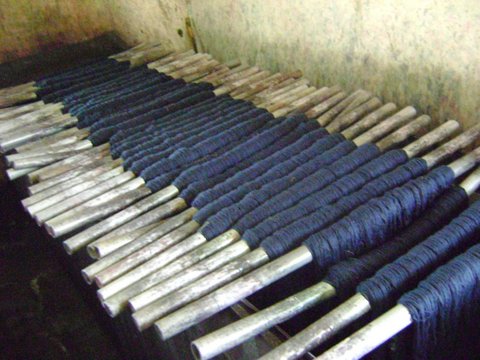
3. Yarn is then subjected to sizing using Maida and Gum as components. The yarn is subjected to alternate dyeing and sizing three times.
Yarn Being Dried after Sizing
4. Yarn is then prepared for warping using an ingenious creel and then wound onto a weavers beam using a conventional sectional warping machines.
5. Pirns are prepared using an indigenous contraption.
6. Yarn is then worked on powerloom having warp stop and weft stop motion.
6. Primitive dobbies are used for woven and zari borders.
7. The yarn is then subjected to finishing using water, sometimes in a padding mangle using softner and desizing agent.
Thanks for your attention. Did you find the information you were looking for ? Please leave a comment. Do you need to know more ? Please suggest a topic in the comments. You can also join the Forum for your specific queries.